









How do you use ChatGPT for real estate?
ChatGPT works for real estate agents in 4 jobs:
- Listing and marketing copy
- Lead follow-up drafting
- Data and document review
- Objection practice
Train it on your voice first, then run saved prompts instead of prompting from an empty chat.
If prompting is too high-effort, hire an AI agentThe hidden cost of prompting ChatGPT from an empty chat
Prompting from an empty chat produces generic output. Most agents type one line, copy the answer, and quietly decide ChatGPT was overhyped.
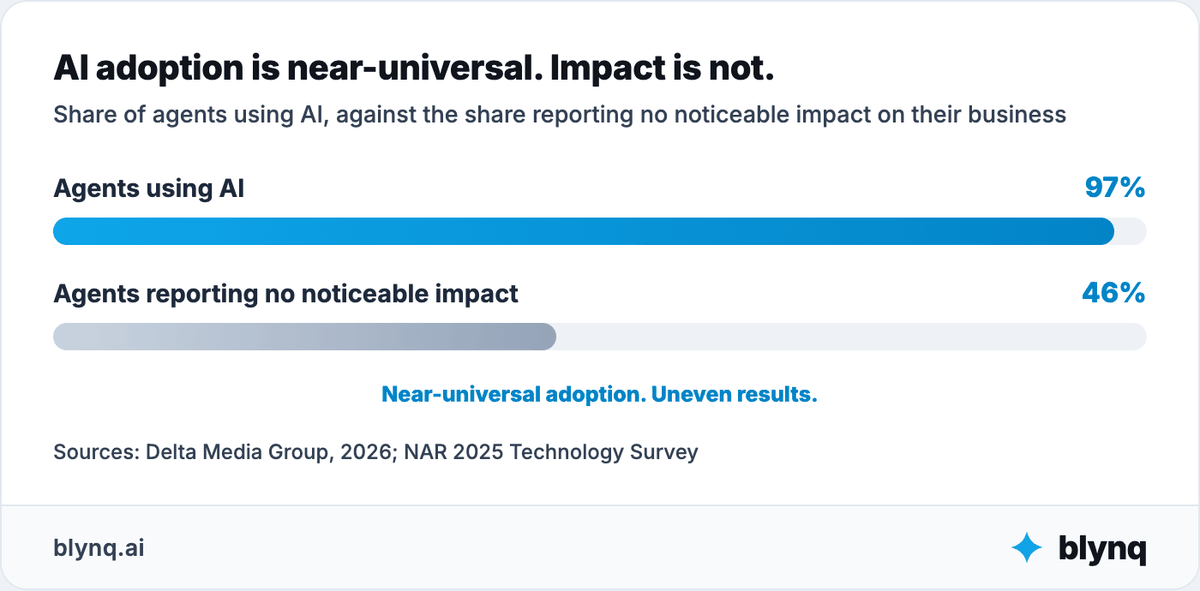
That verdict is expensive. The National Association of REALTORS 2025 Technology Survey found 46% of agents report no noticeable impact from AI.
Meanwhile Delta Media Group puts agent-level adoption at 97%, up from 80% in 2024.
Nearly everyone is using it. Almost half are getting nothing back.
What separates agents who get results from ChatGPT?
Agents who get results stopped using the blank chat. Carrie Soave, an AI strategist and licensed agent, maps 4 levels of use.
| Level | What the agent does | How the prompt looks | What they get |
|---|---|---|---|
| 0. Blank chatbot | Types a question into an empty chat, copies the answer | Ad-hoc, one line | Generic copy needing heavy edits |
| 1. Persistent setup | Loads writing samples, personas and market into a reusable Project or Custom GPT | Templated, voice-locked | On-brand drafts, shorter prompts |
| 2. Workflow automation | Connects CRM and email through triggers | Structured, machine-readable | Drafts that route themselves |
| 3-4. Multi-agent systems | Delegates follow-up, transaction tracking and media to cooperating agents | Orchestrated, schema-driven | A system, not a chat window |
Most agents sit at Level 0. Almost every documented gain starts at Level 1, where business context stops being retyped each session.
Levels 3 and 4 are a multi-year roadmap, not this week's project.
Which ChatGPT plan does a real estate agent need?
ChatGPT plans divide on one thing that matters here: file uploads. The free plan runs every writing prompt below.
| Plan | Price | What it adds for an agent |
|---|---|---|
| Free | $0/mo | Every writing prompt here, with limited messages and uploads |
| Go | $8/mo | Higher message limits |
| Plus | $20/mo | File uploads, photo analysis, voice practice, Projects |
| Pro | From $100/mo | Heaviest usage limits |
Paid access is the threshold for the data and document prompts further down. An agent on r/realtors put the math plainly:
Anyone who says its a waste will probably be irrelevant within the next 2 years. So ask yourself, is $20 a month worth an assistant and either 20 hours of extra free time, or income producing time a month?
r/realtorsRoughly 20 hours a month of recovered admin time is the figure agents cite most often. Prices verified August 1, 2026.
How do you make ChatGPT write in your own voice?
Voice training is the prompt to run before any content prompt. It separates a usable draft from something a client can smell.
Agents notice the tells. Certain words mark automated listing text on sight:
- nestled
- perched
- delve
- symphony
- tapestry
- spa-like
Peers notice too. One agent on r/realtors was blunt about AI-written replies to bad reviews:
Chat gpt is inauthentic. Something you don't want when responding to negative criticism. More and more people are picking up on the AI language and writing style.
r/realtorsStart here: the voice template
I am uploading 5 samples of my own writing: [attach or paste listing
descriptions, emails and social posts].

Analyze my voice across sentence length, vocabulary level, use of humor,
formality, and how I open and close. Produce a reusable style guide I can
paste into future prompts, plus a list of words and phrases I never use.
Save the style guide it returns. Paste it into every prompt that follows.
Which ChatGPT prompts write listing and marketing copy?
Listing prompts fail when they are vague about the property and silent about compliance. These 4 specify both.
1. Three audience-specific MLS descriptions
One property, 3 markets. The most-used prompt in agent communities.
Write 3 distinct versions of an engaging MLS listing description for a property
featuring [bed/bath count, square footage, key architectural details, local
neighborhood features].

Version 1, high-end luxury tone: architectural sophistication, premium
finishes, prestige lifestyle.
Version 2, conversational and story-driven: daily living flow, community
warmth, emotional resonance.
Version 3, investor-focused: capitalization rate potential, cash-flow
indicators, rent-to-value ratio, low-maintenance features.

Comply strictly with Fair Housing Act guidelines. Do not reference race,
color, religion, sex, handicap, familial status or national origin, and do
not imply a preferred type of buyer. Keep each version under 1,000 characters.
The negative constraint in the last paragraph is the important part. Keep it in every marketing prompt you write.
2. One listing cascaded across 4 channels
Convert this MLS description into an SEO-optimized 1,000-word LinkedIn
article. Then convert that article into a YouTube script. Then convert it
into an Instagram Reel script with on-screen text cues.
Jimmy Burgess, Chief Coaching Officer at HomeServices of America, reports over 20% average lift in Facebook engagement from standardizing this listing-to-social cascade.
3. Neighborhood profile for local SEO
Turn the following notes about [neighborhood name] into a 250-word
neighborhood profile for my website. Emphasize walkability, dining, school
ratings and architecture. Notes: [paste your notes].
Supply the notes yourself. ChatGPT does not reliably know your neighborhood, and this is where it invents things.
4. Open house script plus follow-up sequence
Create an open house talking script plus a 4-part SMS and email follow-up
sequence for visitors at a [property type] in [city]. Frame questions to
assess timing and buyer status naturally, without sounding like a screening.Which ChatGPT prompts handle leads and client follow-up?
Lead prompts draft messages. They do not send them, and no prompt below changes that.
5. Niche seller outreach by life event
Give me an SEO-optimized [platform] [post/script] with 7 Ways Executors of
Estates Can Leverage Real Estate Agents to Make Their Job Easier in [city],
with number seven being to call [agent name].
Swap the trigger for another life event:
- Probate
- Divorce
- Military PCS orders
- Corporate relocation
- Downsizing
6. Dormant pipeline reactivation
Write 10 distinct, non-intrusive text messages I can send to prospective
buyers who attended showings with me 30 to 60 days ago but went quiet.
Anchor each one on a recent local price shift, not on a request to meet.
7. Daily outreach queue
Requires a Project already holding your buyer and seller personas.
Review my ideal buyer and seller client personas stored in this Project.
Generate 8 personalized outreach touchpoints, combining text messages, email
templates and social outreach drafts, tailored to market events from the last
24 hours. Format for review and manual CRM execution.
Format for review is deliberate. This produces a queue you approve, not an autosend.
8. Buyer qualification at intake
Provide 10 strategic qualification questions to ask a buyer during an initial
intake consultation, to evaluate financial readiness, urgency and motivation
without sounding aggressive.Can ChatGPT analyze MLS data and read HOA documents?
ChatGPT can analyze exported MLS data and screen long documents on a paid plan. It also decodes equipment photos.
All 4 prompts below need file upload or photo analysis. Scrub names, addresses and financial details from every file before uploading.
9. Subdivision pricing outlier analysis
Analyze this uploaded spreadsheet of historic closings in [subdivision].
Identify pricing outliers based on price per square foot, then correlate them
with lot size and build year. Show your working assumptions.
10. Floor premium analysis for a vertical stack
I am uploading a CSV containing 500 historic closing transactions over the
last 3 years for [building name / micro-market]. Perform a multi-variable
regression analysis on this data.

Calculate the valuation premium per floor differential along the "A" line
stack versus the "B" line stack. Generate a line plot showing floor height
price appreciation over time. Highlight pricing outliers that sold more than
1.5 standard deviations above the building mean.
11. Equipment age from a rating-plate photo
Analyze this photograph of an HVAC rating plate. Extract the brand, model
number and serial number. Decode the serial number to determine the month and
year of manufacture. Cross-reference industry lifespan standards for this
equipment type, calculate estimated remaining useful life, and draft a concise
2-sentence summary formatted for a buyer's post-showing inspection note.
Works the same way on water heaters and electrical panels. Verify before relying on it.
12. HOA and disclosure risk screen
Act as an expert real estate transaction reviewer. Read the attached HOA CC&R
and seller disclosure documents for [property address].

Identify and list all clauses related to: (1) rental restrictions or leasing
caps, (2) pet weight and breed limitations, (3) upcoming special assessments
or historic budget shortfalls, (4) flagged environmental or structural defects.

Provide exact page and paragraph references for every point so I can direct
my buyer to the original text.
The page references are the whole point. They let a human verify, and they keep the work inside your license.
Do these prompts work for real estate investors?
Investors adapt prompts 9 through 12 directly for deal summaries and seller outreach. The analysis structure holds, and only the inputs change.
Which ChatGPT prompts handle objections and AI search visibility?
Objection prompts turn ChatGPT into a sparring partner, not a copywriter.
The visibility prompts address a newer problem. Buyers now ask AI assistants which agent to hire.
13. Interest-rate objection roleplay
Act as an assertive prospective homebuyer in [city]. You are refusing to make
an offer because you want to wait for interest rates to drop back to historic
lows. I am your real estate advisor.

Generate 5 distinct script responses I can use in conversation. Base the logic
on historic appreciation versus refinancing economics, increased competition
when rates drop, and current inventory constraints.

Format each response as: (1) empathetic validation hook, (2) data-backed
perspective shift, (3) open-ended closing question that keeps dialogue going.
Then keep the roleplay running so it pushes back on your delivery.
14. Fee defense against discount brokers
Help me write a unique value proposition that distinguishes my business from
discount brokers in [market]. Emphasize full-service marketing, local
expertise and my negotiation record: [paste your record and marketing
inclusions].
15. Digital footprint audit for AI search
I want you to audit my digital footprint as a real estate agent in [city,
state]. Act as an expert search engine and AI recommendation optimizer. Ask
me a series of questions about my current online profiles, website, reviews
and content. Once answered, evaluate my digital authority and provide a
prioritized action plan to ensure AI search tools recommend me as a top agent.
16. Bio rewritten for AI recommendation
Rewrite my professional real estate biography so it explicitly answers the
most common queries buyers and sellers ask AI platforms when searching for a
top agent in [city, state]. Incorporate local market statistics, client
outcomes and specific community names, keeping the tone authoritative yet
accessible.How do you stop ChatGPT forgetting your business?
ChatGPT forgets everything between separate chats unless you rebuild the context by hand. Three features change that.
| Feature | What it stores or does | Effect on your prompts |
|---|---|---|
| Projects | Target geography, client personas, voice guidelines, service structure | Prompts get shorter, no re-priming each session |
| Custom GPTs | Brokerage documents, pre-listing guides, local zoning notes, brand rules | Prompts become instructions to a trained specialist |
| Tasks | Plain-language scheduled triggers | Prompts run before you wake up |
Tristan Ahumada, a real estate team leader and podcast host, recommends 4 dedicated workspaces:
- Listing strategy
- Buyer consultation
- Lead generation
- Content repurposing
His name for the Level 0 habit is treating the prompt box like a broken vending machine.
Are pre-built Real Estate AI custom GPTs worth using?
Pre-built custom GPTs from the GPT Store are prompt templates, not a smarter model.
One currently ranks first on Google for chatgpt for real estate.
They save setup time. They still do not know your market, your voice or your inventory, and their output still needs fact-checking.
Where a hand-built setup still leaks
Hand-built setups are maintained manually.
Context lives in whichever Project you remembered to open. A style guide updated in one workspace never reaches the other 3.
Blynq stores the business once in a Business Brain that a team of AI agents all read from.
Drew, one of those AI agents, writes listing descriptions and social posts in the stored voice. Leo drafts follow-up texts for buyers who went quiet.
Blynq has no MLS or IDX integration and cannot pull live comps, so pricing work still runs through your MLS.
Unlike ChatGPT, Blynq has no free tier. Plans start at $18 a month, billed annually.
Where does ChatGPT get real estate wrong?
ChatGPT fails in real estate in 7 documented ways. Four of them cost money or create liability.
Can ChatGPT get comps and local data wrong?
ChatGPT has no live MLS access and will invent local figures with total confidence. Asked for sources, it often returns stale blogs from other states.
An agent on r/RealEstate described it this way:
ChatGPT and Claude (which I use every day) don't know the details of individual areas. They hallucinate. Sometimes when I ask questions and request sources, you'll get 10 year old blog posts from random states.
r/RealEstateWhy does ChatGPT agree with whatever my client already believes?
ChatGPT is sycophantic. It tends to confirm the fear the person prompting it already holds.
This is separate from hallucination, and more dangerous with a nervous client.
One documented case: a buyer who won a home for $10,000 over asking repeatedly asked ChatGPT whether they had overpaid. The model agreed.
Panic followed, and the transaction nearly collapsed. The human appraisal came back $18,000 above the purchase price.
Does ChatGPT create Fair Housing risk in listing copy?
Fair Housing exposure is real. The model inherits non-compliant phrasing patterns from its training data.
Describing who a home is perfect for is exactly the construction to avoid.
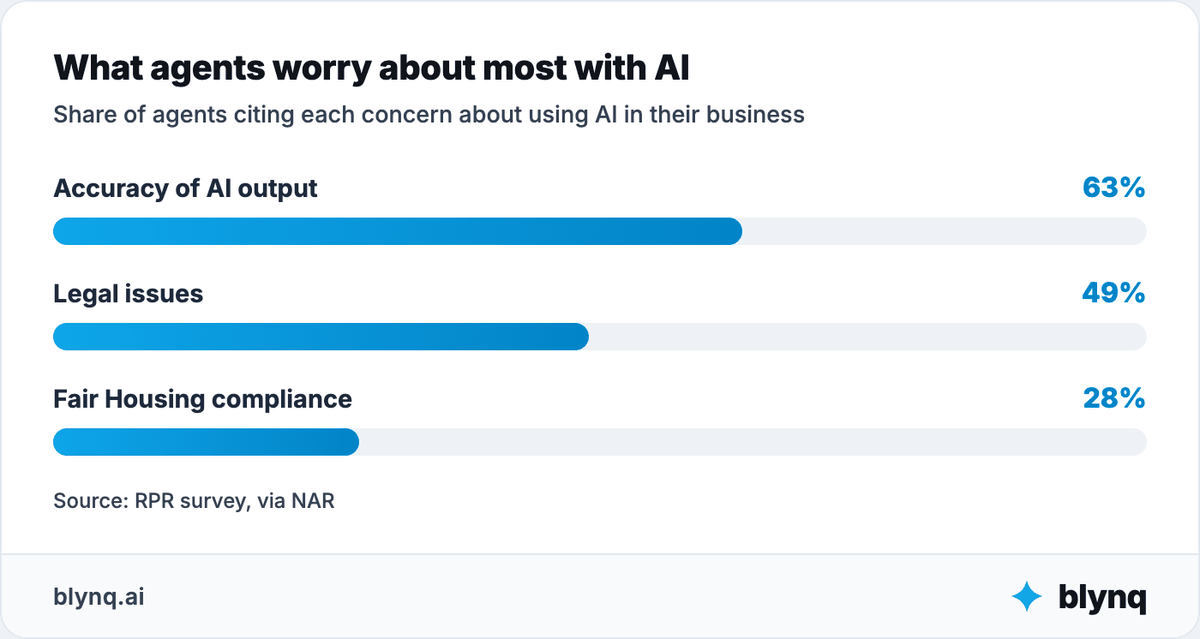
Per NAR's reporting on AI trust, 63% of agents name accuracy as their top concern.
Another 49% cite legal issues, and 28% cite Fair Housing specifically.
Is it safe to put client information into ChatGPT?
Client data is not private by default. Free, Go and Plus plans train on what you paste unless you opt out in settings.
Keep pre-approval letters, financial statements and contract terms out of consumer models until you have.
Can I use ChatGPT to interpret a contract?
Contract interpretation stays with licensed counsel. Lawyers have been sanctioned for filing AI-invented case citations, and real estate is contract-driven work.
Cap the task at summarizing, then route the client to a professional.
| Failure mode | What you will see | What to write into the prompt |
|---|---|---|
| Hallucinated local data | Invented stats, zoning rules, school ratings | Use only the data I provide |
| Sycophancy | It agrees with whatever the client fears | Argue the opposing case and state what would change your answer |
| Generic register | Copy that reads as AI | Reference your saved style guide every time |
| Fair Housing language | Protected-class or steering phrasing | Add the exclusion clause from prompt 1 |
| Stale sourcing | Decade-old posts cited as current | Give sources with dates, and flag anything unverifiable |
| Silent legal drift | Contract or liability interpretation | Summarize only, then tell me who to refer this to |
| PII leakage | Client data sitting in a public model | Scrub names, addresses and financials before upload |
Summary: your first week with ChatGPT for real estate
ChatGPT pays off at Level 1, not Level 0.
The prompts matter less than whether the tool knows your business before you prompt it.
Three steps, in order:
- Run the voice template. Upload 5 writing samples, save the style guide it produces.
- Pick one prompt from one cluster. Listing copy if you are marketing this week, prompt 12 if an HOA packet just landed.
- Move the context out of the chat. Load your market, personas and style guide into a Project, or into a system like Blynq's Business Brain where a shared memory carries across every task instead of per-chat.
Then check the failure table before anything client-facing goes out.
For more depth:
- The guide to using AI in real estate covers the view across every AI tool, not ChatGPT alone.
- The roundup of AI tools for real estate agents covers named products with pricing.
- The explainer on AI agents for real estate covers how an AI agent differs from a chat window.