









What are AI agents for yoga teachers?
AI agents for yoga teachers are systems that take ongoing responsibility for part of a studio business: Marketing, Operations, Client Experience or Finance.
Specialized agents own narrower work instead, such as answering a missed call or sending a class reminder.
Some act on their own. Others analyze, recommend a next step and prepare the work for your review.
That difference matters more than the label on the pricing page.
This vertical splits sharply by task.
U.S. Chamber Foundation data shows small-business AI users apply it to writing and research at 88% to 90%.
Direct teaching work is where yoga teachers push back hardest.
The split is not confusion about what AI is. It is a considered line between the back office and the practice itself.
What work can AI actually take off your plate, and what kind of AI do you need for it?
Blynq is one option on the studio-management side, alongside AgentZap and Mindbody on the execution side. This guide starts with the question.
Learn how to run your business with an AI teamWhich AI agents can help run a yoga business?
The AI agents that help run a yoga business are 8 business roles: Marketing, Sales, Operations, Client Experience, Finance, Analytics, Strategy and Productivity.
The useful starting point is not a separate agent per class, student or post.
A small set of agents works better, each owning a meaningful part of the business.
| AI Agent | What it can help a yoga teacher do | Most useful when |
|---|---|---|
| Marketing Agent | Clarify positioning, plan local visibility and turn class offerings into content | Referrals dried up and the studio depends on walk-ins |
| Sales Agent | Qualify inquiries, review trial-to-membership conversion and plan follow-up | New students try a class but never come back |
| Operations Agent | Review booking, scheduling and recurring admin work | Admin time crowds out class prep and teaching hours |
| Client Experience Agent | Answer calls, send reminders and organize student communication | Calls go unanswered during class and students stop showing up |
| Finance Agent | Review membership pricing, churn and marketing spend against revenue | Classes are full but the studio is barely profitable |
| Analytics Agent | Connect call volume, bookings, attendance and retention | Data sits in the booking platform and nowhere else |
| Strategy Agent | Compare class formats, pricing models and growth options | The studio has more possible directions than it should pursue |
| Productivity Agent | Turn classes, admin and growth work into a realistic weekly focus | Everything feels urgent between teaching hours |
These 8 support the business side. Yoga teachers also use specialized agents and tools for narrow execution.
Common examples include missed-call answering, appointment reminders, local search visibility and churn prediction.
The distinction matters. A Client Experience Agent can diagnose why students stop rebooking. A receptionist agent answers 1 missed call.
One supports the business decision. The other runs a defined workflow.
What counts as an AI agent in a yoga business?
An AI agent in a yoga business is software that holds an ongoing responsibility. A chatbot answers one question; a tool finishes one job.
The terms get confusing quickly. Here is the simplest way to tell the 4 shapes apart.
| Chatbot | AI Tool | AI Agent | AI Team | |
|---|---|---|---|---|
| What it does | Answers a question | Completes a specific job | Helps own an ongoing responsibility | Helps across several parts of the business |
| What you do | Ask each question | Open or trigger it when needed | Give it a goal or responsibility | Give the team access to shared business context |
| What it knows | Usually the conversation or limited product memory | Information needed for its job | Context relevant to its role | Context shared across different specialists |
| Yoga teacher example | "Draft a social caption for tomorrow's class" | Send an automated booking reminder | Own missed-call answering and rebooking across the week | Marketing, Client Experience and Finance work from the same business understanding |
So stop asking whether something is technically an agent. Ask 3 better questions instead.
What will it take responsibility for? What information will it use? What will you still have to review?
How can AI help you run a yoga business?
AI helps run a yoga business by removing missed calls, no-show losses, scattered reminders and the guesswork connecting marketing spend to full classes.
Find your problem in the left column before shopping for anything.
| Recurring problem | What AI can help remove | Best-fit agent or AI setup | When to prioritize it |
|---|---|---|---|
| Calls go unanswered during class | Answering, capture and routing while you teach | Client Experience Agent + phone-receptionist workflow | When most inquiries arrive during active class times |
| Students never rebook after a trial | First-response speed and structured follow-up | Sales Agent + booking workflow | When trial-to-membership conversion feels random |
| No-shows eat class capacity | Automated reminders and confirmation sequences | Client Experience Agent + reminder workflow | When empty mats cost more than the reminder |
| Local visibility is weak | Consistent local search and directory presence | Marketing Agent + local-SEO tool | When the studio depends on walk-in and search discovery |
| The website does not convert visitors | Clearer booking paths and consistent local content | Marketing Agent + website tool | When traffic exists but trial bookings do not follow |
| Admin time crowds out teaching | Scheduling, intake and routine booking tasks | Operations Agent + scheduling workflow | When admin hours cut directly into paid teaching hours |
| Members quietly stop coming | Spotting attendance drop-off before cancellation | Client Experience Agent + Analytics Skill | When cancellations arrive as a surprise |
| Lapsed members never hear from you again | Reactivation outreach to past students | Client Experience Agent + reactivation workflow | When past students disappear with no real goodbye |
| Marketing spend is disconnected from bookings | Connecting channels, inquiries and paid trials | Marketing, Sales and Analytics | When a channel generates activity but uncertain returns |
| Pricing and capacity are unclear | Connecting class fill rate, membership mix and cost | Finance and Analytics | Before adding classes or raising rates |
| Priorities are unclear | Connecting teaching hours, admin and growth work | Strategy Agent + Productivity Agent | When everything feels urgent |
This is a map, not a shopping list. Some problems need a tool. Others need a skill inside a business role.
Others still need a specialized agent that owns a workflow, or several agents working from shared context.
Diagnose the bottleneck before choosing the system.
How should a yoga teacher choose what to give an AI agent first?
A yoga teacher should choose the first AI agent from the bottleneck blocking a named business result, not from the most interesting capability on offer.
Suppose you want fuller classes without longer days. "Automate the marketing" sounds like the obvious answer.
But empty mats have at least 6 possible causes:
- Calls arrive during class and go to voicemail.
- Voicemail rarely gets a callback.
- Trial students never receive a real follow-up.
- No-shows go unreminded until the spot is empty.
- Local search sends inquiries to a studio down the street.
- Admin work leaves no time to plan the classes that would fill the room.
More marketing would make some of these worse, not better, by sending more calls into the same gap.
Missed calls carry a real cost.
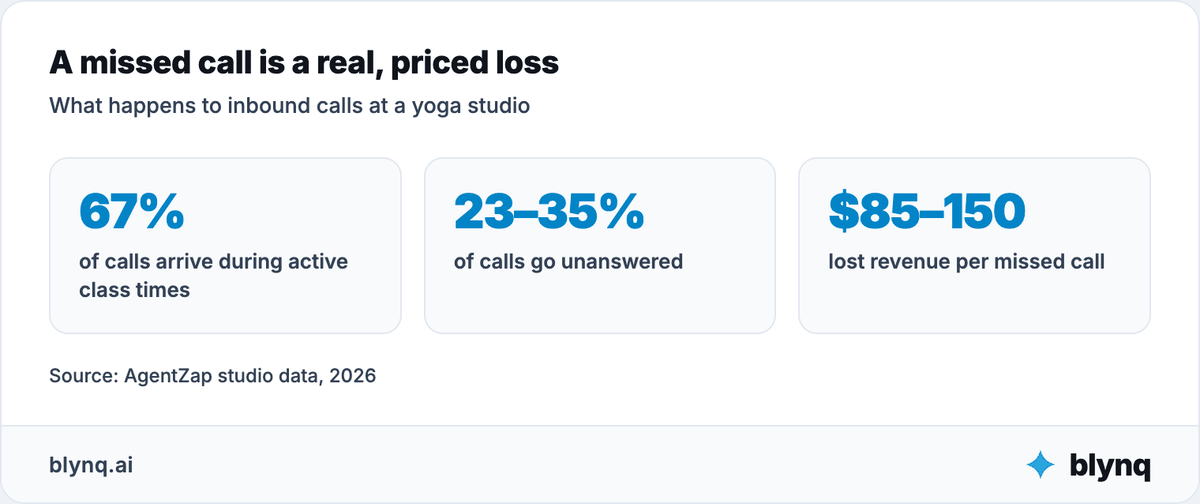
AgentZap's studio data puts 67% of inbound calls arriving during active class times, with a typical unanswered rate of 23% to 35%.
Each missed call is estimated at $85 to $150 in lost revenue, and a caller who reaches voicemail rarely calls back.
Work this sequence before choosing an agent or tool:
| Step | Yoga teacher question |
|---|---|
| Goal | What business result needs to change? |
| Bottleneck | What is preventing that result today? |
| Responsibility | Which area owns the problem? |
| Capability | What must AI analyze, recommend or execute? |
| Context | What must it know to give a useful answer? |
| Constraints | What limits budget, time, capacity or risk? |
| Human boundary | What decision or action stays human? |
| Architecture | Is the right fit general AI, a broad agent, a specialized system or an AI team? |
Do not design the business around what AI can do. Design the AI around what the business needs to achieve.
How do roles, skills and tasks show up in a yoga business?
Roles are the business area an agent owns, skills are what it can do inside that area, and tasks are the work happening right now.
These terms get used interchangeably. Keeping them apart stops you buying a separate system for every small job.
| Concept | Definition | Yoga teacher example |
|---|---|---|
| Agent | AI entity holding ongoing responsibility | Client Experience Agent |
| Role | Business domain the agent owns | Client Experience |
| Skill | Capability used inside the role | Missed-call analysis |
| Task | Specific work being done now | Send this week's class reminders |
| AI Tool | Product for a particular job | Booking-reminder tool |
| Automation | Predefined workflow | Text a confirmation when a student books a class |
| Specialized Agent | System owning a narrow ongoing workflow | Missed-call answering and rebooking |
| AI Team | Several agents sharing business context | Marketing, Client Experience and Finance using the same business knowledge |
| AIOS | Operating layer connecting agents, skills, memory, knowledge, tasks and workflows | Shared AI operating environment for the business |
The core idea is simple. Agents are roles. Skills are capabilities. Tasks are the work being done.
Automation alone does not make something an agent. Neither does an "agent" label on a pricing page.
Does every yoga-business task need its own AI agent?
No. Most yoga-business tasks are skills inside a role you already have, not grounds for buying another agent.
The taxonomy matters because it stops an AI stack becoming a new kind of software clutter.
Writing one Instagram caption is not a Social Media Agent. It is a task using a content skill inside Marketing.
Sending this week's class reminders is not a Reminder Agent. It is a task using a scheduling skill inside Client Experience.
A system that answers every missed call, books the caller, sends the confirmation and flags anything unusual is different.
That may qualify as a specialized agent, because it owns a narrow but ongoing workflow.
The difference is responsibility, not branding.
How can AI support the business behind the mat?
AI supports the business behind the mat in 3 connected places: filling classes, keeping students coming back, and protecting the economics underneath.
How do you turn inquiries into paying students?
You turn inquiries into paying students by answering fast and following up with a real message, then letting Marketing and Sales prepare the rest.
Response speed decides more than most teachers expect.
AgentZap's studio data shows a first responder win rate of 71%. Students book the first studio that replies.
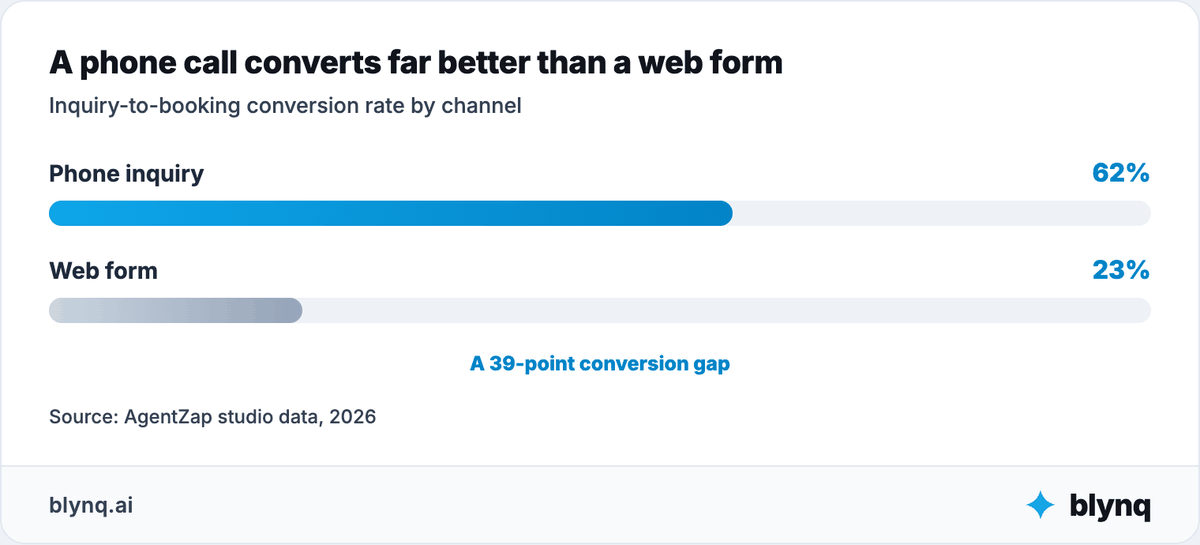
Phone inquiries convert at 62%, against 23% for web forms, which makes a fast, real answer worth more than another form on the website.
A Marketing Agent can clarify who the studio serves, plan local visibility and turn class offerings into content across channels.
A Client Experience Agent works deeper than a single reminder text.
It can review call patterns, flag when voicemail is losing inquiries and prepare the follow-up.
The business question is not only whether AI can answer the phone.
The real questions are which calls matter, why follow-up fails, and what tone fits a yoga business.
How do you keep students coming back?
You keep students coming back by catching drop-off early, then using reminders and check-ins to close the gap before it becomes a cancellation.
Retention is where the real revenue sits.
Industry data puts annual member churn at 30% to 50% for fitness and wellness studios.
Roughly half of that loss happens in the first 6 months.
A Client Experience Agent can track attendance patterns and flag students drifting toward cancellation before the exit interview.
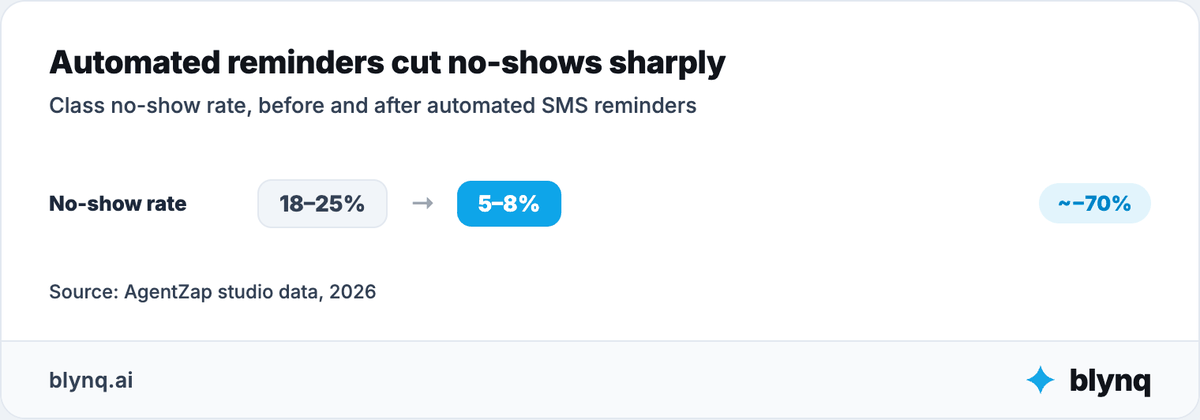
Reminder sequences reduce a real, measurable problem.
No-show rates without reminders run 18% to 25%. AgentZap data shows automated SMS reminder sequences bring that down to 5% to 8%.
AI should help you remember and prepare. It should not impersonate a teacher's attention or make the relationship feel automated.
The human still owns the class itself, the cues, the sequencing and every word spoken on the mat.
How do you protect margin and teaching time?
You protect margin by connecting call volume, bookings, attendance and cost, which is Finance and Analytics work rather than teaching work.
More visibility does not automatically mean a better business. Marketing spend, software subscriptions and admin hours can quietly outpace what a full class actually earns.
Finance and Analytics can connect inquiries, bookings, attendance, membership mix and cost.
Strategy and Productivity then connect those findings with teaching capacity and a realistic weekly focus.
The goal is not more possible actions. It is a reasoned choice about which classes, channels and pricing decisions deserve limited attention.
What does one yoga-business problem look like followed across the studio?
Followed across the studio, one empty-mat problem usually turns out to be a missed-call and follow-up problem instead.
Consider a solo teacher running a small studio whose evening classes never fill. The first instinct is to spend more on local ads.
Operations analysis shows most inquiries call during the 9am class, when nobody answers.
Analytics finds voicemail gets a callback only 28% of the time, so most of those calls are simply lost.
Client Experience shows the students who do reach a human convert well, which means the problem is capture, not interest.
Finance shows the ad spend already produces enough calls; the leak is downstream of the ad.
A missed-call answering workflow addresses the real bottleneck directly. Adding more ad spend first would have poured more calls into the same gap.
The value comes from examining one problem through connected business perspectives, before execution scales it.
Where do specialized yoga-business AI tools and agents fit?
Specialized yoga-business AI tools and agents fit where the bottleneck is narrow and execution-heavy.
That covers phone answering, booking reminders, local search visibility and churn tracking.
Business agents and agents built for one job do different work.
| Business Agent layer | Specialized execution layer |
|---|---|
| Diagnoses, plans and ranks across a role | Performs or owns a defined workflow |
| Uses broad business context | Uses workflow-specific or student-specific data |
| Connects questions across functions | Goes deeper inside one execution category |
| Example: determine why evening classes are not filling | Example: answer a missed call and book the caller |
The market holds several kinds of product. ChatGPT, Claude and Gemini support general research, writing and analysis.
AgentZap runs AI phone answering and booking across many industries, including the yoga and fitness studios its own published data covers.
Mindbody is the dominant fitness and wellness booking platform, with a built-in AI receptionist feature.
Zenoti offers a competing all-in-one platform with its own AI receptionist and upsell tools.
Ninja focuses on local search visibility and names yoga studios directly among the businesses it serves.
These are not interchangeable. A phone-answering agent does not decide whether your pricing works.
A local-search tool does not decide which class format to grow.
A booking platform executes reminders, but you define the cadence, the tone and the cancellation policy.
Blynq sits on the business-management side. Its business roles work from shared context across Marketing, Sales, Operations, Finance, Analytics and Strategy.
The right setup often combines both: studio tools for execution, and a connected set of business agents for the thinking and the decisions.
Do you need one specialist or a connected AI back office?
You need one specialist when the problem stays inside one responsibility, and a connected AI back office when it crosses several.
Yoga-business questions cross functions constantly:
Marketing to inquiries to bookings to attendance to retention to revenue to the next marketing decision.
A marketing recommendation may depend on how well calls convert. A retention priority may depend on teaching capacity.
A pricing decision may depend on churn history and next season's class calendar.
Use this rule:
| Situation | Likely starting point |
|---|---|
| One isolated output | Chatbot or tool |
| One repeatable workflow | Automation or specialized agent |
| One ongoing business responsibility | Broad agent role |
| A question crossing several business functions | AI team with shared context |
Why does business context change yoga-studio AI recommendations?
Business context can change yoga-studio AI recommendations completely, because the same question has opposite correct answers for different studios.
Consider a common question: should I spend more on local ads?
No responsible answer exists without current call volume, answer rate, trial-to-membership conversion, retention and available teaching capacity.
One teacher needs more inquiries.
Another already has enough calls and is losing them to voicemail. A third has more demand than the schedule can hold.
Prompt-based work restarts from the same briefing every time: class formats, pricing, channels, schedule and recent results.
Context-aware AI starts from validated goals, constraints, decisions, actions, outcomes and lessons it already holds.
It should not remember everything indiscriminately. It should separate verified business knowledge from assumptions and retrieve only what the current decision needs.
Why do AI agents need one shared view of the business?
AI agents need one shared view because otherwise you are the integration point, manually carrying call volume into marketing and attendance into pricing.
Several agents do not become a team because they sit in one menu.
If Client Experience knows call patterns, Marketing knows what drives inquiries and Finance knows class costs, but you connect them by hand, nothing has changed.
A useful shared view holds positioning, class formats, pricing, schedule, teaching capacity, current priorities and past decisions.
Student contact information and attendance history need stricter access, verified sources and clear retention rules.
Shared context does not replace teaching judgment. It makes Marketing, Client Experience and Finance relevant to the same business.
An AI team becomes an AIOS when agents, skills, knowledge, memory, tasks and workflows grow around that shared understanding.
The goal is not more AI. It is a yoga business that is easier to understand, decide for and run.
What do students still need from a teacher when AI gets faster?
Students still need a teacher for cueing, presence, sequencing judgment and the felt sense of being taught by a person when AI gets faster.
AI does not make yoga teachers irrelevant. It changes which parts of the job matter most, and this vertical treats that line unusually seriously.
Administrative AI adoption and pedagogical AI adoption run in opposite directions here.
Teachers welcome AI for booking and marketing. They resist it for sequencing, meditation scripts and cueing.
One Yoga Nidra facilitator explained the refusal in technical terms.
"AI doesn't know what Yoga Nidra actually is. It hasn't studied with credible teachers and it is essentially just 'guessing' based on wellness tropes... AI models are just prediction engines trained on the 'average' of the internet."
That commenter, localseotoday, posted on Reddit's r/YogaTeachers, a forum where certified instructors discuss training and practice.
The objection is not sentimental. It is a claim about precision.
A script generated from average internet text cannot carry the tradition-grounded language a modality like Yoga Nidra requires.
A second, blunter comment on Reddit's r/yoga carried 49 upvotes, the highest engagement of any quote in this research.
"I will never buy, use, support, follow, engage with, ect ANY AI use in yoga. Its quite disgusting and insulting to the whole practice."
When booking, reminders and local search get faster, students still need a teacher who can:
- Read a room and adjust cues in real time.
- Sequence around a specific injury, condition or ability.
- Hold the spiritual and lineage context a modality carries.
- Notice what a student's body is actually doing, not describing.
- Build trust through a consistent, personal teaching voice.
- Take responsibility for what happens on the mat.
One path uses AI to draft what students hear and read from you directly.
The other uses it to clear the admin so more time goes to the teaching itself.
The second path strengthens your role. The value moves from producing more content toward protecting the one thing a template cannot replace.
Where does yoga-business AI still need human control?
Yoga-business AI still needs human control wherever physical safety, spiritual content or a student's trust is involved.
The closer AI gets to the teaching itself, the stronger the boundary should hold.
| Area | AI can help with | Human owns |
|---|---|---|
| Phone and booking | Answering, capture and scheduling | Tone, judgment calls and unusual requests |
| Reminders | Sending confirmations and no-show follow-ups | The relationship itself |
| Local marketing | Directory listings, local search and post drafts | Voice, brand judgment and final approval |
| Class scheduling | Demand forecasting and capacity suggestions | The calendar decision itself |
| Sequencing | Idea generation and structure suggestions to review | The sequence a teacher actually delivers |
| Cueing and pacing | Reviewing a recording for pacing or filler words | Live adjustment and real-time correction |
| Meditation and Yoga Nidra scripts | Nothing recommended without full teacher rewrite | Every word spoken in a guided practice |
| Injury and contraindication guidance | Nothing without a qualified human review | All safety judgment for a specific student |
| Student communication | Drafting a first pass | Anything sent under the teacher's own name |
| Teacher training content | Nothing recommended for curricula | Curriculum, ethics and lineage judgment |
The strongest boundary sits around anything spoken directly to a student's body. A software engineer working through their own 200-hour training put it plainly.
"AI can be a tremendous help when used with the above insight. Helping with the things you described (sequencing, cuing, pacing... background research on anatomy and philosophy) can be really great."
That comment is from Woof-Good_Doggo on Reddit's r/YogaTeachers.
It describes AI as fallible research support, checked by a trained teacher, never an unsupervised source of cues.
A recent 200-hour graduate described the safer version of that same use case.
"Personally, I started recording my cuing sessions and running them through AI to get feedback. To make sure if my pacing was correct, what words I can use better, to be inclusive and safe."
The pattern across both quotes is the same.
AI reviews a teacher's own recorded work after the fact. It does not write the cue a student hears live.
Injury and contraindication judgment carries real liability.
A sequence that ignores a student's pregnancy, joint replacement or recent injury can cause real harm. No AI tool carries that responsibility.
Yoga Alliance's ethical standards set the professional expectations Registered Yoga Teachers already work under, and nothing about using AI changes them.
The correct fallback is often simple: use AI to prepare and review, never to speak for you on the mat.
AI should have a clear boundary, not an unlimited mandate.
How do you choose the right AI setup for a yoga business?
You choose the right AI setup for a yoga business by evaluating its operating model, not its label.
Ask 6 questions of anything you are considering:
- What responsibility or workflow does it help own?
- What can it analyze, recommend or execute?
- What business or student data can it access, and where is that stored?
- Does it rely on verified source data?
- What must you review and approve before it reaches a student?
- Does it integrate with the systems that matter, and show what it did?
Consider 3 legitimate approaches:
| Approach | Strengths | Trade-offs | Best fit |
|---|---|---|---|
| Custom build | Maximum control and studio-specific rules | Technical ownership, maintenance and integration risk | Teachers with technical support and distinctive processes |
| Self-directed Claude or ChatGPT | Flexibility, strong analysis and custom projects | You design the context, memory and orchestration | Yoga teachers who want to design their own setup |
| Ready-made AI team or purpose-built SaaS | Faster setup, structured roles and continuity | More opinionated and limited to supported capabilities | Yoga teachers who want structure without building it |
Adoption in this vertical is genuinely uneven, so a modest setup is not falling behind.
The NEXT Small Business Survey found active small-business AI usage fell from 42% to 28% between 2024 and 2025.
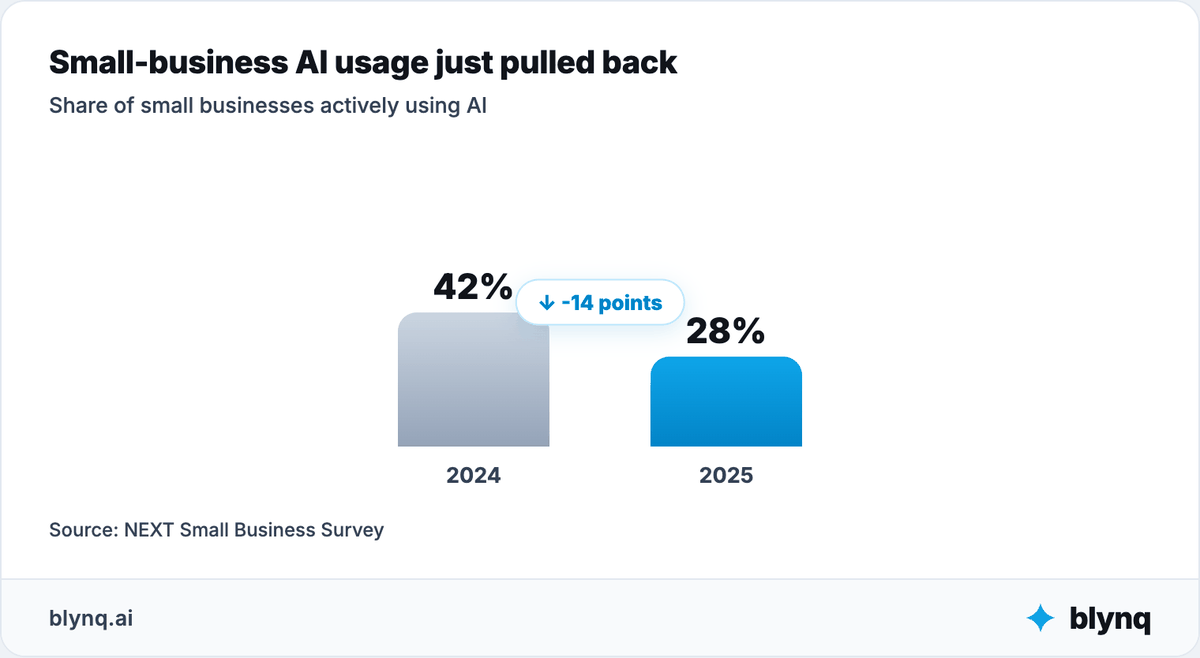
More owners now plan no further adoption.
That pullback suggests a first wave of trial-and-abandon, which makes a deliberate, bottleneck-first setup more valuable than chasing whatever launched most recently.
Before committing, verify the system actually reads from and writes to what you need: your booking platform, payment processor, calendar and student communication channel.
Check permissions, approvals, activity logs and failure handling.
Do not assume "works with" means "integrates with."
If you constantly re-brief the system and copy data between tools, the AI is adding administrative work.
How do you put AI to work in your yoga business in 30 days?
Put AI to work in 30 days by picking 1 measurable goal and diagnosing the bottleneck behind it.
Run the agent alongside your current process, then expand only where it earned the expansion.
Start with the goal, not the tool.
Week 1: Diagnose
Choose a goal and a bottleneck. Do not start with a product.
Common candidates: missed calls during class, weak trial-to-membership conversion, or rising no-shows.
Define the 1 metric that would show improvement.
Exit criterion: a named metric and a current baseline number, written down.
Week 2: Build context
Give the system what judgment requires: class formats, pricing, schedule, teaching capacity, channels and previous decisions.
Decide what stays private or needs controlled access. Student contact information and attendance history belong in that category.
Exit criterion: the agent answers a question about your business you did not have to re-explain.
Week 3: Run alongside the current process
Use the agent for analysis, planning or structured work while the existing process stays visible.
Review errors, missing context and recommendations that do not fit your students.
Exit criterion: a written list of what it got wrong and what context was missing.
Week 4: Evaluate and expand carefully
Measure the metric from Week 1. Record what the system learned and what still requires your judgment.
Add another skill or role only when it solves a real adjacent problem.
If the second role depends on knowledge from the first, prioritize shared context over another disconnected tool.
Exit criterion: a keep-or-drop decision supported by the baseline number.
Example setup for a solo yoga teacher
Suppose the goal is filling evening classes without adding ad spend.
| Setup layer | What to include |
|---|---|
| Business context | Class formats, pricing, schedule, teaching capacity and conversion definitions |
| Client Experience Agent | Review call and booking patterns, identify where inquiries are lost and recommend fixes |
| Analytics Skill | Compare call volume, answer rate and trial-to-membership conversion by time of day |
| Specialized workflow | Answer missed calls, book the caller and send confirmation |
| Human boundary | You handle sequencing, cueing, meditation content and every word spoken in class |
| Success measure | Higher answer rate and more trial bookings converted after 30 days, without added ad spend |
This is enough for a first setup. It needs no separate agents for calls, reminders, local search and retention.
Start with the responsibility, add the skills and workflow it needs, and expand only when a problem genuinely crosses into a new role.
What to do now
Pick 1 business result that needs to change this quarter, and write down the number that measures it today.
Diagnose what is actually blocking it, using the 8-step sequence above. The bottleneck is rarely where the first instinct points.
Decide what stays human: sequencing, cueing, meditation scripts and everything spoken on the mat. Then choose the setup that fits what remains.
AI agents help most when they own a real responsibility, use several skills and understand the business behind the task.
The future is not a separate bot for every task. Expect fewer capable agents, specialized execution where it earns its place, and shared context underneath.
The point is not to add more AI.
The goal is a yoga business that is easier to understand, decide for and run, while the teaching stays entirely yours.