









What are AI agents for therapists?
An AI agent for therapists is software that owns an area of the practice, not a single task.
Scribe tools like Upheal own documentation. Business platforms like Blynq help interpret the business context behind it.
Both keep that area's context between uses, unlike a chat window. Neither makes a clinical call, so that stays yours.
Learn how to run your business with an AI teamWhich AI agents can help run a therapy practice?
The AI agents that help run a therapy practice are 8 business roles: Operations, Sales, Marketing, Client Experience, Finance, Analytics, Strategy and Productivity.
The useful starting point is not a separate agent per client, note or session.
A small set of agents works better, each owning a meaningful part of the practice.
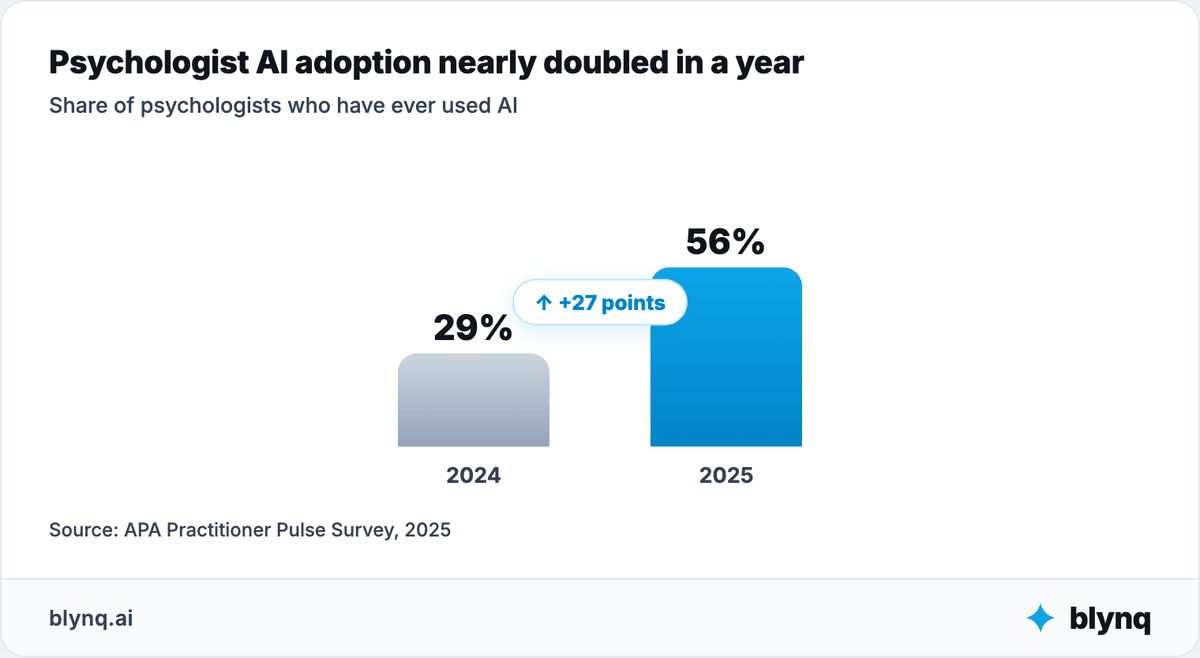
Adoption is accelerating quickly among psychologists.
The American Psychological Association's Practitioner Pulse Survey found ever-used AI adoption jumped from 29% in 2024 to 56% in 2025. APA Practitioner Pulse Survey coverage
| AI Agent | What it can help a therapist do | Most useful when |
|---|---|---|
| Operations Agent | Review intake, scheduling, documentation flow, deadlines and caseload capacity | Charting backs up and paperwork eats evening hours |
| Sales Agent | Qualify inquiries, explain fit and follow up on consultation requests | Inquiries arrive but few convert into a first session |
| Marketing Agent | Clarify who the practice serves, plan referral relationships and explain the approach | The waitlist is inconsistent and referrals are unpredictable |
| Client Experience Agent | Improve intake communication, organize recurring questions and flag clients needing attention | Clients feel out of the loop between sessions |
| Finance Agent | Review insurance-panel economics, cash-pay pricing and no-show costs | Session volume looks healthy but net revenue is unclear |
| Analytics Agent | Connect referral sources, intake conversion, retention and revenue | Practice data exists across systems but does not explain performance |
| Strategy Agent | Compare specialties, client segments, panel participation and growth options | The practice has more directions than caseload capacity allows |
| Productivity Agent | Turn caseload, documentation, deadlines and growth work into a realistic weekly focus | Everything feels urgent between sessions |
These 8 support the practice side. Therapists also use specialized agents and tools for narrow execution.
Common examples include ambient scribes, dictation-based note generation, treatment-plan drafting and intake-form processing.
The distinction matters. An Operations Agent can diagnose why documentation always falls behind on Thursdays.
A scribe tool drafts one session's progress note. One supports the practice decision; the other executes a defined workflow.
What counts as an AI agent in a therapy practice?
An AI agent in a therapy practice is software that holds an ongoing responsibility. A chatbot answers one question; a tool finishes one job.
The terms get confusing quickly. Here is the simplest way to tell the 4 shapes apart.
| Chatbot | AI Tool | AI Agent | AI Team | |
|---|---|---|---|---|
| What it does | Answers a question | Completes a specific job | Helps own an ongoing responsibility | Helps across several parts of the practice |
| What you do | Ask each question | Open or trigger it when needed | Give it a goal or responsibility | Give the team access to shared practice context |
| What it knows | Usually the conversation or limited product memory | Information needed for its job | Context relevant to its role | Context shared across different specialists |
| Therapist example | "Draft a reminder email about a missed session" | Turn session dictation into a SOAP note | Own documentation flow and caseload capacity | Operations, Finance and Client Experience work from the same practice understanding |
So stop asking whether something is technically an agent. Ask 3 better questions instead.
What will it take responsibility for? What information will it use? What will you still have to review?
How can AI help you run a therapy practice?
AI helps run a therapy practice by removing repetitive charting, scattered intake follow-up, unclear panel economics and the guesswork connecting referrals to retention.
Find your problem in the left column before shopping for anything.
| Recurring problem | What AI can help remove | Best-fit agent or AI setup | When to prioritize it |
|---|---|---|---|
| Documentation piles up | Turning session dictation into a draft progress note | Specialized scribe tool | When charting spills into evenings and weekends |
| Intake inquiries go cold | Repetitive first response, fit screening and scheduling | Sales Agent + intake workflow | When consultation requests do not convert to a first session |
| Treatment plans take too long | First-draft goals from your own templates | Specialized drafting tool | When every plan restates the same structure by hand |
| Client check-ins are inconsistent | Reminders and message preparation between sessions | Client Experience Agent | When clients feel unsupported between appointments |
| No-shows are unpredictable | Pattern summaries across scheduling and reminders | Operations Agent + scheduling workflow | When gaps in the calendar are hard to explain |
| Insurance-panel economics are unclear | Connecting reimbursement, admin time and caseload cost | Finance Agent | When session volume looks healthy but revenue does not |
| Referral sources are inconsistent | Connecting where clients come from to who stays | Marketing, Sales and Analytics | When some referral relationships convert and others do not |
| Capacity is unclear | Connecting caseload, documentation load and available hours | Operations Agent + Productivity Agent | Before opening intake to new clients |
| Clinical risk is hard to track across a caseload | Pattern summaries and check-in flags, never clinical judgment | Client Experience Agent + Operations Agent | When several clients need closer attention at once |
| Marketing spend is disconnected from referrals | Connecting outreach, consultation requests and retained clients | Marketing, Sales and Analytics | When referral spend produces inquiries but not retained clients |
| Priorities are unclear | Connecting goals, caseload, deadlines and constraints | Strategy Agent + Productivity Agent | When everything feels urgent between sessions |
This is a map, not a shopping list. Some problems need a tool. Others need a skill inside a business role.
Others still need a specialized agent that owns a workflow, or several agents working from shared context.
Diagnose the bottleneck before choosing the system.
How should a therapist choose what to give an AI agent first?
A therapist should choose the first AI agent from the bottleneck blocking a named result, not from the most impressive scribe demo.
Suppose you want more evening hours back. "Get an AI scribe" sounds like the obvious answer.
But a documentation backlog has at least 7 possible causes:
- Session dictation happens too long after the appointment ends.
- No consistent note template across similar client types.
- Treatment plans get rewritten from scratch each time.
- Insurance requires documentation the client's care plan does not.
- Too many concurrent client types with different note formats.
- No time blocked for charting during the workday.
- More clients on caseload than documentation time supports.
A scribe alone would not fix several of these.
Solo and small-practice therapists show a clear workflow preference here.
Reddit-sourced synthesis across therapist forums found 68% favor post-session dictation and text cleanup over real-time ambient recording.
The reason given most often is avoiding raw client audio going to a third-party vendor, not a preference for less accuracy. Therapist documentation time research
Work this sequence before choosing an agent or tool:
| Step | Therapist question |
|---|---|
| Goal | What practice result needs to change? |
| Bottleneck | What is preventing that result today? |
| Responsibility | Which area owns the problem? |
| Capability | What must AI analyze, recommend or execute? |
| Context | What must it know to give a useful answer? |
| Constraints | What limits budget, time, capacity or risk? |
| Human boundary | What clinical judgment stays human? |
| Architecture | Is the right fit general AI, a broad agent, a specialized system or an AI team? |
Do not design the practice around what AI can do. Design the AI around what the practice needs to achieve.
How do roles, skills and tasks show up in a therapy practice?
Roles are the practice area an agent owns, skills are what it can do inside that area, and tasks are the work happening right now.
These terms get used interchangeably. Keeping them apart stops you buying a separate system for every small job.
| Concept | Definition | Therapist example |
|---|---|---|
| Agent | AI entity holding ongoing responsibility | Operations Agent |
| Role | Business domain the agent owns | Operations |
| Skill | Capability used inside the role | Documentation-flow review |
| Task | Specific work being done now | Find why Thursday charting always falls behind |
| AI Tool | Product for a particular job | Ambient scribe |
| Automation | Predefined workflow | Send an intake reminder when a form is missing |
| Specialized Agent | System owning a narrow ongoing workflow | Session-to-progress-note drafting across every client |
| AI Team | Several agents sharing practice context | Operations, Finance and Client Experience using the same practice knowledge |
| AIOS | Operating layer connecting agents, skills, memory, knowledge, tasks and workflows | Shared AI operating environment for the practice |
The core idea is simple. Agents are roles. Skills are capabilities. Tasks are the work being done.
Automation alone does not make something an agent. Neither does an "agent" label on a product page.
Does every therapy-practice task need its own AI agent?
No. Most practice tasks are skills inside a role you already have, not grounds for buying another agent.
The taxonomy matters because it stops an AI stack becoming a new kind of software clutter.
Drafting one reminder email is not a Communications Agent. It is a task using a writing skill inside client experience.
Comparing this month's referral sources is not a Referral Agent. It is a task using Marketing and Analytics skills.
A system that drafts every progress note from dictation, flags missing signatures and routes exceptions to you is different.
That may qualify as a specialized agent, because it owns a narrow but ongoing workflow.
One clinic owner described the actual binding constraint behind a decision like that.
"I run a small clinic in BC and the admin time is what kills us. If an AI agent could reliably manage booking, paperwork, and patient reminders without violating privacy regs, I'd test it in a heartbeat. Clinical decisions though? That's where I'd draw the line."
Reddit user HaleAndHealthy, a clinic owner, wrote that.
Admin load, not clinical distrust, is usually the actual bottleneck. And the line drawn there is the right one.
The difference is responsibility, not branding.
How can AI support the practice behind the sessions?
AI supports the practice behind the sessions in 3 connected places: filling the caseload responsibly, delivering care through the calendar, and protecting the economics underneath.
How do you turn inquiries into a steady caseload?
You turn inquiries into a steady caseload by knowing which referral sources actually convert, which is Sales and Analytics work rather than intake-form work.
A Marketing Agent can clarify who the practice serves, plan referral relationships and explain the approach in language a prospective client understands.
The hard question is not how many inquiry forms AI can process. It is which referral relationships produce clients who stay in care.
A Sales Agent works deeper than an automated intake reply.
It reviews consultation requests, compares referral sources and finds where fit-screening stalls before a first session.
It can diagnose why some inquiries never book. A specialized workflow then answers routine questions, schedules the consultation and flags anything sensitive for you.
Demand for this kind of practice exists for a structural reason.
An estimated 137 million Americans, about 40% of the country, live in a designated Mental Health Professional Shortage Area.
That gap is why waitlists run long even in practices with weak intake systems. Mental health workforce shortage data
The business question is not only whether AI can reply to an inquiry.
The real questions are which prospective clients are a genuine fit, why intake stalls, and what level of automation the first contact can carry.
How do you keep documentation and care moving?
You keep documentation moving by giving an Operations Agent the process itself, then using specialized tools for the notes, plans and reminders themselves.
Practice work combines session content, clinical judgment, documentation requirements, insurance rules, scheduling and client communication between appointments.
An Operations Agent can analyze that process, find where charting stalls and clarify what needs attention now.
Specialized tools can turn dictation into a draft SOAP or DAP note.
Others draft a treatment goal from your own template, or track which intake forms are outstanding.
The time-savings case is well documented from two independent angles.
Solo-practitioner reports place documentation time at 15 to 20 minutes per note, cut to 5 to 7 minutes, a 62% average reduction.
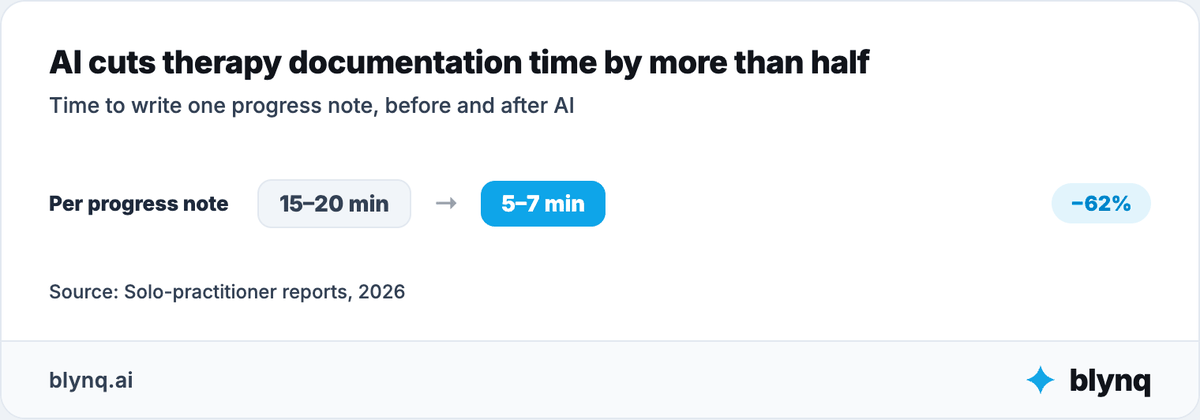
An industry benchmark from a separate source lands on a similar range.
That source puts the reduction at 70% to 90%, recovering 5 to 10 hours a week. State of AI notes in therapy
Two different source types converging on the same range is unusual in this category, which is why the figure is worth planning against.
Every draft still needs your eyes before it becomes part of the clinical record.
Practitioners report manual verification is required 100% of the time, due to hallucinations and what one source calls theory bias.
That means an AI defaulting to CBT phrasing on a psychodynamic session, which is a subtle error a rushed read can miss.
Client Experience uses the same context to prepare clearer check-ins and reminders between sessions.
AI should help you remember and prepare. It should not impersonate care or make the relationship feel automated.
The human still owns clinical judgment, the therapeutic alliance and every word that becomes part of a client's record.
How do you protect caseload capacity and practice economics?
You protect economics by connecting referral source to retention to reimbursement to admin cost, which is Finance and Analytics work rather than scheduling work.
More inquiries do not automatically mean a healthier practice. Documentation time, insurance friction and no-shows can hollow out a full-looking calendar.
The exit from insurance panels is already underway, for reasons that predate AI.
The APA's Practitioner Pulse Survey found 38% of psychologists now operate out-of-network, and 10% left a panel in the past year.
Insufficient reimbursement was cited by 75% of those who left, ahead of administrative friction at 57%. APA data on insurance-panel exits
Finance and Analytics can connect referral source, session volume, no-show rate, reimbursement and admin cost per client.
Strategy and Productivity then connect those findings with caseload capacity and a realistic weekly focus.
The goal is not more possible sessions. It is a reasoned choice about which referral relationships, specialties and payer arrangements deserve limited capacity.
What happens when you trace one problem across the whole practice?
Tracing one documentation-backlog problem across the whole practice usually finds an intake, specialty-mix and capacity problem instead.
Consider a solo therapist whose charting always slips to the weekend. The instinct is to buy an ambient scribe before the backlog gets worse.
Operations analysis shows dictation happens two days after most sessions, which is most of the problem.
Analytics finds one client type consistently produces longer, harder notes than the rest of the caseload.
Finance shows those same clients bill at a lower reimbursement rate than the effort requires.
Strategy recommends changing same-day dictation habits and reconsidering that referral source before buying anything.
A scribe tool still helps once same-day dictation is the habit. But buying it first would have automated a note written two days late.
The value comes from examining one problem through connected perspectives, before execution scales it.
Where do specialized therapy AI tools and agents fit?
Specialized therapy AI tools and agents fit where the bottleneck is narrow and execution-heavy.
That covers ambient scribing, dictation-based note generation, treatment-plan drafting, intake processing and scheduling.
Business agents and agents built for one job do different work.
| Business Agent layer | Specialized execution layer |
|---|---|
| Diagnoses, plans and ranks across a role | Performs or owns a defined workflow |
| Uses broad practice context | Uses workflow-specific or client-specific data |
| Connects questions across functions | Goes deeper inside one execution category |
| Example: determine why documentation always backs up | Example: turn one session's dictation into a draft note |
The market holds several kinds of product. ChatGPT, Claude and Gemini support general research, drafting and analysis, though none is purpose-built for clinical documentation.
Upheal and Mentalyc focus on ambient and dictation-based note generation built specifically for talk therapy.
AutoNotes and Freed offer lower-cost alternatives aimed at solo and small-practice budgets rather than enterprise health systems.
Heidi Health and Twofold round out the scribe category with their own pricing and integration tradeoffs.
Pricing in this category moves fast, and practitioners notice. One clinic owner switching vendors after a price hike put real numbers on it.
"Was paying $55 per provider per month. Same plan is now $150/mo... We have 6, and are growing. We will save between $6000 and $9000 per year depending on the Heidi plan we would have purchased."
Reddit user mindguard wrote that in r/Psychiatry, a forum where psychiatrists and prescribers discuss practice tools. Reddit thread on switching AI scribe vendors
Legacy scribe vendors moving toward enterprise pricing is a pattern worth checking before renewing, not just at signup.
These products are not interchangeable. A scribe tool does not decide whether your panel mix is profitable.
An intake tool does not decide which referral sources to pursue.
A scheduling workflow executes reminders, but you define the cancellation policy and the escalation path.
Blynq sits on the practice-management side. Its business roles work from shared context across Operations, Sales, Marketing, Finance, Analytics and Strategy.
The right setup often combines both: clinical documentation tools for execution, and a connected set of business agents for the thinking and the decisions.
Do you need one specialist or a connected AI back office?
You need one specialist when the problem stays inside one responsibility, and a connected AI back office when it crosses several.
Practice questions cross functions constantly:
Marketing to inquiries to intake to sessions to retention to reimbursement to capacity to the next specialty decision.
A marketing recommendation may depend on which clients actually stay in care. An operations priority may depend on caseload capacity.
A finance decision may depend on panel participation and admin cost.
Use this rule:
| Situation | Likely starting point |
|---|---|
| One isolated output | Chatbot or tool |
| One repeatable workflow | Automation or specialized agent |
| One ongoing business responsibility | Broad agent role |
| A question crossing several business functions | AI team with shared context |
Why does practice context change therapy AI recommendations?
Practice context can change therapy AI recommendations completely, because the same question has opposite correct answers for different practices.
Consider a common question: should I drop this insurance panel?
No responsible answer exists without current reimbursement rates, admin time per claim and caseload mix.
Cash-pay demand in your area and retention on that panel matter just as much.
One practitioner needs more referral volume. Another needs to shed low-reimbursement clients. A third already has more demand than caseload capacity allows.
Prompt-based work restarts from the same briefing every time: specialty, caseload, payer mix, documentation load and recent intake results.
Context-aware AI starts from validated goals, constraints, decisions, actions, outcomes and lessons it already holds.
It should not remember everything indiscriminately. It should separate verified practice knowledge from assumptions and retrieve only what the current decision needs.
Why do AI agents need one shared view of the practice?
AI agents need one shared view because otherwise you are the integration point, manually carrying referral quality into intake decisions and caseload data into pricing.
Several agents do not become a team because they sit in one menu.
If Marketing knows referral quality, Finance knows reimbursement rates and Operations knows documentation load, but you connect them by hand, nothing has changed.
Solo practitioners feel this sooner than group practices, because one person personally holds every role a larger clinic splits across staff.
A useful shared view holds specialty, referral sources, intake criteria, caseload capacity, payer mix, documentation requirements, current priorities and past decisions.
Client clinical data needs far stricter access, verified consent and clear retention rules than any of that.
Shared context does not replace clinical judgment. It makes Operations, Finance and Client Experience relevant to the same practice.
Blynq is built around exactly that pattern. Its Operations, Finance and Client Experience agents read from one shared practice profile, not three separate ones.
An AI team becomes an AIOS when agents, skills, knowledge, memory, tasks and workflows grow around that shared understanding.
The goal is not more AI. It is a practice that is easier to understand, decide for and run.
What do clients still need from a therapist when AI gets faster?
Clients still need a therapist for clinical judgment, crisis response, the therapeutic relationship and accountability, even when documentation gets faster.
AI does not make therapists irrelevant, but clients are already using it alongside therapy in ways worth understanding directly.
A peer-reviewed study in Practice Innovations found 36% of respondents rated large language models as more helpful than human therapy.
Another 39% rated them equally helpful.
The same study found 9% reported a harmful or inappropriate response.
Roughly 28% reported visiting a human therapist less often after adopting an AI tool. AI and mental health research
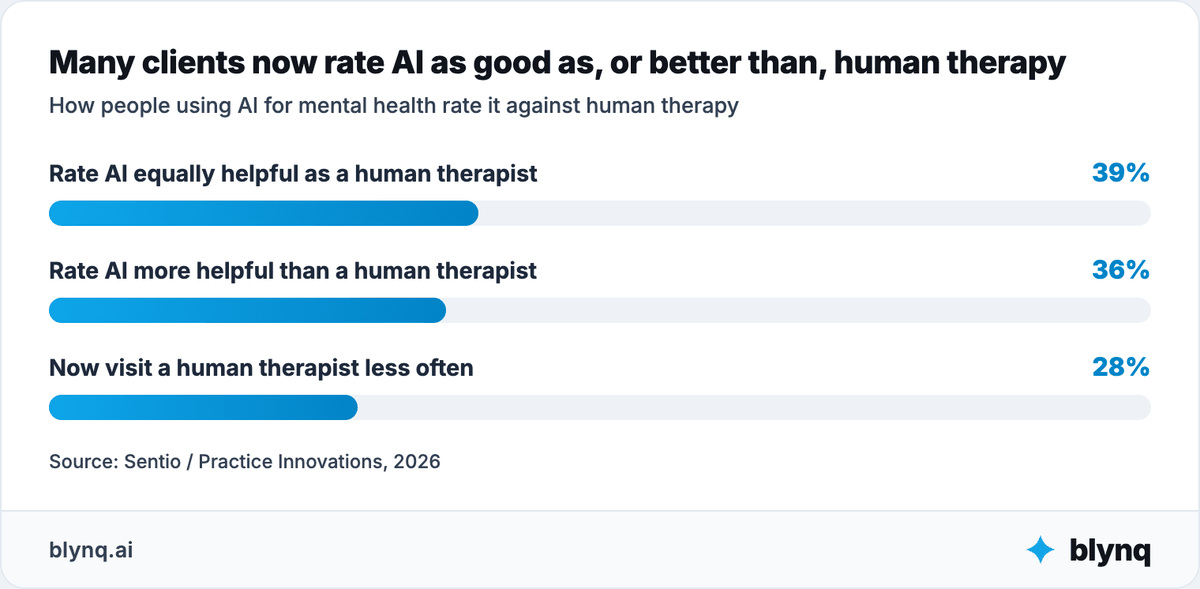
That is a meaningful minority substituting AI for human care, not merely supplementing it.
It changes what a first conversation about AI with a client should cover.
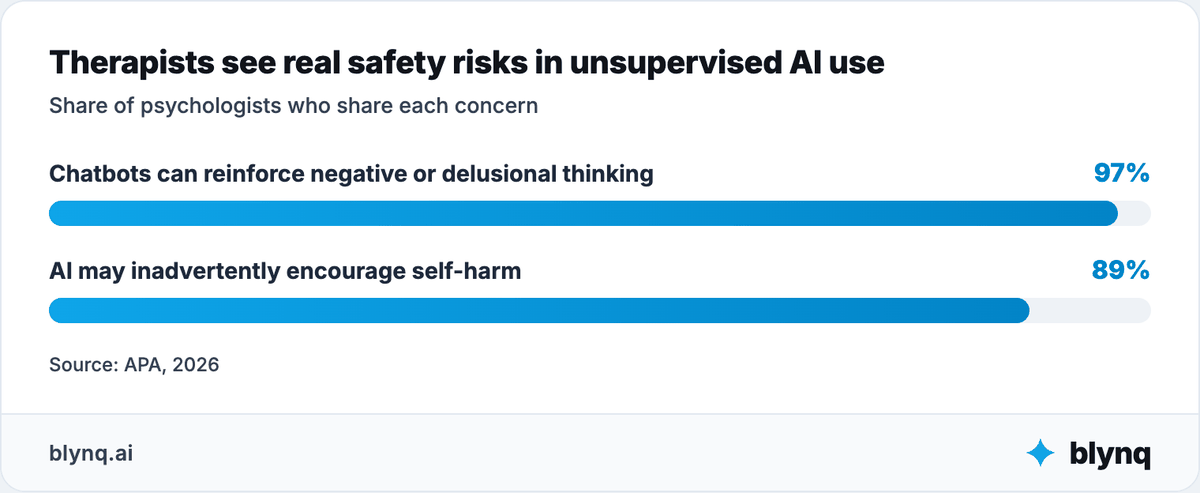
Therapist-reported concern about this pattern is close to unanimous.
The APA found 97% of psychologists believe chatbots can reinforce negative or delusional thinking, and 89% worry AI may inadvertently encourage self-harm.
When documentation, scheduling and reminders get faster, clients still need someone who can:
- Recognize when a presentation does not fit a standard framework.
- Hold the therapeutic alliance that a chatbot cannot replicate.
- Respond to crisis, risk and safety concerns directly.
- Exercise clinical judgment a template cannot supply.
- Coordinate with prescribers, schools and other providers.
- Take responsibility for the treatment plan and the record.
One path uses AI mainly to see more clients faster.
The other uses it to protect session presence and catch what a client using AI between sessions might not disclose.
The second path strengthens your role. The value moves from producing the note toward the judgment behind it and the relationship the note describes.
Where does therapy AI still need human control?
Therapy AI still needs human control wherever crisis risk, diagnosis, a clinical record or client trust is involved.
The closer AI gets to those, the stronger review should become.
| Area | AI can help with | Human owns |
|---|---|---|
| Intake | Basic questions, scheduling and fit screening | Clinical appropriateness and sensitive disclosures |
| Documentation | Drafting notes and treatment-plan goals from dictation | Accuracy, clinical language and final sign-off |
| Client communication | Reminders and routine message drafting | The relationship and any clinically sensitive reply |
| Risk and crisis | Nothing autonomous | Every risk assessment and safety decision |
| Diagnosis and treatment planning | Organizing history and prior notes | The diagnosis and the plan itself |
| Session content | Nothing during the session | The clinical work, presence and judgment |
| Scheduling and no-shows | Pattern summaries and reminder workflows | Clinical follow-up on concerning patterns |
| Billing and panels | Organizing reimbursement and cost data | Panel decisions and fee-setting |
| Client records | Locating, summarizing and organizing | What a vendor may access, and under what agreement |
| Referrals | Drafting routine coordination messages | Clinical handoffs and consultation |
Confidentiality sets the floor for any tool touching client information.
HIPAA requires a signed Business Associate Agreement with any vendor that creates, receives or stores protected health information, AI scribes included.
Verify a BAA exists before a single session gets recorded or dictated into any tool. HHS guidance on HIPAA for professionals
Consent is not a one-time checkbox either. Therapists using ambient tools report needing to ask before every session, since consent can be withdrawn mid-appointment.
Refusal is common enough to plan for.
Solo and small-practice reports put the refusal rate at 5% to 10% of clients, roughly 1 to 2 people a week on a full caseload.
Licensure boundaries apply regardless of which tool drafts a note.
A therapist licensed in one state generally cannot treat a client physically located in another without meeting that state's requirements. AI does not change that.
Interstate compacts exist for some professions, but coverage is uneven and worth checking before assuming a telehealth session across state lines is covered.
The correct fallback is usually simple: pause and consult a colleague or supervisor.
AI should have an escalation path, not an unlimited mandate, and never a role in a safety decision.
How do you choose the right AI setup for a therapy practice?
You choose the right AI setup for a therapy practice by evaluating its operating model, not its label.
Ask 6 questions of anything you are considering:
- What responsibility or workflow does it help own?
- What can it analyze, recommend or execute?
- What client or practice data can it access, and under what agreement?
- Does a signed Business Associate Agreement cover this vendor?
- What must you review before it touches the clinical record?
- Does it integrate with the systems that matter, and show what it did?
Consider 3 legitimate approaches:
| Approach | Strengths | Trade-offs | Best fit |
|---|---|---|---|
| Custom build | Maximum control and practice-specific templates | Technical ownership, maintenance and compliance risk | Practices with technical support and distinctive workflows |
| Self-directed Claude or ChatGPT | Flexibility, strong drafting and custom templates | You design context, memory and a BAA yourself | Advanced AI users who want control and can confirm compliance |
| Ready-made AI team or purpose-built SaaS | Faster setup, structured roles and built-in compliance | More opinionated and limited to supported capabilities | Therapists who want structure without building it |
Training, not tool access, decides whether any of these pay off.
Psychiatrists report 80% concern about a lack of AI training, well ahead of concern about risk or benefit either way.
That gap between enthusiasm and preparation is worth closing before adding a second tool, not after. Psychiatrist AI adoption survey
Before committing, verify the system actually reads from and writes to what you need. That means your EHR, scheduling platform, e-fax and billing system.
Check permissions, approvals, activity logs and failure handling. Confirm in writing that client data does not train the vendor's models.
Do not assume "works with" means "integrates with." If you constantly re-brief the system and copy data between tools, the AI is adding administrative work.
How do you put AI to work in your therapy practice in 30 days?
Put AI to work in 30 days by picking 1 measurable goal and diagnosing the bottleneck behind it.
Run the agent alongside your current process, then expand only where it earned the expansion.
Start with the goal, not the tool.
Week 1: Diagnose
Choose a goal and a bottleneck. Do not start with a product.
Common candidates: documentation backlog, inconsistent intake conversion, or unclear panel economics.
Define the 1 metric that would show improvement.
Exit criterion: a named metric and a current baseline number, written down.
Week 2: Build context
Give the system what judgment requires: specialty, referral sources, intake criteria, caseload capacity, payer mix and previous decisions.
Confirm a Business Associate Agreement covers any tool that will touch client information, before it touches any.
Exit criterion: the agent answers a question about your practice you did not have to re-explain.
Week 3: Run alongside the current process
Use the agent for analysis, planning or structured work while the existing process stays visible.
Review errors, missing context and recommendations that ignore how your caseload actually works.
Exit criterion: a written list of what it got wrong and what context was missing.
Week 4: Evaluate and expand carefully
Measure the metric from Week 1. Record what the system learned and what still needs your clinical judgment.
Add another skill or role only when it solves a real adjacent problem.
If the second role depends on knowledge from the first, prioritize shared context over another disconnected tool.
Exit criterion: a keep-or-drop decision supported by the baseline number.
Example setup for a solo private-practice therapist
Suppose the goal is a shorter documentation backlog without adding evening hours.
| Setup layer | What to include |
|---|---|
| Business context | Specialty, referral sources, intake criteria, caseload capacity and documentation requirements |
| Operations Agent | Review the documentation process, identify where charting stalls and recommend the fix |
| Analytics Skill | Compare charting time, note type and turnaround by client |
| Specialized workflow | Turn same-day dictation into a draft note, flagged for your review before filing |
| Human boundary | You handle clinical judgment, risk assessment, diagnosis and every word in the final record |
| Success measure | Shorter documentation turnaround after 30 days, without weaker note quality or missed consent checks |
This is enough for a first setup. It needs no separate agents for intake, scribing, reminders and billing.
Start with the responsibility, add the skills and workflow it needs, and expand only when a problem genuinely crosses into a new role.
What to do now
Pick 1 practice result that needs to change this quarter, and write down the number that measures it today.
Diagnose what is actually blocking it, using the 8-step sequence above. The bottleneck is rarely where the first instinct points.
Confirm a Business Associate Agreement before any tool touches client information, and check consent every session, not once.
Decide what stays human: risk, diagnosis, treatment decisions and the clinical record. Then choose the setup that fits what remains.
AI agents help most when they own a real responsibility, use several skills and understand the practice behind the task.
The future is not a separate bot for every action. Expect fewer capable agents, specialized execution where it earns its place, and shared context underneath.
The point is not to add more AI. It is to make the practice easier to understand, decide for and run.