









What are AI agents for solopreneurs?
AI agents for solopreneurs are systems that take ongoing responsibility for part of a one-person business: Finance, Marketing, Sales or Operations.
Specialized agents own narrower work instead, such as reviewing a contract before you sign it or auto-scheduling your week.
Some act on their own. Others analyze, recommend a next step and prepare the work for your review.
That difference matters more than the label on the pricing page.
Solo operators adopt AI at roughly half the rate of businesses with employees.
JPMorgan Chase Institute puts nonemployer-firm adoption at 15.3%, against 26.1% for firms with staff.
That gap doubled between 2023 and 2025, and JPMorgan traces it to bandwidth, skills and time, not cost.
If you already use ChatGPT, you do not need new vocabulary. You need a more useful question.
What work can AI actually take off your plate, and what kind of AI do you need for it?
Blynq is one option on the business-management side, alongside Found, ContractClarifyAI and Motion on the execution side. This guide starts with the question.
Learn how to run your business with an AI teamWhich AI agents can help run a solo business?
The AI agents that help run a solo business are 8 business roles: Finance, Marketing, Sales, Operations, Client Experience, Analytics, Strategy and Productivity.
The useful starting point is not a separate agent per task, client or deadline.
A small set of agents works better, each owning a meaningful part of the business.
| AI Agent | What it can help a solopreneur do | Most useful when |
|---|---|---|
| Finance Agent | Review cash runway, open invoices, tax set-asides and pricing | You cannot say how many weeks of runway you have |
| Marketing Agent | Clarify positioning, repurpose content and build one repeatable channel | Good work exists but nobody is finding it |
| Sales Agent | Qualify inquiries, run outreach and keep the pipeline from going empty | The pipeline swings between full and empty with no warning |
| Operations Agent | Review contracts, compliance deadlines and recurring admin | A missed filing or a bad clause could cost real money |
| Client Experience Agent | Organize client communication and flag relationships needing attention | Client messages, tasks and updates all pile into one inbox |
| Analytics Agent | Connect income sources, hours worked and profit per client | You cannot tell which work actually pays |
| Strategy Agent | Compare offers, pricing models and growth directions | Every decision feels like it carries the whole business |
| Productivity Agent | Turn deadlines, client work and admin into a realistic weekly focus | Everything feels urgent and nothing feels finished |
These 8 support the business side. Solopreneurs also use specialized agents and tools for narrow execution.
Common examples include contract review, predictive bookkeeping, invoice reconciliation, calendar auto-scheduling and tax-reserve tracking.
The distinction matters. A Finance Agent can diagnose why cash flow feels unpredictable every month.
A bookkeeping agent tracks 1 bank feed. One supports the decision; the other runs a defined workflow.
What counts as an AI agent for a solopreneur?
An AI agent for a solopreneur is software that holds an ongoing responsibility. A chatbot answers one question; a tool finishes one job.
The terms get confusing quickly. Here is the simplest way to tell the 4 shapes apart.
| Chatbot | AI Tool | AI Agent | AI Team | |
|---|---|---|---|---|
| What it does | Answers a question | Completes a specific job | Helps own an ongoing responsibility | Helps across several parts of the business |
| What you do | Ask each question | Open or trigger it when needed | Give it a goal or responsibility | Give the team access to shared business context |
| What it knows | Usually the conversation or limited product memory | Information needed for its job | Context relevant to its role | Context shared across different specialists |
| Solopreneur example | "Draft a follow-up email to a slow-paying client" | Flag a risky clause in one contract | Own cash-runway tracking across every income stream | Finance, Marketing and Operations work from the same business understanding |
So stop asking whether something is technically an agent. Ask 3 better questions instead.
What will it take responsibility for? What information will it use? What will you still have to review?
How can AI help you run a solo business?
AI helps run a solo business by removing the four-tab problem: manually connecting a spreadsheet, an invoicing app, a CRM and an inbox by hand.
Find your problem in the left column before shopping for anything.
| Recurring problem | What AI can help remove | Best-fit agent or AI setup | When to prioritize it |
|---|---|---|---|
| Cash flow feels unpredictable | Connecting balance, invoices and burn rate into a runway number | Finance Agent + predictive bookkeeping tool | When you find out you are low on cash after it already matters |
| Income sources blur together | Sorting gross payouts, fees and tax set-asides by client | Finance Agent + reconciliation workflow | When tax time turns into a guessing game |
| Contracts get signed unread | Flagging risky clauses in plain English before signature | Operations Agent + contract-review tool | When legal review costs more than the deal is worth |
| Compliance deadlines slip | Tracking state filings, renewals and federal filing dates | Operations Agent + compliance calendar | When one missed date creates a real penalty |
| Inbox becomes the task manager | Triaging, categorizing and drafting replies | Client Experience Agent + admin workflow | When client work, admin and scheduling collide in one feed |
| Marketing never happens | Repurposing one piece of work into a repeatable channel | Marketing Agent + content tool | When good work exists but nobody finds it |
| Sales pipeline goes empty | Background prospecting and lead qualification | Sales Agent + outreach workflow | When outreach only happens once the pipeline is already dry |
| Decisions feel isolating | Pressure-testing a choice from more than one angle | Strategy Agent | When there is nobody to sanity-check a call before you make it |
| Capacity is unclear | Connecting deadlines, client work and admin into one view | Productivity Agent | Before saying yes to one more client |
| Pricing feels arbitrary | Connecting hours, income and profit by client or offer | Analytics Agent + Finance Agent | When some work quietly pays less than it costs to deliver |
| Priorities are unclear | Connecting goals, deadlines, commitments and constraints | Strategy Agent + Productivity Agent | When everything feels urgent |
This is a map, not a shopping list. Some problems need a tool. Others need a skill inside a business role.
Others still need a specialized agent that owns a workflow, or several agents working from shared context.
Diagnose the bottleneck before choosing the system.
How should a solopreneur choose what to give an AI agent first?
A solopreneur should choose the first AI agent from the bottleneck blocking a named result, not from the most impressive demo.
Suppose you want steadier income without working more hours. "Automate the marketing" sounds like the obvious answer.
But unsteady income has at least 7 possible causes:
- No repeatable channel, so every month starts from zero.
- Prospecting only happens once the pipeline is already empty.
- Cash flow is invisible until it is already a problem.
- Contracts get signed without review, creating unpaid scope creep.
- Compliance deadlines eat time in ways nobody planned for.
- Every decision gets made alone, with no one to pressure-test it.
- More client work than the week can actually hold.
Automating marketing first would leave every other cause untouched.
Reddit user Ok_Recipe_2389 described the isolation directly on r/Solopreneur, a forum for people running one-person businesses.
"as a solopreneur every decision exists in a vacuum of infinite possibility and that is what makes it so exhausting. you are not just deciding what to do. you are simultaneously deciding what matters, what to ignore, what to prioritize, and what to defer."
Work this sequence before choosing an agent or tool:
| Step | Solopreneur question |
|---|---|
| Goal | What business result needs to change? |
| Bottleneck | What is preventing that result today? |
| Responsibility | Which area owns the problem? |
| Capability | What must AI analyze, recommend or execute? |
| Context | What must it know to give a useful answer? |
| Constraints | What limits budget, time, capacity or risk? |
| Human boundary | What decision or signature stays yours? |
| Architecture | Is the right fit general AI, a broad agent, a specialized system or an AI team? |
Do not design the business around what AI can do. Design the AI around what the business needs to achieve.
How do roles, skills and tasks show up in a solo business?
Roles are the business area an agent owns, skills are what it can do inside that area, and tasks are the work happening right now.
These terms get used interchangeably. Keeping them apart stops you buying a separate system for every small job.
| Concept | Definition | Solopreneur example |
|---|---|---|
| Agent | AI entity holding ongoing responsibility | Finance Agent |
| Role | Business domain the agent owns | Finance |
| Skill | Capability used inside the role | Cash-runway calculation |
| Task | Specific work being done now | Check this week's runway |
| AI Tool | Product for a particular job | Contract-review tool |
| Automation | Predefined workflow | Send a reminder when an invoice goes unpaid |
| Specialized Agent | System owning a narrow ongoing workflow | Auto-scheduling every calendar block |
| AI Team | Several agents sharing business context | Finance, Marketing and Operations using the same business knowledge |
| AIOS | Operating layer connecting agents, skills, memory, knowledge, tasks and workflows | Shared AI operating environment for the business |
The core idea is simple. Agents are roles. Skills are capabilities. Tasks are the work being done.
Automation alone does not make something an agent. Neither does an "agent" label on a landing page.
Does every solopreneur task need its own AI agent?
No. Most solopreneur tasks are skills inside a role you already have, not grounds for buying another agent.
The taxonomy matters because it stops an AI stack becoming a new kind of software clutter.
Drafting one client email is not a Communications Agent. It is a task using a writing skill inside client experience.
Comparing which offer made the most profit this quarter is not a Profitability Agent. It is a task using Finance and Analytics skills.
A system that reviews every incoming contract, flags risky clauses and tracks which ones still need a signature is different.
That may qualify as a specialized agent, because it owns a narrow but ongoing workflow.
The difference is responsibility, not branding.
How can AI support the business behind the work?
AI supports the business behind the work in 3 connected places.
Those are seeing cash clearly, protecting what you sign, and building one channel that keeps the pipeline full.
How do you get predictive visibility into cash flow?
You get predictive visibility by connecting your balance, open invoices and burn rate into one runway number, instead of waiting for month-end.
Standard bookkeeping tools categorize what already happened. They rarely answer the question that actually matters day to day.
Reddit user IdeasInProcess put that gap plainly on r/Solopreneur.
"Accounting always feels 'backward-looking.' I would happily pay for a solution that doesn't just categorise expenses... but actually tells me: 'Based on your current burn and open invoices, you will run out of cash in exactly 43 days unless you close one deal.'"
A Finance Agent can review runway, flag which invoices are overdue and estimate quarterly tax reserves before the IRS deadline arrives.
That is different from bookkeeping software. Bookkeeping records the past. A Finance Agent uses that record to answer a forward-looking question.
The business question is not only whether the books are accurate.
It is whether you can see next month clearly enough to act on it now.
How do you keep contracts, filings and admin from creating risk?
You reduce risk by giving an Operations Agent the recurring compliance work, then using a specialized tool to review anything you are about to sign.
Skipping legal review is common, and it is expensive when it goes wrong.
Contract review through ContractsCounsel's marketplace averages $540 per flat-fee project, with lawyers typically billing $250 to $350 an hour.
That price gap is exactly why so many solo founders skim and sign instead.
One founder on Indie Hackers, a community for independent founders, described the pattern.
"Honestly -- skim and sign, most of the time... Especially early on when you're moving fast and the contract feels like a formality. The painful lesson comes later when a 90-day termination notice or IP assignment clause actually matters."
An Operations Agent can track recurring compliance dates.
That includes state annual reports, franchise tax filings and the federal Beneficial Ownership Information filing under the Corporate Transparency Act.
A specialized contract-review tool reads the actual document and flags a risky clause before you sign, in plain English rather than legal language.
The human still owns the signature, the filing, the interpretation and every consequence that follows from them.
How do you protect time and build one channel that works?
You protect time by picking one repeatable marketing channel instead of running five badly, then letting an agent handle the repetitive part of it.
Deterministic work like writing code or delivering a service pays off immediately.
Marketing rarely does, which is why founders avoid it until the pipeline is already empty.
One solo creator wrote about that trap in a post on r/Solopreneur.
"Marketing is the real 'Final Boss' of solopreneurship... you can produce all day, but if you do not have a system to sell, you have a hobby instead of a business."
A Marketing Agent can repurpose one piece of work into platform-specific formats. A Sales Agent can run background prospecting so outreach never starts from zero.
Time savings alone do not fix an empty pipeline.
The fix is a system that runs whether or not you feel like doing outreach that day.
What does one solopreneur problem look like followed across the business?
Followed across the business, one unpredictable-income problem usually turns out to be a visibility, review and channel problem at the same time.
Consider a solo founder whose income swings between comfortable and alarming every few months. The instinct is to chase more leads.
Finance analysis shows the real issue is timing, not volume. Invoices go out late and nobody tracks when they are actually due.
Operations reveals 2 client contracts were signed without review and both carry unfavorable payment terms that delay cash by 60 days.
Marketing shows outreach only restarts once the pipeline is already dry, which is why every slow month feels like a surprise.
Strategy recommends fixing invoice timing and building 1 repeatable channel before adding any lead-generation tool.
A predictive cash-flow agent still helps. But automating outreach first would have accelerated a pipeline built on a broken foundation.
The value comes from examining one problem through connected perspectives, before execution scales it.
Where do specialized solopreneur AI tools and agents fit?
Specialized solopreneur AI tools and agents fit where the bottleneck is narrow and execution-heavy.
That covers predictive bookkeeping, contract review, calendar auto-scheduling, invoice reconciliation and tax-reserve tracking.
Business agents and agents built for one job do different work.
| Business Agent layer | Specialized execution layer |
|---|---|
| Diagnoses, plans and ranks across a role | Performs or owns a defined workflow |
| Uses broad business context | Uses workflow-specific or client-specific data |
| Connects questions across functions | Goes deeper inside one execution category |
| Example: determine why cash flow feels unpredictable every month | Example: flag a risky clause in one contract |
The market holds several kinds of product. ChatGPT, Claude and Gemini support general research, drafting and analysis.
Found combines business banking with an AI assistant that tracks tax reserves and flags write-offs as transactions happen.
ContractClarifyAI reviews contracts and scores risk in plain English, though it says outright that its output is educational, not legal advice.
Motion auto-schedules tasks into open calendar time and reshuffles the day when something new lands.
These are not interchangeable. A contract-review tool does not decide whether a client relationship is worth keeping.
A scheduling tool does not decide which channel deserves your marketing hours.
A bookkeeping assistant tracks reserves, but you decide what to charge and who to work with.
Blynq sits on the business-management side. Its business roles work from shared context across Finance, Marketing, Sales, Operations, Analytics and Strategy.
The right setup often combines both: specialized tools for execution, and a connected set of business agents for the thinking and the decisions.
Do you need one specialist or a connected AI back office?
You need one specialist when the problem stays inside one responsibility, and a connected AI back office when it crosses several.
Solo-business questions cross functions constantly:
Marketing to inquiries to signed clients to delivered work to invoices to cash to the next marketing decision.
A marketing recommendation may depend on how much delivery capacity exists. A pricing decision may depend on which clients are actually profitable.
A cash-flow forecast may depend on which contracts carry slow payment terms.
Use this rule:
| Situation | Likely starting point |
|---|---|
| One isolated output | Chatbot or tool |
| One repeatable workflow | Automation or specialized agent |
| One ongoing business responsibility | Broad agent role |
| A question crossing several business functions | AI team with shared context |
Why does business context change solopreneur AI recommendations?
Business context can change solopreneur AI recommendations completely, because the same question has opposite correct answers for different founders.
Consider a common question: should I raise my rates?
No responsible answer exists without current pipeline health, which clients are profitable, upcoming capacity and how the last rate change affected demand.
One founder needs more volume. Another needs better clients. A third already has more work than the week can hold.
Prompt-based work restarts from the same briefing every time: offer, pricing, positioning, channels and recent results.
Context-aware AI starts from validated goals, constraints, decisions, actions, outcomes and lessons it already holds.
It should not remember everything indiscriminately. It should separate verified business knowledge from assumptions and retrieve only what the current decision needs.
Why do AI agents need one shared view of the business?
AI agents need one shared view because otherwise you are the integration point, manually carrying invoice status into pricing and capacity into sales decisions.
Several agents do not become a team because they sit in one menu.
If Finance knows the runway, Sales knows the pipeline and Operations knows which contracts are risky, but you connect them by hand, nothing has changed.
That manual connecting is the four-tab problem by another name.
It is a spreadsheet, an invoicing app, a CRM and an inbox that never talk to each other.
A useful shared view holds positioning, offers, pricing, income sources, capacity, compliance deadlines, current priorities and past decisions.
Client and financial data need stricter access, verified sources and clear retention rules than any of that.
Shared context does not replace judgment. It makes Finance, Marketing, Operations and Sales relevant to the same business.
An AI team becomes an AIOS when agents, skills, knowledge, memory, tasks and workflows grow around that shared understanding.
The goal is not more AI. It is a solo business that is easier to understand, decide for and run.
What do clients still need from a solopreneur when AI gets faster?
Clients still need a solopreneur for judgment, accountability and the relationship itself, even when drafting and admin get faster.
AI does not make a solo founder replaceable. It changes which parts of the job clients actually value.
The adoption data points at capability, not willingness.
JPMorgan Chase Institute found only 48% of nonemployer firms are even familiar with AI, against 55% for a few employees and 82% for large firms.
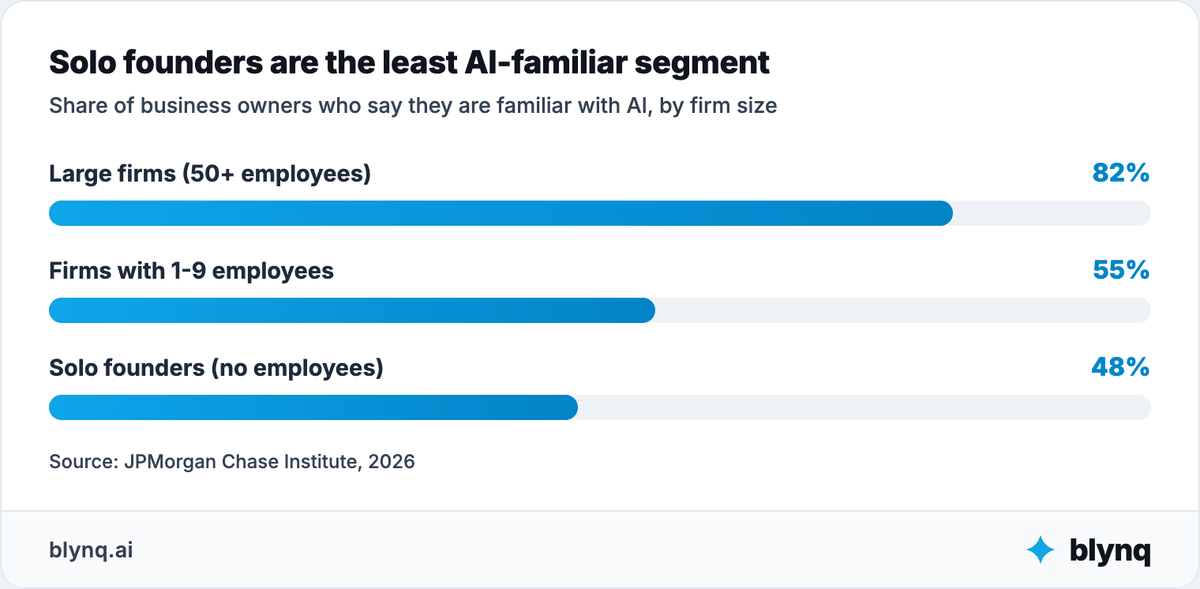
Familiarity, not interest, is the gap most solo founders are actually stuck behind.
When drafts, first replies and admin get faster, clients still need someone who can:
- Take responsibility for the outcome, not just the output.
- Recognize when a request does not fit the standard process.
- Explain trade-offs and hold a position under pressure.
- Negotiate scope, price and timeline honestly.
- Coordinate the other people a project touches.
- Stand behind the work with a name and a signature.
One path uses AI mainly to produce more content and contact more leads.
The other uses it to arrive more prepared and protect the judgment that clients are actually paying for.
The second path strengthens your position. The value moves from producing the work toward standing behind it.
Where does a solopreneur's AI setup still need human control?
A solopreneur's AI setup still needs human control wherever a signature, client money or legal exposure is involved.
The closer AI gets to those, the stronger review should become.
| Area | AI can help with | Human owns |
|---|---|---|
| Lead intake | Basic questions, capture and routing | Which clients to take on |
| Contracts | Flagging risky clauses in plain English | Reading the original and the signature |
| Compliance filings | Tracking deadlines and preparing drafts | Filing accuracy and the signature |
| Bookkeeping | Categorization, reconciliation and reserve tracking | Judgment on unusual transactions |
| Tax preparation | Organizing records and estimating reserves | Filing sign-off and accuracy |
| Client communication | Drafting and organizing recurring questions | Tone, relationship and sensitive replies |
| Marketing content | Repurposing and drafting across formats | Brand voice, claims and final approval |
| Pricing | Organizing cost and profit data | The number you actually charge |
| Scheduling | Auto-scheduling and calendar protection | What gets prioritized and what gets dropped |
| Strategic decisions | Structuring options and trade-offs | The decision and its consequences |
Contract review is the clearest place AI still needs a backstop.
ContractClarifyAI states plainly that its analysis is "educational explanations only" and recommends a licensed attorney before signing.
That caveat is the correct default for any AI reviewing a document with your signature on it, not just this one tool.
Compliance carries its own weight.
Quarterly estimated taxes and Schedule C reporting stay yours to file correctly, regardless of what software prepared the numbers.
The Beneficial Ownership Information filing under the Corporate Transparency Act works the same way.
FinCEN holds the business owner accountable, not the tool that tracked the deadline.
The correct fallback is usually simple.
Treat any AI output touching money, a contract or a filing as a draft for your review, not a finished answer.
AI should have an escalation path, not an unlimited mandate.
How do you choose the right AI setup for a solo business?
You choose the right AI setup for a solo business by evaluating its operating model, not its label.
Ask 6 questions of anything you are considering:
- What responsibility or workflow does it help own?
- What can it analyze, recommend or execute?
- What business or client data can it access, and where is that stored?
- Does it rely on verified source data?
- What must you review and sign?
- Does it integrate with the systems that matter, and show what it did?
Consider 3 legitimate approaches:
| Approach | Strengths | Trade-offs | Best fit |
|---|---|---|---|
| Custom build | Maximum control and workflows tailored to one business | Technical ownership, maintenance and integration risk | Founders comfortable configuring and debugging tools |
| Self-directed Claude or ChatGPT | Flexibility, strong analysis and custom projects | You design the context, memory and orchestration | Solopreneurs who want to design their own setup |
| Ready-made AI team or purpose-built SaaS | Faster setup, structured roles and continuity | More opinionated and limited to supported capabilities | Solopreneurs who want structure without building it |
Adoption data suggests most solo founders are earlier in this than the marketing implies.
SBA Office of Advocacy found 82% of businesses with fewer than 5 employees say AI is not applicable to them at all.
That figure is closing fast against larger firms, which means the founders who move now have a real window before it does.
Before committing, verify the system actually reads from and writes to what you need: your bank, your invoicing tool, your calendar or your contract storage.
Check permissions, approvals, activity logs and failure handling.
Do not assume "works with" means "integrates with." If you constantly re-brief the system and copy data between tools, the AI is adding administrative work.
How do you put AI to work in your solo business in 30 days?
Put AI to work in 30 days by picking 1 measurable goal and diagnosing the bottleneck behind it.
Run the agent alongside your current process, then expand only where it earned the expansion.
Start with the goal, not the tool.
Week 1: Diagnose
Choose a goal and a bottleneck. Do not start with a product.
Common candidates: unpredictable cash flow, contracts signed without review, or a pipeline that only gets attention once it is empty.
Define the 1 metric that would show improvement.
Exit criterion: a named metric and a current baseline number, written down.
Week 2: Build context
Give the system what judgment requires: offer, pricing, income sources, capacity, compliance deadlines and previous decisions.
Decide what stays private or needs controlled access. Client and financial data belong in that category by default.
Exit criterion: the agent answers a question about your business you did not have to re-explain.
Week 3: Run alongside the current process
Use the agent for analysis, planning or structured work while the existing process stays visible.
Review errors, missing context and recommendations that do not fit how your business actually runs.
Exit criterion: a written list of what it got wrong and what context was missing.
Week 4: Evaluate and expand carefully
Measure the metric from Week 1. Record what the system learned and what still needs your review.
Add another skill or role only when it solves a real adjacent problem.
If the second role depends on knowledge from the first, prioritize shared context over another disconnected tool.
Exit criterion: a keep-or-drop decision supported by the baseline number.
Example setup for a solo founder
Suppose the goal is predictable cash flow without adding client work.
| Setup layer | What to include |
|---|---|
| Business context | Offer, pricing, income sources, capacity, compliance deadlines and runway definitions |
| Productivity Agent | Turn deadlines, client work and admin into a realistic weekly focus |
| Analytics Skill | Compare income by source, hours worked and profit per client |
| Specialized workflow | Track cash runway, flag overdue invoices and estimate tax reserves |
| Human boundary | You handle contract signatures, filing sign-off and pricing decisions |
| Success measure | A visible runway number and fewer overdue invoices after 30 days, without added client work |
This is enough for a first setup. It needs no separate agents for bookkeeping, invoicing, scheduling and contracts.
Start with the responsibility, add the skills and workflow it needs, and expand only when a problem genuinely crosses into a new role.
What to do now
Pick 1 business result that needs to change this quarter, and write down the number that measures it today.
Diagnose what is actually blocking it, using the 8-step sequence above. The bottleneck is rarely where the first instinct points.
Decide what stays human: signatures, filings, pricing and client relationships. Then choose the setup that fits what remains.
AI agents help most when they own a real responsibility, use several skills and understand the business behind the task.
The future is not a separate tool for every task. Expect fewer capable agents, specialized execution where it earns its place, and shared context underneath.
The point is not to add more AI. It is to make the solo business easier to understand, decide for and run.