









What are AI agents for realtors?
An AI agent for realtors is software that owns an area of the business, not a single task.
Voice tools like Structurely own lead response. Business platforms like Blynq help interpret the business context behind it.
Both keep that area's context between uses, unlike a chat window. Neither reads your MLS, so pricing calls stay yours.
Learn how to run your business with an AI teamWhich AI agents can help run a real estate business?
The AI agents that help run a real estate business are 8 business roles: Marketing, Sales, Operations, Client Experience, Finance, Analytics, Strategy and Productivity.
The useful starting point is not a separate agent per listing, lead or document.
A small set of agents works better, each owning a meaningful part of the business.
| AI Agent | What it can help a realtor do | Most useful when |
|---|---|---|
| Marketing Agent | Clarify positioning, plan campaigns, promote listings and connect content with signed clients | Marketing activity is high but its business value is unclear |
| Sales Agent | Rank leads, review the pipeline, diagnose conversion and plan follow-up | Leads arrive but appointments and signed clients are inconsistent |
| Operations Agent | Review transaction processes, recurring work, deadlines, handoffs and capacity | Details fall through when listings and closings overlap |
| Client Experience Agent | Improve buyer and seller communication, organize feedback and flag relationships needing attention | Clients need clearer updates or issues surface too late |
| Finance Agent | Review commission economics, marketing costs, budgets and scenarios | GCI looks healthy but net economics are unclear |
| Analytics Agent | Connect lead sources, appointments, signed clients, closings and profit | Data exists across systems but does not explain performance |
| Strategy Agent | Compare farm areas, client segments, growth options and positioning choices | The realtor has more possible directions than the business should pursue |
| Productivity Agent | Turn active clients, listings, deadlines and growth work into a realistic weekly focus | Everything feels urgent |
These 8 support the business side. Realtors also use specialized agents and tools for narrow execution.
Common examples include voice response, CRM nurture, document review, offer organization, transaction monitoring and virtual staging.
The distinction matters. A Sales Agent can diagnose why leads are not converting. A voice agent answers and qualifies an approved type of inquiry.
One supports the business decision. The other runs a defined workflow.
What counts as an AI agent in real estate?
An AI agent in real estate is software that holds an ongoing responsibility. A chatbot answers one question; a tool finishes one job.
The terms get confusing quickly. Here is the simplest way to tell the 4 shapes apart.
| Chatbot | AI Tool | AI Agent | AI Team | |
|---|---|---|---|---|
| What it does | Answers a question | Completes a specific job | Helps own an ongoing responsibility | Helps across several parts of the business |
| What you do | Ask each question | Open or trigger it when needed | Give it a goal or responsibility | Give the team access to shared business context |
| What it knows | Usually the conversation or limited product memory | Information needed for its job | Context relevant to its role | Context shared across different specialists |
| Realtor example | "Write a follow-up text to a Zillow lead" | Virtually stage a vacant living room | Own Sales priorities and follow-up across the pipeline | Marketing, Sales and Finance work from the same business understanding |
So stop asking whether something is technically an agent. Ask 3 better questions instead.
What will it take responsibility for? What information will it use? What will you still have to do?
How can AI help you run a real estate business?
AI helps run a real estate business by removing repetitive first responses, scattered feedback, manual document review and the guesswork connecting spend to commission.
Find your problem in the left column before shopping for anything.
| Recurring problem | What AI can help remove | Best-fit agent or AI setup | When to prioritize it |
|---|---|---|---|
| New leads go unanswered | Repetitive first response, capture and routing | Sales Agent + lead-response or voice workflow | When good leads arrive outside working hours |
| Follow-up is inconsistent | Ranking, reminders and message preparation | Sales Agent + CRM nurture workflow | When inquiries stall before appointments |
| Listing marketing takes too long | Rewriting verified property information across channels | Marketing Agent + content tool | When every listing requires the same production work |
| Showing feedback is scattered | Collection, organization and pattern summaries | Client Experience Agent + feedback workflow | When seller updates lack useful evidence |
| Past clients disappear | Remembering whom to contact in your sphere, and why | Client Experience Agent | When referrals and repeat business matter |
| Documents take hours to review | First-pass summaries and issue finding | Specialized document tool | When inspection, TDS or HOA packets create time pressure |
| Offers are difficult to compare | Organizing terms, differences and questions | Specialized comparison tool | When several offers arrive at once |
| Transaction details fall through | Checklists, reminders and missing-item visibility | Operations Agent + transaction workflow | When concurrent escrows create operational risk |
| Capacity is unclear | Connecting active clients, showings, listings and deadlines | Operations Agent + Productivity Agent | Before taking on more clients |
| Marketing spend is disconnected from profit | Connecting sources, conversion, commission and cost | Marketing, Sales, Finance and Analytics | When a channel generates activity but uncertain returns |
| Priorities are unclear | Connecting goals, pipeline, commitments and constraints | Strategy Agent + Productivity Agent | When everything feels urgent |
This is a map, not a shopping list. Some problems need a tool. Others need a skill inside a business role.
Others still need a specialized agent that owns a workflow, or several agents working from shared context.
Diagnose the bottleneck before choosing the system.
How should a realtor choose what to give an AI agent first?
A realtor should choose the first AI agent from the bottleneck blocking a named business result, not from the most interesting capability on offer.
Suppose you want more closings. "Automate lead generation" sounds like the obvious answer.
But flat closings have at least 7 possible causes:
- Too few qualified inquiries.
- Slow response to new leads.
- Poor conversion from inquiry to appointment.
- Weak follow-up after the first conversation.
- Too much spend on the wrong channel.
- More active clients than you can serve well.
- Commission economics that make a channel unprofitable.
More leads would make several of these worse, not better.
Work this sequence before choosing an agent or tool:
| Step | Realtor question |
|---|---|
| Goal | What business result needs to change? |
| Bottleneck | What is preventing that result today? |
| Responsibility | Which area owns the problem? |
| Capability | What must AI analyze, recommend or execute? |
| Context | What must it know to give a useful answer? |
| Constraints | What limits budget, time, capacity or risk? |
| Human boundary | What decision or action stays human? |
| Architecture | Is the right fit general AI, a broad agent, a specialized system or an AI team? |
Do not design the business around what AI can do. Design the AI around what the business needs to achieve.
How do roles, skills and tasks show up in real estate?
Roles are the business area an agent owns, skills are what it can do inside that area, and tasks are the work happening right now.
These terms get used interchangeably. Keeping them apart stops you buying a separate system for every small job.
| Concept | Definition | Realtor example |
|---|---|---|
| Agent | AI entity holding ongoing responsibility | Marketing Agent |
| Role | Business domain the agent owns | Marketing |
| Skill | Capability used inside the role | Channel analysis |
| Task | Specific work being done now | Compare Zillow and Meta performance |
| AI Tool | Product for a particular job | Virtual-staging tool |
| Automation | Predefined workflow | Send a message when a Follow Up Boss lead arrives |
| Specialized Agent | System owning a narrow ongoing workflow | Inbound voice qualification |
| AI Team | Several agents sharing business context | Marketing, Sales and Finance using the same business knowledge |
| AIOS | Operating layer connecting agents, skills, memory, knowledge, tasks and workflows | Shared AI operating environment for the business |
The core idea is simple. Agents are roles. Skills are capabilities. Tasks are the work being done.
Automation alone does not make something an agent. Neither does an "agent" label on a pricing page.
Does every real estate task need its own AI agent?
No. Most real estate tasks are skills inside a role you already have, not grounds for buying another agent.
The taxonomy matters because it stops an AI stack becoming a new kind of software clutter.
Writing one Instagram caption is not a Social Media Agent. It is a task using a content skill inside Marketing.
Comparing Zillow and Meta spend this month is not a Channel Comparison Agent. It is a task using Marketing, Sales and Analytics skills.
A system that handles every inbound call, asks qualification questions, records outcomes and escalates exceptions is different.
That may qualify as a specialized agent, because it owns a narrow but ongoing workflow.
The difference is responsibility, not branding.
How can AI support the business behind the transactions?
AI supports the business behind the transactions in 3 connected places: creating and converting demand, serving clients through live deals, and protecting the economics underneath.
How do you turn attention into appointments and signed clients?
You turn attention into signed clients by deciding which activity produces appointments, then letting a Marketing Agent and a Sales Agent work on that answer.
A Marketing Agent can clarify positioning, choose which audience and listing deserve attention, and turn verified property facts into several formats.
The hard question is not how many posts AI can produce. It is which activity creates appointments and signed clients.
A Sales Agent works deeper than an automated follow-up sequence. It reviews the pipeline, compares lead sources and finds stalled opportunities.
It can diagnose where inquiry-to-appointment conversion breaks. A specialized workflow then responds, asks approved questions, updates the CRM and books the call.
Realtors already lean this way. Blynq reviewed 35 Reddit and BiggerPockets threads on live AI deployments.
In those, 68.6% used AI for text and copy, versus 17.1% for voice.
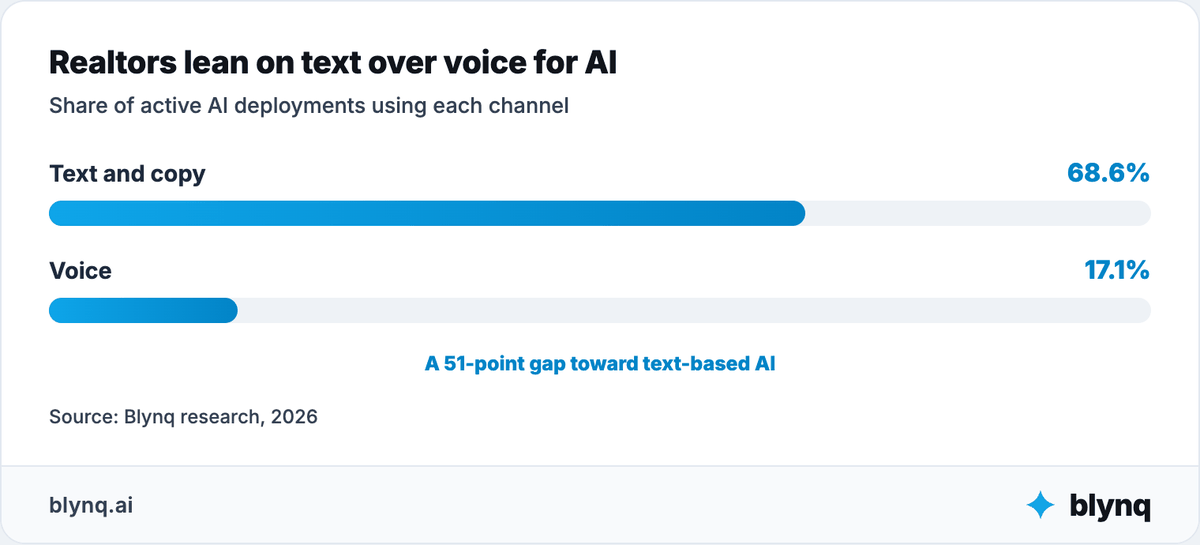
Latency, dropped calls and compliance fear drive that gap, which means text-based follow-up is the lower-risk first build for most solo agents.
The business question is not only whether AI can follow up.
The real questions are which leads matter, why follow-up fails, and what automation the relationship can carry.
How do you keep listings, clients and transactions moving?
You keep transactions moving by giving an Operations Agent the process itself, then using specialized systems for documents, feedback and deadlines.
Live real estate work combines property facts, client expectations, showing feedback, documents, offers, deadlines and several outside parties.
An Operations Agent can analyze that process, find fragile handoffs and clarify what needs attention now.
Specialized systems can summarize a TDS or HOA packet, collect showing feedback, or monitor defined transaction steps.
Client Experience uses the same context to prepare clearer buyer and seller updates and surface repeated confusion.
AI should help you remember and prepare. It should not impersonate care or make the relationship feel automated.
The human still owns factual accuracy, advice, negotiation, contractual deadlines and every promise made to a client.
How do you protect time, commission and future pipeline?
You protect commission by connecting lead source to appointment to closing to cost, which is Finance and Analytics work rather than marketing work.
More closings do not automatically mean a better business.
Portal spend, referral fees, advertising, desk fees, E&O and time can hollow out a busy-looking channel.
Finance and Analytics can connect lead sources, appointments, signed clients, closings, GCI and cost.
Strategy and Productivity then connect those findings with capacity, positioning and a realistic weekly focus.
The goal is not more possible actions. It is a reasoned choice about which farm area, channel and client segment deserve limited attention.
What happens when you trace one problem across the whole business?
Tracing one lead-volume problem across the whole business usually finds a qualification, capacity and channel-economics problem instead.
Consider a solo agent buying Zillow Premier Agent leads. Volume looks healthy, closings are flat, and evenings disappear into follow-up.
The first instinct is a voice agent, so every inquiry gets an instant response.
Sales analysis shows response time is only part of it. Analytics finds one source producing many inquiries and few appointments.
Finance shows referral fees and advertising weaken the channel even when it closes. Operations reveals active buyers already consume most showing capacity.
Strategy recommends improving qualification and reallocating spend before adding volume.
A lead-response workflow may still help. But automating every inquiry first would have accelerated the wrong system.
The value comes from examining one problem through connected business perspectives, before execution scales it.
Where do specialized real estate AI tools and agents fit?
Specialized real estate AI tools and agents fit where the bottleneck is narrow and execution-heavy.
That covers lead response, voice qualification, CRM nurture, document review, valuation and staging.
Business agents and agents built for one job do different work.
| Business Agent layer | Specialized execution layer |
|---|---|
| Diagnoses, plans and ranks across a role | Performs or owns a defined workflow |
| Uses broad business context | Uses workflow-specific or transaction-specific data |
| Connects questions across functions | Goes deeper inside one execution category |
| Example: determine why Zillow leads are not converting | Example: answer and qualify an inbound call |
The market holds several kinds of product. ChatGPT, Claude and Gemini support general research, writing and analysis.
Structurely and Ylopo AI focus on lead engagement and qualification, though both assume you have already decided which leads are worth pursuing.
ContactSwing builds AI voice workflows. HouseCanary CanaryAI supports valuation and market analysis.
These are not interchangeable. A voice agent does not decide whether Zillow spend is profitable.
A valuation assistant does not decide which audience you should pursue.
A CRM workflow executes follow-up, but you define the process, qualification rules and escalation path.
Blynq sits on the business-management side. Its business roles work from shared context across Marketing, Sales, Operations, Finance, Analytics and Strategy.
The right setup often combines both: real estate tools for execution, and a connected set of business agents for the thinking and the decisions.
For a product-by-product comparison, see the best AI tools for real estate agents.
Do you need one specialist or a connected AI back office?
You need one specialist when the problem stays inside one responsibility, and a connected AI back office when it crosses several.
Real estate questions cross functions constantly:
Marketing to leads to appointments to clients to closings to commission to profit to the next marketing decision.
A marketing recommendation may depend on sales conversion. A sales priority may depend on capacity.
A finance decision may depend on channel performance and future pipeline.
Use this rule:
| Situation | Likely starting point |
|---|---|
| One isolated output | Chatbot or tool |
| One repeatable workflow | Automation or specialized agent |
| One ongoing business responsibility | Broad agent role |
| A question crossing several business functions | AI team with shared context |
Why does business context change real estate AI recommendations?
Business context can change real estate AI recommendations completely, because the same question has opposite correct answers for different businesses.
Consider a common question: should I spend more on Zillow?
No responsible answer exists without current spend, lead quality, speed to lead, appointment rates, signed-client conversion, closings, GCI, capacity and previous results.
One agent needs more volume. Another needs better conversion. A third already has more opportunities than the business can serve well.
Prompt-based work restarts from the same briefing every time: farm area, audience, positioning, budget, tone, active campaigns and recent results.
Context-aware AI starts from validated goals, constraints, decisions, actions, outcomes and lessons it already holds.
It should not remember everything indiscriminately. It should separate verified business knowledge from assumptions and retrieve only what the current decision needs.
Why do AI agents need one shared view of the business?
AI agents need one shared view because otherwise you are the integration point, manually carrying campaign performance to sales and acquisition cost to finance.
Several agents do not become a team because they sit in one menu.
If Marketing knows campaign performance, Sales knows lead quality and Finance knows acquisition cost, but you connect them by hand, nothing has changed.
Tool sprawl is a live complaint. One small-business owner on Reddit's r/aiToolForBusiness, a forum for AI buyers, described the fix directly.
"context sharing between agents matters more than feature lists. we paid for separate tools for a year that each did their function well but didn't talk to each other."
Feature lists are how these products are sold, which is why shared context is the harder thing to evaluate on a demo call.
A useful shared view holds positioning, farm areas served, lead sources, pipeline definitions, capacity, financial goals, current priorities and past decisions.
Client and transaction data needs stricter access, verified sources and clear retention rules.
Shared context does not replace role expertise. It makes Marketing, Sales, Operations and Finance relevant to the same business.
Blynq is built around exactly that pattern. Its Marketing, Sales, Operations and Finance agents read from one shared business profile, not four separate ones.
An AI team becomes an AIOS when agents, skills, knowledge, memory, tasks and workflows grow around that shared understanding.
The goal is not more AI. It is a real estate business that is easier to understand, decide for and run.
What do clients still need from a realtor when AI gets faster?
Clients still need a realtor for interpretation, negotiation, coordination and accountability, even when AI gets faster.
AI does not make realtors irrelevant. It changes which parts of the job clients value.
The 2025 National Association of REALTORS Technology Survey found 66% of realtors adopt new technology mainly to save time.
The same survey found 64% adopt it to improve the client experience.
Only 33% described AI's impact on their business as moderately positive.
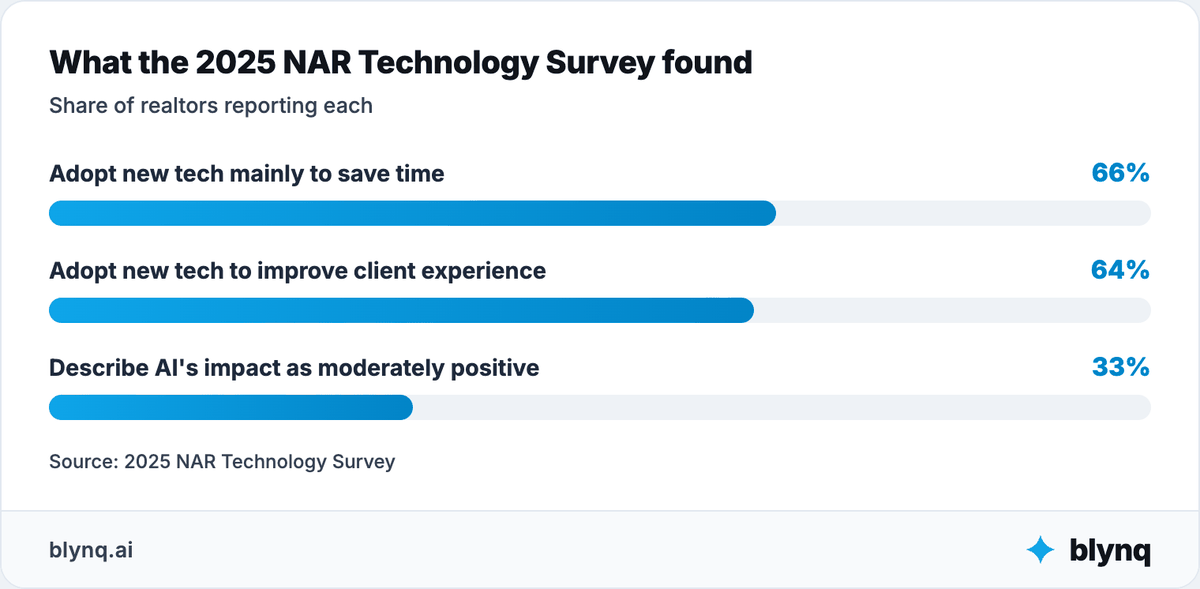
Access to the technology is not the same as turning it into a better service.
When first responses, listing drafts, document summaries and market reports get faster, clients still need someone who can:
- Interpret local conditions rather than repeat market data.
- Recognize when a property, offer or client situation does not fit the template.
- Explain trade-offs and uncertainty clearly.
- Negotiate when priorities conflict.
- Coordinate lenders, inspectors, attorneys and title.
- Take responsibility for advice, deadlines and the transaction.
One path uses AI mainly to produce more content and contact more leads.
The other uses it to arrive more prepared, more responsive and better informed, while judgment and representation stay human.
The second path strengthens your role. The value moves from producing information toward interpreting it and owning the next decision.
Where does real estate AI still need human control?
Real estate AI still needs human control wherever money, contracts, housing decisions, legal duty or client trust are involved.
The closer AI gets to those, the stronger review should become.
| Area | AI can help with | Human owns |
|---|---|---|
| Lead intake | Basic questions, capture and routing | Advice, representation and sensitive questions |
| Lead follow-up | Ranking, preparation and defined workflows | Relationship judgment and personal outreach |
| Showing feedback | Collection and pattern summaries | Seller advice and pricing decisions |
| Past clients | Reminders and message preparation | The relationship itself |
| Listing content | Drafting and repurposing | Facts, Fair Housing, brand judgment and approval |
| Market reports | Structuring and explaining verified inputs | Source data and local interpretation |
| Documents | Summarizing, locating and comparing information | Reading the original, legal interpretation and professional review |
| Offers | Organizing terms and preparing questions | Advice, negotiation and client decisions |
| Transactions | Checklists, reminders and issue visibility | Contractual deadlines and final action |
| Finance | Organizing inputs and scenarios | Source accuracy and financial decisions |
Valuation deserves particular caution. Across 10 threads on LLM performance for CMAs and ARVs, Blynq found 60% reported severe hallucinations or comp failures.
Generative models fail at hyper-local valuation without MLS verification, so a Zestimate-style number from a chatbot is a starting point and never a CMA.
Housing advertising stays subject to Fair Housing rules even when targeting or copy comes from an automated system.
AI-generated language can repeat bias, invent facts or make claims you would never approve by hand.
HUD guidance on AI and housing advertising
AI voice needs legal care too. Automated calling and synthetic voices may fall under consent, robocall, TCPA and state-law requirements.
FCC guidance on unwanted robocalls and texts
The correct fallback is usually simple: "Let me have the agent call you back."
AI should have an escalation path, not an unlimited mandate.
How do you choose the right AI setup for a real estate business?
You choose the right AI setup for a real estate business by evaluating its operating model, not its label.
Ask 6 questions of anything you are considering:
- What responsibility or workflow does it help own?
- What can it analyze, recommend or execute?
- What business, client or transaction context can it access?
- Does it rely on verified source data?
- What must you review and approve?
- Does it integrate with the systems that matter, and show what it did?
Consider 3 legitimate approaches:
| Approach | Strengths | Trade-offs | Best fit |
|---|---|---|---|
| Custom build | Maximum control and proprietary workflows | Technical ownership, maintenance and integration risk | Teams with technical support and distinctive processes |
| Self-directed Claude or ChatGPT | Flexibility, strong analysis and custom projects | You design the context, memory and orchestration | Realtors who want to design their own setup |
| Ready-made AI team or purpose-built SaaS | Faster setup, structured roles and continuity | More opinionated and limited to supported capabilities | Realtors who want structure without building it |
Custom builds fail in a predictable place. Blynq reviewed 12 threads on custom AI workflow builds.
Of those, 66.7% cited a fragile stack and API integration friction.
Debugging webhooks and middleware consumed more time than prompt writing, which is the cost most build-versus-buy decisions underestimate.
Before committing, verify the system actually reads from and writes to what you need: CRM, email, calendar, documents, MLS, IDX, accounting or transaction management.
Check permissions, approvals, activity logs and failure handling.
Do not assume "works with" means "integrates with."
If you constantly re-brief the system and copy data between bots, the AI is adding management work.
How do you put AI to work in your real estate business in 30 days?
Put AI to work in 30 days by picking 1 measurable goal and diagnosing the bottleneck behind it.
Run the agent alongside your current process, then expand only where it earned the expansion.
Start with the goal, not the tool.
Week 1: Diagnose
Choose a goal and a bottleneck. Do not start with a product.
Common candidates: weak inquiry-to-appointment conversion, unclear channel ROI, or inconsistent past-client follow-up.
Define the 1 metric that would show improvement.
Exit criterion: a named metric and a current baseline number, written down.
Week 2: Build context
Give the system what judgment requires: goals, audience, positioning, channels, process, constraints, recent performance and previous decisions.
Decide what stays private or needs controlled access, especially client and transaction data.
Exit criterion: the agent answers a question about your business you did not have to re-explain.
Week 3: Run alongside the current process
Use the agent for analysis, planning or structured work while the existing process stays visible.
Review errors, missing context and recommendations that do not fit your market.
Exit criterion: a written list of what it got wrong and what context was missing.
Week 4: Evaluate and expand carefully
Measure the metric from Week 1. Record what the system learned and what still needs a human.
Add another skill or role only when it solves a real adjacent problem.
If the second role depends on knowledge from the first, prioritize shared context over another disconnected tool.
Exit criterion: a keep-or-drop decision supported by the baseline number.
Example setup for a solo realtor
Suppose the goal is better inquiry-to-appointment conversion without raising lead spend.
| Setup layer | What to include |
|---|---|
| Business context | Farm area, ideal client, lead sources, pipeline stages, capacity and conversion definitions |
| Sales Agent | Review the pipeline, identify where leads stall and recommend follow-up priorities |
| Analytics Skill | Compare speed to lead, contact and appointment rates by source |
| Specialized workflow | Respond to approved inquiry types, capture answers and prepare the next action |
| Human boundary | You handle advice, sensitive qualification, relationship judgment and representation |
| Success measure | Faster qualified response and higher appointment conversion after 30 days, without weaker lead quality |
This is enough for a first setup. It needs no separate agents for portal leads, follow-up, appointments and conversion.
Start with the responsibility, add the skills and workflow it needs, and expand only when a problem genuinely crosses into a new role.
What to do now
Pick 1 business result that needs to change this quarter, and write down the number that measures it today.
Diagnose what is actually blocking it, using the 8-step sequence above. The bottleneck is rarely where the first instinct points.
Decide what stays human: advice, negotiation, disclosure, deadlines and representation. Then choose the setup that fits what remains.
AI agents help most when they own a real responsibility, use several skills and understand the business behind the task.
The future is not a separate bot for every action.
Expect fewer capable agents, specialized execution where it earns its place, and shared context underneath.
The point is not to add more AI. It is to make the real estate business easier to understand, decide for and run.