









What are AI agents for personal trainers?
An AI agent for personal trainers is software that owns an area of the business, not a single task.
Program tools like Trainerize own workout generation. Business platforms like Blynq help interpret the business context behind it.
Both keep that area's context between uses, unlike a chat window. Neither sees a client's form, so that call stays yours.
Learn how to run your business with an AI teamWhich AI agents can help run a personal training business?
The AI agents that help run a training business are 8 business roles: Client Experience, Sales, Operations, Marketing, Finance, Analytics, Strategy and Productivity.
The useful starting point is not a separate agent per client, program or check-in.
A small set of agents works better, each owning a meaningful part of the business.
| AI Agent | What it can help a trainer do | Most useful when |
|---|---|---|
| Client Experience Agent | Draft check-ins, analyze feedback, flag clients at risk of ghosting | Clients disappear before you notice they are struggling |
| Sales Agent | Qualify inquiries, price packages and follow up on trial-to-paid conversion | Consults happen but few convert into training packages |
| Operations Agent | Review programming workflow, scheduling, no-shows and capacity | Session prep and admin eat the evenings |
| Marketing Agent | Clarify your niche, plan content and explain what differentiates you from an app | Anyone with a phone competes for the same client |
| Finance Agent | Review package pricing, churn cost and margin per client | Your calendar is full but income feels flat |
| Analytics Agent | Connect lead sources, consults, retention and revenue per client | Practice data does not explain which clients are profitable |
| Strategy Agent | Compare service models, price tiers and specializations | Cheap AI apps are pricing you out of new clients |
| Productivity Agent | Turn sessions, programming, check-ins and outreach into a realistic weekly focus | Every hour outside sessions still feels behind |
These 8 support the business side. Trainers also use specialized agents and tools for narrow execution.
Common examples include workout program generation, macro tracking, form-check via pose estimation, and check-in messaging.
The distinction matters. A Client Experience Agent can diagnose why 3 clients quietly stopped booking.
A program-builder tool writes this week's workout. One supports the business decision; the other runs a defined workflow.
What counts as an AI agent in personal training?
An AI agent in personal training is software that holds an ongoing responsibility. A chatbot answers one question; a tool finishes one job.
The terms get confusing quickly. Here is the simplest way to tell the 4 shapes apart.
| Chatbot | AI Tool | AI Agent | AI Team | |
|---|---|---|---|---|
| What it does | Answers a question | Completes a specific job | Helps own an ongoing responsibility | Helps across several parts of the business |
| What you do | Ask each question | Open or trigger it when needed | Give it a goal or responsibility | Give the team access to shared business context |
| What it knows | Usually the conversation or limited product memory | Information needed for its job | Context relevant to its role | Context shared across different specialists |
| Trainer example | "Suggest a substitute for barbell squats" | Generate this week's program in Trainerize | Own client retention and flag who needs a check-in | Sales, Client Experience and Finance work from the same business understanding |
So stop asking whether something is technically an agent. Ask 3 better questions instead.
What will it take responsibility for? What information will it use? What will you still have to review in person?
How can AI help you run a personal training business?
AI helps you run a personal training business by removing repetitive programming, scattered check-ins, and the guesswork connecting price to what clients will pay.
Find your problem in the left column before shopping for anything.
| Recurring problem | What AI can help remove | Best-fit agent or AI setup | When to prioritize it |
|---|---|---|---|
| Programming takes hours every week | Drafting a first-pass workout from your own methodology | Specialized program-builder tool | When every client needs a fresh block written from scratch |
| Clients go quiet before they quit | Spotting disengagement early and flagging it | Client Experience Agent + check-in workflow | When ghosting costs you clients you never got to save |
| Onboarding a new client takes too long | Intake forms, goal-setting and a first program, prepared faster | Client Experience Agent + onboarding workflow | When a full intake eats an unpaid afternoon |
| Nutrition questions pile up between sessions | Drafting answers within your scope, for your review | Client Experience Agent | When clients text at all hours expecting a reply |
| Free AI apps undercut your price | Clarifying what a human relationship is worth beyond a program | Marketing Agent + Strategy Agent | When prospects compare you to a $20-a-month app |
| Package pricing does not match delivery cost | Connecting session time, admin time and margin per client | Finance Agent + Analytics Agent | When a full calendar does not translate into more income |
| Consults do not convert to paid clients | Qualifying leads and following up on trial-to-paid conversion | Sales Agent | When people try a session and never come back |
| Progress tracking is scattered across apps | Connecting workouts, macros and check-ins into one picture | Analytics Agent | When you cannot show a client their own progress clearly |
| Capacity is unclear | Connecting active clients, sessions and admin load | Operations Agent + Productivity Agent | Before taking on more clients |
| Marketing content takes too long | Turning your training philosophy into consistent content | Marketing Agent + content tool | When posting consistently keeps losing to session work |
| Priorities are unclear | Connecting goals, sessions, admin and growth work | Strategy Agent + Productivity Agent | When everything feels urgent between clients |
This is a map, not a shopping list. Some problems need a tool. Others need a skill inside a business role.
Others still need a specialized agent that owns a workflow, or several agents working from shared context.
Diagnose the bottleneck before choosing the system.
How should a trainer choose what to give an AI agent first?
A trainer should choose the first AI agent from the bottleneck blocking a named result, not from the most impressive app demo.
Suppose you want more income without more hours. "Automate the programming" sounds like the obvious answer.
But flat income despite full sessions has at least 7 possible causes:
- Too few consults convert into paid packages.
- Clients quietly reduce sessions or churn.
- Package pricing does not cover your actual time.
- Programming and admin eat evenings meant for new clients.
- Free AI apps compress what clients expect to pay.
- No system for spotting who is about to quit.
- More clients than you can serve well without burning out.
Automating programming first would make some of these worse, not better.
This tension has a name in the data.
Trainerize found 78% use AI to draft training plans. NASM found 43.5% of weekly AI users also see AI as their profession's biggest threat.
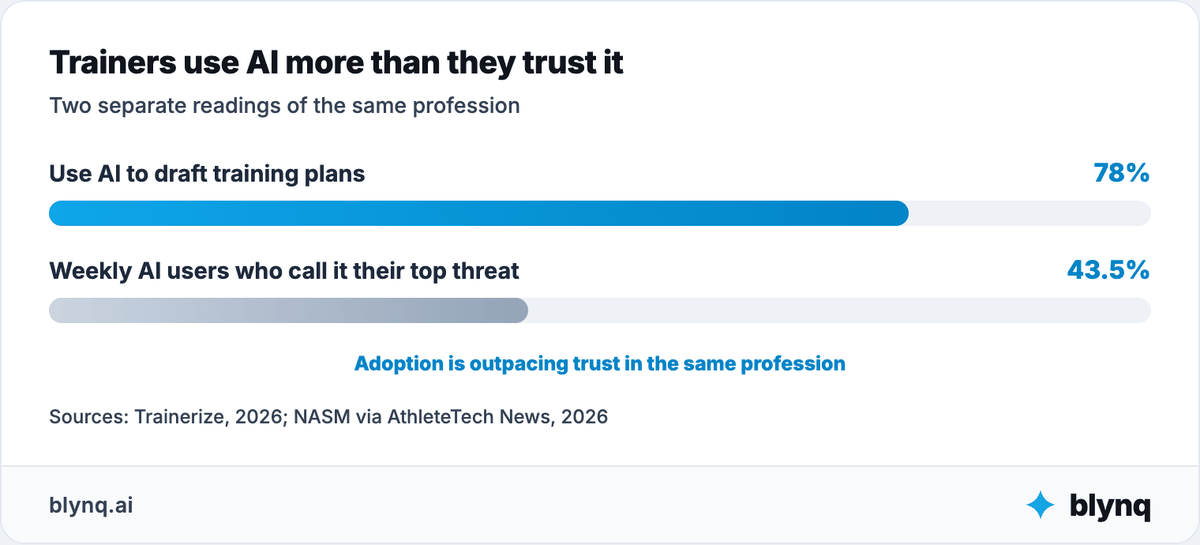
Adoption and anxiety are coexisting in the same person.
The real question is not whether to use AI. It is what you let it own.
Work this sequence before choosing an agent or tool:
| Step | Trainer question |
|---|---|
| Goal | What business result needs to change? |
| Bottleneck | What is preventing that result today? |
| Responsibility | Which area owns the problem? |
| Capability | What must AI analyze, recommend or execute? |
| Context | What must it know to give a useful answer? |
| Constraints | What limits budget, time, capacity or risk? |
| Human boundary | What judgment stays with you in the room? |
| Architecture | Is the right fit general AI, a broad agent, a specialized system or an AI team? |
Do not design the business around what AI can do. Design the AI around what the business needs to achieve.
How do roles, skills and tasks show up in personal training?
Roles are the business area an agent owns, skills are what it can do inside that area, and tasks are the work happening right now.
These terms get used interchangeably. Keeping them apart stops you buying a separate system for every small job.
| Concept | Definition | Trainer example |
|---|---|---|
| Agent | AI entity holding ongoing responsibility | Client Experience Agent |
| Role | Business domain the agent owns | Client Experience |
| Skill | Capability used inside the role | Retention risk flagging |
| Task | Specific work being done now | Draft this week's check-in messages |
| AI Tool | Product for a particular job | Workout program builder |
| Automation | Predefined workflow | Send a reminder when a client misses a session |
| Specialized Agent | System owning a narrow ongoing workflow | Daily macro logging from a photo |
| AI Team | Several agents sharing business context | Sales, Client Experience and Finance using the same practice knowledge |
| AIOS | Operating layer connecting agents, skills, memory, knowledge, tasks and workflows | Shared AI operating environment for the business |
The core idea is simple. Agents are roles. Skills are capabilities. Tasks are the work being done.
Automation alone does not make something an agent. Neither does an "AI-powered" label on a fitness app.
Does every personal training task need its own AI agent?
No. Most personal training tasks are skills inside a role you already have, not grounds for buying another agent.
The taxonomy matters because it stops an AI stack becoming a new kind of software clutter.
Writing one client's workout is not a Programming Agent. It is a task using a program-design skill inside Operations.
Estimating today's macros from a photo is not a Nutrition Agent. It is a task using a Client Experience skill.
A system that logs every client's food daily, flags what is off-plan, and prompts a check-in is different.
That may qualify as a specialized agent, because it owns a narrow but ongoing workflow.
One trainer summed up the right instinct for combining a certification with AI output.
"Use your certification (e.g. like NASM's 5 Phases) as a basis of those questions. You provide the container, and it supplies the build."
Reddit user UncommercializedSaw wrote that in r/personaltraining, a forum where trainers discuss the business. Reddit thread on AI workout building
Your certification framework is the structure. AI fills it in faster than you would by hand.
The difference is responsibility, not branding.
How can AI support the business behind the sessions?
AI supports the business behind the sessions in 3 connected places.
Those are turning interest into paying clients, delivering training week to week, and protecting the pricing underneath.
How do you turn interest into booked clients?
You turn interest into booked clients by qualifying who is ready to commit, then letting a Sales Agent and a Marketing Agent work that answer.
A Marketing Agent can clarify your niche, plan content and explain what a relationship with you offers that an app cannot.
The hard question is not how many posts AI can produce. It is which content actually books a consult.
A Sales Agent works deeper than a follow-up template. It reviews consult-to-package conversion and finds where people try you once and disappear.
It can diagnose whether the drop-off is price, fit or timing. A specialized workflow then follows up and books the next consult.
Free AI substitutes are the backdrop to this whole conversation.
Human 1:1 training runs about $1,040 a month, against $300 for hybrid AI-human coaching and $10 to $30 for a dedicated app.
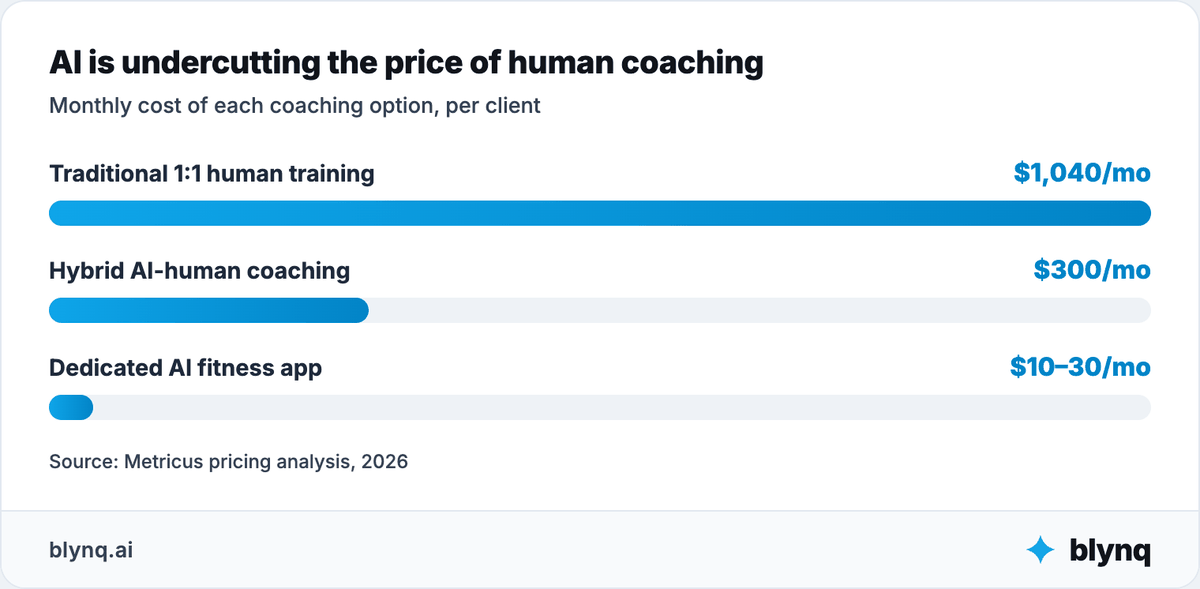
Industry pricing research from Metricus documents that ladder, and it is not a hypothetical threat.
The business question is not only whether AI can follow up.
The real questions are which prospects are worth your time and what they are actually paying for.
How do you keep sessions, programs and check-ins moving?
You keep delivery moving by giving Client Experience the communication itself, then using specialized tools for programming and tracking.
Weekly delivery combines programming, scheduling, check-ins, progress data and the occasional client who quietly disengages.
A Client Experience Agent can review recent messages, spot a pattern of missed check-ins and flag who needs outreach now.
Specialized tools can draft this week's program, log macros from a photo, or track progress across sessions.
The programming time savings are real and independently corroborated.
Trainerize data shows manual program creation runs 45 to 60 minutes, against 20 to 25 minutes with AI assistance.
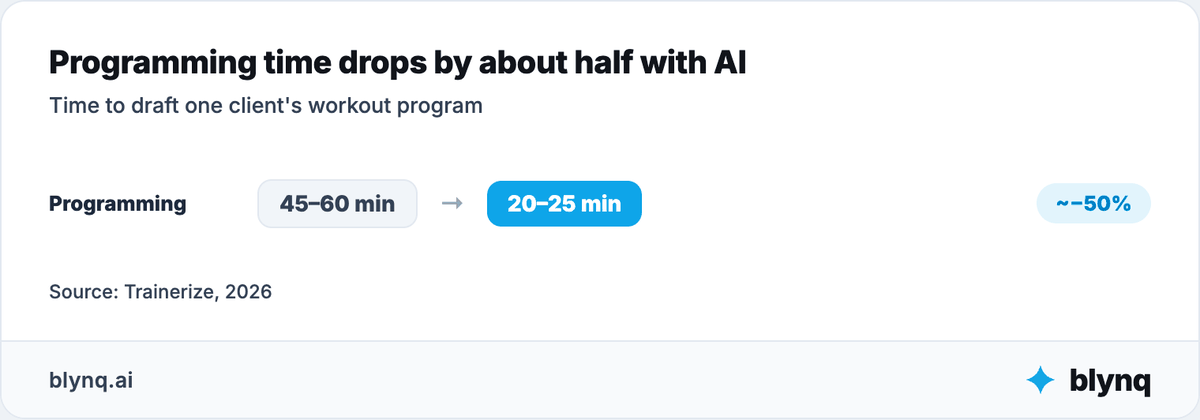
That is roughly half the time on the single most time-consuming recurring deliverable in the business.
Client Experience uses the same context to draft check-ins and catch what a busy week would miss.
AI should help you notice and prepare. It should not impersonate the relationship or make coaching feel automated.
One trainer drew that line plainly after seeing a competitor's fully automated approach.
"Imagine being so bad at your job you outsource having to answer client questions to AI. It's 'personal training'. Not 'AI responses to your questions because I'm too lazy to answer'."
Reddit user Athletic_adv wrote that in r/personaltraining. Reddit thread on automating client questions
The human still owns programming judgment, injury-relevant adjustments, and every promise made about a client's progress.
How do you protect time, retention and pricing?
You protect the business by connecting churn risk to pricing to margin, which is Finance and Analytics work rather than programming work.
A full calendar does not automatically mean a healthy business. Free-tier competition, no-shows, and underpriced packages can hollow out a busy-looking roster.
Finance and Analytics can connect lead sources, consults, package tier, retention and margin per client.
Strategy and Productivity then connect those findings with capacity, niche and a realistic weekly focus.
The goal is not more content or more sessions squeezed in.
A reasoned choice about which clients, price tier and specialization deserve limited attention serves the business better.
What happens when you trace one problem across the whole business?
Tracing one income problem across the whole business usually finds a retention and pricing problem instead.
Consider an independent trainer with 15 recurring clients whose calendar stays full but income has flattened for 2 quarters.
The first instinct is to add more clients, so a fuller calendar produces more revenue.
Client Experience analysis shows 3 clients have quietly dropped to half their normal session frequency without saying why.
Analytics finds those same 3 sit on the oldest, lowest-priced package tier.
Finance shows that tier no longer covers the trainer's actual time once admin is counted.
Strategy recommends a retention conversation and a repriced tier before adding a single new client.
A check-in workflow still helps catch the next quiet client sooner. But adding volume first would have scaled the wrong problem.
The value comes from examining one problem through connected perspectives, before execution scales it.
Where do specialized personal training AI tools and agents fit?
Specialized personal training AI tools and agents fit where the bottleneck is narrow and execution-heavy.
That covers program generation, macro and photo-based food logging, pose-estimation form checks, and scheduling.
Business agents and agents built for one job do different work.
| Business Agent layer | Specialized execution layer |
|---|---|
| Diagnoses, plans and ranks across a role | Performs or owns a defined workflow |
| Uses broad business context | Uses workflow-specific or client-specific data |
| Connects questions across functions | Goes deeper inside one execution category |
| Example: determine why 3 clients quietly reduced sessions | Example: generate this week's workout program |
The market holds several kinds of product. ChatGPT, Claude and Gemini support general drafting and research.
Trainerize builds AI-generated workout programs at platform scale, with over 40% of its programs now AI-built.
Fitbod is a consumer app that writes adaptive programs directly for the end client, which makes it as much a competitor as a tool.
My PT Hub and Everfit handle client management, programming and messaging in one platform. PT Distinction focuses on habit tracking and accountability.
A clinical trial found an AI pose-estimation system reached 97.2% keypoint accuracy and matched a physiotherapist's assessment 95.8% of the time.
That is genuine clinical-grade motion tracking, verified in a peer-reviewed study, not a marketing claim. Peer-reviewed AI resistance training trial
These products are not interchangeable. A program builder does not decide whether your pricing tier is profitable.
A macro-logging app does not decide which clients need a retention conversation.
A pose-estimation tool checks form, but you decide what to do about what it flags.
Blynq sits on the business-management side. Its business roles work from shared context across Client Experience, Sales, Marketing, Finance, Analytics and Strategy.
The right setup often combines both: fitness-specific tools for execution, and a connected set of business agents for the thinking and the decisions.
Do you need one specialist or a connected AI back office?
You need one specialist when the problem stays inside one responsibility, and a connected AI back office when it crosses several.
Training business questions cross functions constantly:
Marketing to consults to packages to sessions to retention to margin to the next pricing decision.
A marketing recommendation may depend on which clients actually convert. A sales priority may depend on capacity.
A pricing decision may depend on retention data and the client mix behind it.
Use this rule:
| Situation | Likely starting point |
|---|---|
| One isolated output | Chatbot or tool |
| One repeatable workflow | Automation or specialized agent |
| One ongoing business responsibility | Broad agent role |
| A question crossing several business functions | AI team with shared context |
Why does business context change personal training AI recommendations?
Business context can change personal training AI recommendations completely, because the same question has opposite correct answers for different trainers.
Consider a common question: should I lower my prices to compete with fitness apps?
No responsible answer exists without your current retention rate, consult-to-package conversion, client mix, capacity, and what your specific clients are actually paying for.
One trainer needs more consults. Another needs better retention. A third already has more demand than sessions available.
Prompt-based work restarts from the same briefing every time: niche, certification, client list, packages, and recent results.
Context-aware AI starts from validated goals, constraints, decisions, actions, outcomes and lessons it already holds.
It should not remember everything indiscriminately. It should separate verified business knowledge from assumptions and retrieve only what the current decision needs.
Why do AI agents need one shared view of the business?
AI agents need one shared view because otherwise you are the integration point, manually carrying consult outcomes into pricing and retention risk into scheduling.
Several agents do not become a team because they sit in one menu.
Marketing may know what content converts. Sales may know which packages sell, and Finance may know margin per client.
If you connect them by hand every time, nothing has actually changed.
Independent trainers feel this fastest, because one person personally holds every role a bigger studio would split across staff.
A useful shared view holds niche, client segments, package tiers, capacity, retention definitions, financial goals, current priorities and past decisions.
Client health and progress data need stricter access, verified sources and clear retention rules than any of that.
Shared context does not replace your expertise. It makes Sales, Client Experience and Finance relevant to the same business.
Blynq is built around exactly that pattern. Its Sales, Client Experience and Finance agents read from one shared business profile, not three separate ones.
An AI team becomes an AIOS when agents, skills, knowledge, memory, tasks and workflows grow around that shared understanding.
The goal is not more AI. It is a training business that is easier to understand, decide for and run.
What do clients still need from a trainer when AI gets faster?
Clients still need a trainer for physical assessment, judgment under real constraints, and the relationship itself, even when AI writes a program in seconds.
AI does not make trainers irrelevant. It changes which parts of the job clients value.
A peer-reviewed comparison found GPT-4 and human coaches were statistically indistinguishable on program-design quality across personalization, effectiveness, safety and comprehensiveness.
That is a genuinely level result on paper programming.
That is exactly why the in-person parts matter more, not less. Peer-reviewed AI vs. human coaching study
Trainers themselves see where the line sits.
NASM data shows 92.1% of Millennial trainers rank mental health, stress management and emotional support as core to what they offer.
One trainer described the specific gap a general model cannot close.
"ChatGPT will nail it but most trainers won't. But users of chatGPT won't know to tell it that they have long femurs and a lateral hip shift before asking for a workout plan, trainers see that."
Reddit user MortifiedCucumber wrote that in r/personaltraining. Reddit thread on ChatGPT and exercise selection
When programming, tracking and first-draft communication get faster, clients still need someone who can:
- Assess movement and physical limitations a text prompt cannot see.
- Adjust a program in real time based on how a lift actually looks.
- Notice disengagement before a client says anything.
- Hold accountability across a relationship, not a single session.
- Recognize when a symptom needs a referral, not a workaround.
- Take responsibility for advice given in the room.
One path uses AI mainly to produce more content and undercut the going rate.
The other uses it to become better prepared and more present, while judgment and physical assessment stay human.
The second path strengthens your role. The value moves from writing the program toward reading the client in front of you.
Where does personal training AI still need human control?
Personal training AI still needs human control wherever injury, medical risk, nutrition therapy or professional liability are involved.
The closer AI gets to those, the stronger review should become.
| Area | AI can help with | Human owns |
|---|---|---|
| Client intake | Forms, goal-setting and scheduling | Physical assessment and medical clearance screening |
| Program design | First-draft programming and periodization structure | Exercise selection for injuries and physical limitations |
| Form and technique | Pose-estimation flags and general cues | Live correction and stopping an unsafe rep |
| Check-ins | Drafting messages and spotting disengagement patterns | The relationship and hard conversations |
| Nutrition guidance | General macro tracking and logging | Medical nutrition therapy, which stays with a dietitian |
| Client questions | Drafting answers for your review | What actually reaches the client, and when |
| Progress data | Compiling and visualizing trends | Interpreting a plateau or a red flag |
| Retention | Flagging accounts at risk of churn | The outreach and the relationship repair |
| Pricing | Organizing margin and package data | The rate you actually charge |
| Marketing content | Drafting posts and campaigns | Claims about outcomes and safety |
Nutrition sits closer to a hard line than programming does.
Advice crossing into medical nutrition therapy for a diagnosed condition is regulated in most US states as dietetics practice, not personal training.
A trainer offering general healthy-eating guidance is on solid ground.
Advising a client with diabetes on macros for their condition is a different category, AI-assisted or not.
Reselling unedited AI output as a paid coaching service carries its own ethical exposure. One trainer called it out directly after seeing the practice firsthand.
"It often will attribute random sets or make some odd choices. I also find it morally bankrupt for a PT to be selling a service and then just generating a program and using that."
Reddit user TriarchOuroboros wrote that in r/personaltraining. Reddit thread on reselling AI-generated programs
The consequences are not hypothetical.
One documented case ended with a gym issuing a client a partial refund, after a trainer used undisclosed AI for workouts and dietary guidance.
Disclosure and review are the difference between a legitimate tool and a liability. Reddit thread on an undisclosed-AI refund case
The correct fallback is usually simple: review every AI-generated program before it reaches a client, every time.
AI should have an escalation path, not an unlimited mandate.
How do you choose the right AI setup for a personal training business?
You choose the right AI setup for a training business by evaluating its operating model, not its label.
Ask 6 questions of anything you are considering:
- What responsibility or workflow does it help own?
- What can it analyze, recommend or execute?
- What business or client data can it access, and under what terms?
- Does it rely on verified source data or your own methodology?
- What must you review before it reaches a client?
- Does it integrate with the systems that matter, and show what it did?
Consider 3 legitimate approaches:
| Approach | Strengths | Trade-offs | Best fit |
|---|---|---|---|
| Custom build | Maximum control and a proprietary programming style | Technical ownership, maintenance and integration risk | Trainers with technical support and a distinctive method |
| Self-directed Claude or ChatGPT | Flexibility, strong drafting and per-client customization | You design the context, memory and review process | Advanced AI users who want control |
| Ready-made AI team or purpose-built SaaS | Faster setup, structured roles and continuity | More opinionated and limited to supported capabilities | Trainers who want structure without building it |
Trainerize data shows over 70% of trainers report AI improved their working efficiency, with about a third calling the impact highly significant.
That is a broad-based gain, not a niche benefit for a technical minority.
Before committing, verify the system actually reads from and writes to what you need.
That means your scheduling platform, payment processor, client management system and any wearables your clients use.
Check permissions, activity logs and failure handling. Ask specifically whether client data trains the vendor's models.
Do not assume "works with" means "integrates with." If you constantly re-brief the system and copy data between apps, the AI is adding administrative work.
How do you put AI to work in your personal training business in 30 days?
Put AI to work in 30 days by picking 1 measurable goal and diagnosing the bottleneck behind it.
Run the agent alongside your current process, then expand only where it earned the expansion.
Start with the goal, not the tool.
Week 1: Diagnose
Choose a goal and a bottleneck. Do not start with a product.
Common candidates: consult-to-package conversion, client retention, or hours spent on programming and admin.
Define the 1 metric that would show improvement.
Exit criterion: a named metric and a current baseline number, written down.
Week 2: Build context
Give the system what judgment requires: your niche, client segments, package tiers, capacity, pricing and previous decisions.
Decide what stays private or needs controlled access. Client health and progress data belong in that category by default.
Exit criterion: the agent answers a question about your business you did not have to re-explain.
Week 3: Run alongside the current process
Use the agent for analysis, planning or structured work while the existing process stays visible.
Review errors, missing context and recommendations that ignore how your clients actually train.
Exit criterion: a written list of what it got wrong and what context was missing.
Week 4: Evaluate and expand carefully
Measure the metric from Week 1. Record what the system learned and what still needs your judgment.
Add another skill or role only when it solves a real adjacent problem.
If the second role depends on knowledge from the first, prioritize shared context over another disconnected tool.
Exit criterion: a keep-or-drop decision supported by the baseline number.
Example setup for an independent trainer with 15 recurring clients
Suppose the goal is better retention without adding new clients.
| Setup layer | What to include |
|---|---|
| Business context | Niche, client segments, package tiers, capacity and retention definitions |
| Client Experience Agent | Review recent check-ins, flag disengagement patterns and draft outreach |
| Analytics Skill | Compare session frequency, package tier and churn risk by client |
| Specialized workflow | Draft weekly programs and log macros so admin time drops |
| Human boundary | You handle physical assessment, exercise adjustments and the relationship itself |
| Success measure | Fewer quiet drop-offs and higher session frequency after 30 days, without added admin time |
This is enough for a first setup. It needs no separate agents for programming, check-ins, tracking and retention.
Start with the responsibility, add the skills and workflow it needs, and expand only when a problem genuinely crosses into a new role.
What to do now
Pick 1 business result that needs to change this quarter, and write down the number that measures it today.
Diagnose what is actually blocking it, using the 8-step sequence above. The bottleneck is rarely where the first instinct points.
Decide what stays human: physical assessment, exercise adjustments, nutrition therapy limits and the relationship itself. Then choose the setup that fits what remains.
AI agents help most when they own a real responsibility, use several skills and understand the business behind the task.
The future is not a separate bot for every action. Expect fewer capable agents, specialized execution where it earns its place, and shared context underneath.
The point is not to add more AI. It is to make the training business easier to understand, decide for and run.