









What are AI agents for consultants?
An AI agent for consultants is software that owns an area of the practice, not a single task.
Research tools like AlphaSense own market and competitor research. Business platforms like Blynq help interpret the business context behind them.
Both keep that area's context between uses, unlike a chat window. Neither writes the proposal, so the pitch stays yours.
Learn how to run your business with an AI teamWhich AI agents can help run a consulting practice?
The AI agents that help run a consulting practice are 8 business roles: Sales, Marketing, Operations, Client Experience, Finance, Analytics, Strategy and Productivity.
The useful starting point is not a separate agent per proposal, deliverable or client.
A small set of agents works better, each owning a meaningful part of the practice.
Independent consultants have moved fast on adoption.
MBO Partners puts overall independent-worker AI use at 79%, ahead of typical small-business adoption. MBO Partners 2025 AI Report
| AI Agent | What it can help a consultant do | Most useful when |
|---|---|---|
| Sales Agent | Qualify inquiries, scope engagements, prep proposals and follow up after a discovery call | Inquiries arrive but conversion to signed engagements is inconsistent |
| Marketing Agent | Clarify positioning, plan content and connect thought leadership to signed clients | Content activity is high but its business value is unclear |
| Operations Agent | Review delivery process, deliverable pipeline, deadlines and analyst-hour capacity | Deliverables slip when two engagements overlap |
| Client Experience Agent | Improve client updates, organize feedback and flag relationships needing attention | Clients only hear from you at milestones |
| Finance Agent | Review realization, utilization, engagement economics and pricing scenarios | Billable hours look full but margin is unclear |
| Analytics Agent | Connect lead sources, proposals, signed engagements and profit | Data exists across systems but does not explain performance |
| Strategy Agent | Compare niches, client segments, pricing models and growth options | The practice has more possible directions than it should pursue |
| Productivity Agent | Turn active engagements, deadlines and business-development work into a realistic weekly focus | Everything feels urgent |
These 8 support the practice side. Consultants also use specialized agents and tools for narrow execution.
Common examples include secondary research, deck drafting, transcription, financial modeling and RFP response.
The distinction matters. A Sales Agent can diagnose why proposals are not converting.
A research tool pulls the market data behind one deliverable. One supports the decision; the other executes a defined workflow.
What counts as an AI agent in consulting?
An AI agent in consulting is software that holds an ongoing responsibility. A chatbot answers one question; a tool finishes one job.
The terms get confusing quickly. Here is the simplest way to tell the 4 shapes apart.
| Chatbot | AI Tool | AI Agent | AI Team | |
|---|---|---|---|---|
| What it does | Answers a question | Completes a specific job | Helps own an ongoing responsibility | Helps across several parts of the practice |
| What you do | Ask each question | Open or trigger it when needed | Give it a goal or responsibility | Give the team access to shared practice context |
| What it knows | Usually the conversation or limited product memory | Information needed for its job | Context relevant to its role | Context shared across different specialists |
| Consultant example | "Summarize this client interview transcript" | Turn secondary research into a slide | Own Sales priorities and proposal follow-up | Sales, Operations and Finance work from the same practice understanding |
So stop asking whether something is technically an agent. Ask 3 better questions instead.
What will it take responsibility for? What information will it use? What will you still have to review?
How can AI help you run a consulting practice?
AI helps run a consulting practice by removing repetitive research, slow first drafts, scattered client feedback and the guesswork connecting utilization to margin.
Find your problem in the left column before shopping for anything.
| Recurring problem | What AI can help remove | Best-fit agent or AI setup | When to prioritize it |
|---|---|---|---|
| Proposals take too long to write | Drafting scope, timeline and pricing from a discovery call | Sales Agent + proposal tool | When RFPs arrive faster than you can respond |
| Secondary research eats analyst hours | First-pass market and competitor research | Specialized research tool | When every engagement starts with the same desk research |
| Deliverable drafting is slow | Turning raw findings into a first-draft deck | Operations Agent + deck tool | When formatting consumes more time than analysis |
| Client updates are inconsistent | Preparing clear status and organizing recurring questions | Client Experience Agent | When clients only hear from you at milestones |
| Utilization is unclear | Connecting billable hours, bench time and pipeline | Operations Agent + Analytics Agent | Before accepting the next engagement |
| Pricing is disconnected from delivered value | Connecting scope, hours and realized margin | Finance Agent + Analytics Agent | When billable hours look full but margin is thin |
| Past clients disappear | Remembering whom to follow up with and why | Client Experience Agent + Sales Agent | When referrals and repeat engagements matter |
| NDA-bound work needs a separate workflow | Tracking what can and cannot touch a public model | Operations Agent | When one engagement bans LLM use and another does not |
| Marketing content takes too long | Turning expertise into thought leadership across channels | Marketing Agent + content tool | When visibility is low but expertise is deep |
| Capacity is unclear | Connecting active engagements, deadlines and analyst-hour load | Operations Agent + Productivity Agent | Before taking on the next client |
| Priorities are unclear | Connecting goals, pipeline, commitments and constraints | Strategy Agent + Productivity Agent | When everything feels urgent |
Deliverable drafting sits high on that list for a reason.
MIT research cited via Consultport found a 44% reduction in professional writing and reporting time when AI assists the draft.
That is the single largest time-compression category available to a solo consultant, ahead of research or scheduling.
This is a map, not a shopping list. Some problems need a tool. Others need a skill inside a business role.
Others still need a specialized agent that owns a workflow, or several agents working from shared context.
Diagnose the bottleneck before choosing the system.
How should a consultant choose what to give an AI agent first?
A consultant should choose the first AI agent from the bottleneck blocking a named result, not from the most impressive demo.
Suppose you want more signed engagements. "Automate the proposals" sounds like the obvious answer.
But weak conversion has at least 7 possible causes:
- Too few qualified inquiries.
- Slow response after a discovery call.
- Proposals that do not match what the client actually asked for.
- Weak follow-up after the proposal goes out.
- Pricing that does not match the value delivered.
- More active engagements than you can serve well.
- A niche broad enough that every proposal starts from zero.
Faster proposals would make several of these worse, not better.
This is not a hypothetical risk.
A field experiment on 758 consultants found AI-augmented work was 19 points less accurate on tasks outside AI's current capability.
Consultants still finished faster and rated their own output higher.
The researchers call this the "jagged frontier." AI helps enormously inside it and quietly misleads outside it. HBS/BCG field experiment on AI-augmented consulting
The same study found AI acts as a skill equalizer on tasks inside the frontier.
Lower-baseline performers gained 43% in quality, against 17% for higher-baseline performers.
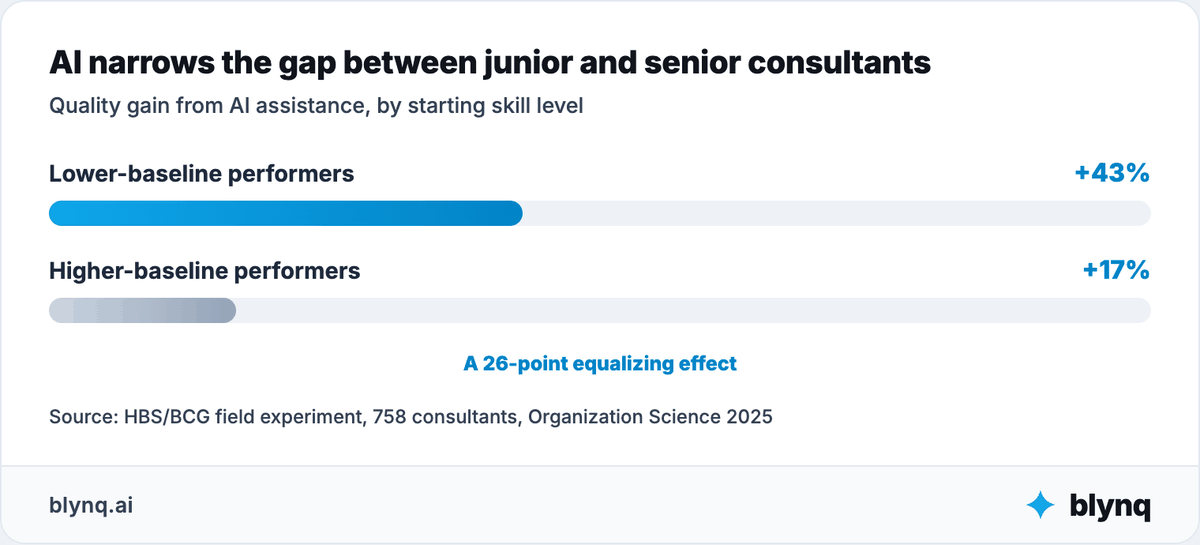
Knowing which side of that line a task sits on matters more than which model you use.
Work this sequence before choosing an agent or tool:
| Step | Consultant question |
|---|---|
| Goal | What business result needs to change? |
| Bottleneck | What is preventing that result today? |
| Responsibility | Which area owns the problem? |
| Capability | What must AI analyze, recommend or execute? |
| Context | What must it know to give a useful answer? |
| Constraints | What limits budget, time, capacity or risk? |
| Human boundary | What judgment stays human? |
| Architecture | Is the right fit general AI, a broad agent, a specialized system or an AI team? |
Do not design the practice around what AI can do. Design the AI around what the practice needs to achieve.
How do roles, skills and tasks show up in consulting?
Roles are the practice area an agent owns, skills are what it can do inside that area, and tasks are the work happening right now.
These terms get used interchangeably. Keeping them apart stops you buying a separate system for every small job.
| Concept | Definition | Consultant example |
|---|---|---|
| Agent | AI entity holding ongoing responsibility | Sales Agent |
| Role | Business domain the agent owns | Sales |
| Skill | Capability used inside the role | Proposal drafting |
| Task | Specific work being done now | Draft this week's RFP response |
| AI Tool | Product for a particular job | Secondary-research tool |
| Automation | Predefined workflow | Send a follow-up when a proposal goes unanswered for 5 days |
| Specialized Agent | System owning a narrow ongoing workflow | Transcript-to-deliverable drafting |
| AI Team | Several agents sharing practice context | Sales, Operations and Finance using the same practice knowledge |
| AIOS | Operating layer connecting agents, skills, memory, knowledge, tasks and workflows | Shared AI operating environment for the practice |
The core idea is simple. Agents are roles. Skills are capabilities. Tasks are the work being done.
Automation alone does not make something an agent. Neither does an "agent" label on a product page.
Does every consulting task need its own AI agent?
No. Most consulting tasks are skills inside a role you already have, not grounds for buying another agent.
The taxonomy matters because it stops an AI stack becoming a new kind of software clutter.
Summarizing one client interview is not a Transcription Agent. It is a task using a research skill inside delivery.
Turning a findings doc into slides this week is not a Deck Agent. It is a task using Operations and Marketing skills.
A system that drafts every first-pass deliverable, tracks review status and escalates anything off-template is different.
That may qualify as a specialized agent, because it owns a narrow but ongoing workflow.
One boutique-firm founder described exactly this shift, from linear drafting to parallel option-generation.
"Before AI: Research, draft, edit, refine, repeat. With AI: define the problem, let AI generate options, curate and refine, final pass."
Reddit user Famous-Call6538 wrote that in r/consulting, a forum where consultants discuss practice and tooling.
They run a boutique AI advisory firm as principal consultant. Reddit thread on daily AI usage in consulting
The shift is in the shape of the work, not just the time saved.
The difference is responsibility, not branding.
How can AI support the practice behind the engagements?
AI supports the practice behind the engagements in 3 connected places: winning the right work, delivering it well, and protecting the economics underneath.
How do you turn expertise into signed engagements?
You turn expertise into signed engagements by deciding which activity produces proposals, then letting a Marketing Agent and a Sales Agent work on that answer.
A Marketing Agent can clarify positioning, decide which niche and content deserve attention, and turn expertise into thought leadership across channels.
The hard question is not how many articles AI can produce. It is which visibility actually creates a discovery call.
A Sales Agent works deeper than a template proposal. It reviews the pipeline, compares inquiry sources and finds where scoping conversations stall.
It can diagnose where inquiry-to-proposal conversion breaks. A specialized workflow then drafts the scope, timeline and pricing for your review.
Solo consultants are already the norm here, not the exception.
The independent-consultant workforce runs to 27.7 million people, growing 6.5% a year.
Boutique-firm revenue is growing 38% faster than traditional consultancies. The rise of boutique consulting firms
The business question is not only whether AI can draft a proposal.
The real questions are which inquiries matter, why conversion stalls, and what the client relationship can carry.
How do you keep deliverables and clients moving?
You keep delivery moving by giving an Operations Agent the process itself, then using specialized tools for research, drafting and formatting.
Delivery work combines client interviews, secondary research, financial models, slide decks, review cycles and deadlines across several engagements at once.
An Operations Agent can analyze that process, find where deliverables slip and clarify what needs attention now.
Specialized tools can pull market research, draft a first-pass deck, or transcribe and summarize a client interview.
Analyst-hour compression is well documented at the mechanical level.
One senior analytics consultant described data cleaning and first-draft model structures moving from 2 to 3 hours down to minutes.
"the model does not know client context so you still bring that, but the raw throughput on structured tasks is real."
Reddit user AttitudeGlass64 wrote that in r/consulting. Reddit thread on AI workflows in consulting
Client context is exactly the part that stays with you. The mechanical work is what compresses.
Client Experience uses the same context to prepare clearer updates and surface the questions clients keep asking.
AI should help you remember and prepare. It should not impersonate attention or make the relationship feel automated.
The human still owns the recommendation, the judgment behind it and every promise made to a client.
How do you protect utilization, pricing and future pipeline?
You protect margin by connecting scope to hours to realized value, which is Finance and Analytics work rather than delivery work.
More signed engagements do not automatically mean a better practice. Underpriced scope, tool costs and unbilled review time can hollow out a busy-looking practice.
The market is already repricing around this.
Upwork's Future Workforce Index found high-complexity AI-augmented advisory work grew 72% in contract volume, with earnings up 22% to 45%.
Low-complexity execution work grew in volume too, but per-contract earnings fell 13%, and total task earnings fell 28%. Upwork Future Workforce Index 2026
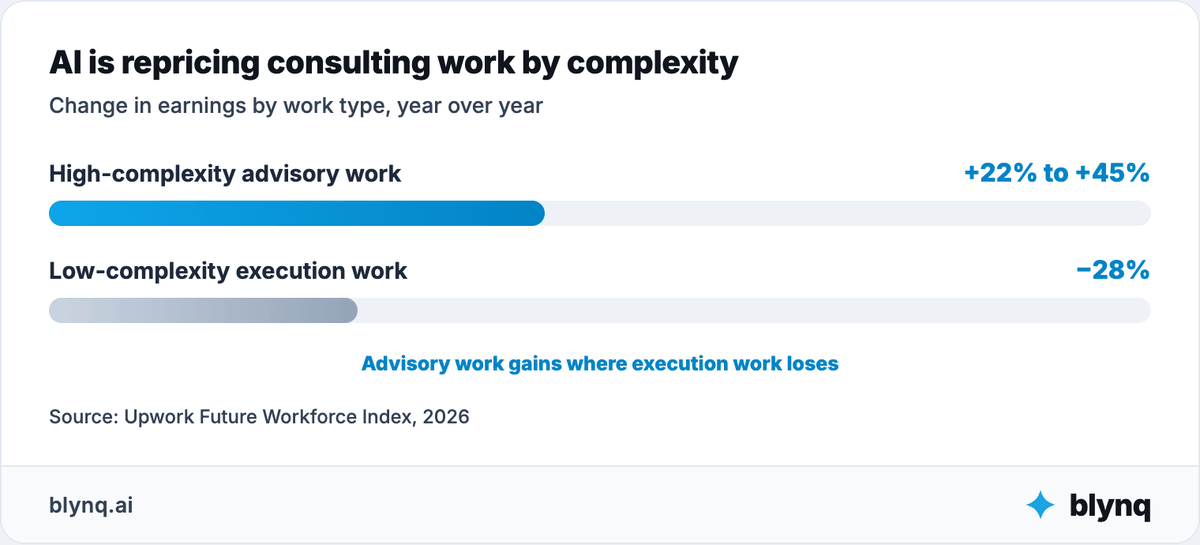
Selling judgment and workflow design commands a growing premium. Selling raw output does not.
Finance and Analytics can connect engagement type, hours delivered, realized fee and cost.
Strategy and Productivity then connect those findings with capacity, niche and a realistic weekly focus.
The goal is not more possible actions. It is a reasoned choice about which niche, client segment and pricing model deserve limited attention.
What happens when you trace one problem across the whole practice?
Tracing one proposal-volume problem across the whole practice usually finds a positioning, pricing and capacity problem instead.
Consider a solo consultant whose RFP response rate has climbed but conversion has flattened. The instinct is to draft even more proposals, faster.
Sales analysis shows conversion stalls at the pricing conversation, not at the draft.
Analytics finds most inquiries come from a channel that produces broad, underscoped requests.
Finance shows the fixed-fee floor sits below what similar engagements actually cost to deliver well.
Operations reveals two active engagements already consume most available analyst-hour capacity.
Strategy recommends narrowing the niche and repricing before chasing more inquiries.
A proposal-drafting tool still helps, and it addresses a real friction point. But automating every response first would have accelerated the wrong system.
The value comes from examining one problem through connected perspectives, before execution scales it.
Where do specialized consulting AI tools and agents fit?
Specialized consulting AI tools and agents fit where the bottleneck is narrow and execution-heavy.
That covers secondary research, deck drafting, transcription, financial modeling and RFP response.
Business agents and agents built for one job do different work.
| Business Agent layer | Specialized execution layer |
|---|---|
| Diagnoses, plans and ranks across a role | Performs or owns a defined workflow |
| Uses broad practice context | Uses engagement-specific or deliverable-specific data |
| Connects questions across functions | Goes deeper inside one execution category |
| Example: determine why proposal conversion is falling | Example: draft the first-pass market research for one deliverable |
The market holds several kinds of product.
Claude, ChatGPT and Gemini support general research, writing and analysis. One MBB-adjacent practitioner put Claude's share of wallet at their firm above 90%.
AlphaSense focuses on market and financial research. ThinkCell builds presentation charts inside PowerPoint.
Gamma drafts full decks from a prompt. NotebookLM summarizes and cross-references a set of source documents.
These are not interchangeable. A research tool does not decide whether your fixed-fee floor covers the work.
A deck tool does not decide which niche to pursue.
A research assistant executes a query, but you define the scope, the sources that count and the interpretation.
Solo practitioners are already closing the tooling gap with larger firms.
One case study describes solo architecture consultants compressing a 3-week RFP response cycle into 72 hours using white-label AI. Compressing RFP response cycles with AI
Treat that specific figure as one vendor's case study rather than an industry norm.
The direction is real: proposal speed is no longer an enterprise-firm advantage.
Blynq sits on the practice-management side. Its business roles work from shared context across Sales, Marketing, Operations, Finance, Analytics and Strategy.
The right setup often combines both: research and drafting tools for execution, and a connected set of business agents for the thinking and the decisions.
Do you need one specialist or a connected AI back office?
You need one specialist when the problem stays inside one responsibility, and a connected AI back office when it crosses several.
Practice questions cross functions constantly:
Marketing to inquiries to proposals to signed engagements to delivery to realized fee to profit to the next positioning decision.
A marketing recommendation may depend on which inquiries actually convert. A delivery priority may depend on capacity.
A pricing decision may depend on which engagements are actually profitable once analyst hours are counted.
Use this rule:
| Situation | Likely starting point |
|---|---|
| One isolated output | Chatbot or tool |
| One repeatable workflow | Automation or specialized agent |
| One ongoing business responsibility | Broad agent role |
| A question crossing several business functions | AI team with shared context |
Why does practice context change consulting AI recommendations?
Practice context can change consulting AI recommendations completely, because the same question has opposite correct answers for different practices.
Consider a common question: should I raise my rates?
No responsible answer exists without current utilization, realization by engagement type and pipeline strength.
Niche positioning, competitor rates and how much AI genuinely compresses the work matter just as much.
One consultant needs more volume. Another needs better positioning. A third already has more demand than the practice can serve well.
Prompt-based work restarts from the same briefing every time: niche, ideal client, positioning, active engagements, pricing model and recent results.
Context-aware AI starts from validated goals, constraints, decisions, actions, outcomes and lessons it already holds.
It should not remember everything indiscriminately. It should separate verified practice knowledge from assumptions and retrieve only what the current decision needs.
Why do AI agents need one shared view of the practice?
AI agents need one shared view because otherwise you are the integration point, manually carrying pipeline signal into pricing and capacity into the next proposal.
Several agents do not become a team because they sit in one menu.
If Sales knows which inquiries convert, Operations knows delivery capacity and Finance knows realized margin, but you connect them by hand, nothing has changed.
Governance gaps make this more urgent for consultants than for most small businesses.
Business.com found 77% of AI-using small businesses have no formal written AI policy.
The top-cited adoption barriers are data security, time and unclear ROI, in that order.
For a practice handling client NDAs, an unwritten policy is not a minor gap. Small business AI adoption barriers
A useful shared view holds niche, ideal client, pipeline definitions, capacity, pricing model, current priorities and past decisions.
Client and engagement data needs stricter access, verified sources and clear retention rules, especially anything under an NDA.
Shared context does not replace expertise. It makes Sales, Operations, Finance and Marketing relevant to the same practice.
Blynq is built around exactly that pattern. Its Sales, Operations, Finance and Marketing agents read from one shared practice profile, not four separate ones.
An AI team becomes an AIOS when agents, skills, knowledge, memory, tasks and workflows grow around that shared understanding.
The goal is not more AI. It is a practice that is easier to understand, decide for and run.
What do clients still need from a consultant when AI gets faster?
Clients still need a consultant for client-context judgment, recommendation, negotiation and accountability, even when AI gets faster.
AI does not make consultants irrelevant. It changes which parts of the work clients value.
The gap is measurable and it runs both directions.
The same 758-consultant field experiment found a 19-point accuracy drop on complex managerial tasks outside AI's current capability.
Consultants still finished faster and rated their own output higher.
Confidence and correctness diverged, which is precisely the risk a client is paying you to manage. HBS/BCG field experiment on AI-augmented consulting
When research, drafting and formatting get faster, clients still need someone who can:
- Bring the client context AI does not have.
- Recognize when a problem sits outside AI's current capability.
- Take a position and defend it under pushback.
- Negotiate scope, timeline and price.
- Coordinate stakeholders, sponsors and other advisors.
- Take responsibility for the recommendation and what happens next.
One path uses AI mainly to produce more content and pitch more prospects.
The other uses it to arrive more prepared and sharper on judgment, while the recommendation itself stays yours.
The second path strengthens your position. The value moves from producing analysis toward interpreting it and owning the call.
Where does consulting AI still need human control?
Consulting AI still needs human control wherever client confidentiality, a strategic recommendation or professional reputation is involved.
The closer AI gets to those, the stronger review should become.
| Area | AI can help with | Human owns |
|---|---|---|
| Inquiry intake | Basic questions, capture and routing | Scoping judgment and sensitive questions |
| Proposals | Drafting scope, timeline and pricing | Final terms and the client conversation |
| Secondary research | First-pass market and competitor data | Source quality and what it means for this client |
| Deliverables | Drafting structure and first-pass content | Client-context judgment and final review |
| Financial models | Building structure and formulas | Assumptions and what they justify |
| Client updates | Drafting and organizing recurring questions | Relationship judgment and tone |
| NDA-bound work | Nothing that touches client-identifying data | What can and cannot enter a public model |
| Recommendations | Structuring options and trade-offs | The recommendation and the risk you own |
| Presentations | Formatting and first-draft slides | The narrative and what the client is meant to conclude |
| Billing and margin | Organizing inputs and scenarios | Pricing decisions and what to charge |
NDA-bound engagements need an explicit policy, not an assumption. One senior consultant described a hard line at zero.
"Most of my engagements have had explicit requirements that client data not be fed into a LLM."
Reddit user Yetanotherdeafguy, a senior management consultant in independent practice, wrote that in r/consulting. Reddit thread on daily AI usage in consulting
Decide per engagement what counts as client-identifying data, and write the rule down before the work starts, not during it.
The correct fallback is usually simple: keep the client's data out of any tool you have not personally vetted.
AI should have a clear boundary, not an unlimited mandate.
How do you choose the right AI setup for a consulting practice?
You choose the right AI setup for a consulting practice by evaluating its operating model, not its label.
Ask 6 questions of anything you are considering:
- What responsibility or workflow does it help own?
- What can it analyze, recommend or execute?
- What practice or client data can it access, and under what terms?
- Does it rely on verified source data?
- What must you review before it reaches a client?
- Does it integrate with the systems that matter, and show what it did?
Consider 3 legitimate approaches:
| Approach | Strengths | Trade-offs | Best fit |
|---|---|---|---|
| Custom build | Maximum control and firm-specific workflows | Technical ownership, maintenance and integration risk | Practices with technical support and distinctive processes |
| Self-directed Claude or ChatGPT | Flexibility, strong analysis and per-engagement context | You design the context, memory and orchestration | Advanced AI users who want control |
| Ready-made AI team or purpose-built SaaS | Faster setup, structured roles and continuity | More opinionated and limited to supported capabilities | Consultants who want structure without building it |
Below roughly 150 people, most consultancies use direct API or SaaS subscriptions rather than self-hosted infrastructure. One cloud strategy consultant put the practical ceiling directly.
"smaller boutiques, under 150 people, Anthropic is too good to ignore. Above 150 people, self hosting some models, some cloud hosted frontier models, plus some internal fine tuned models."
Reddit user New-Cauliflower3844 wrote that in r/consulting. Reddit thread on AI tools in consulting
For a solo or small practice, that puts the build-versus-buy decision solidly on the buy side.
Before committing, verify the system actually reads from and writes to what you need: proposal tools, calendar, document storage, CRM and billing.
Check permissions, approvals, activity logs and failure handling. Ask specifically what happens to any document you upload.
Do not assume "works with" means "integrates with." If you constantly re-brief the system and copy data between tools, the AI is adding management work.
How do you put AI to work in your consulting practice in 30 days?
Put AI to work in 30 days by picking 1 measurable goal and diagnosing the bottleneck behind it.
Run the agent alongside your current process, then expand only where it earned the expansion.
Start with the goal, not the tool.
Week 1: Diagnose
Choose a goal and a bottleneck. Do not start with a product.
Common candidates: proposal-to-signed conversion, deliverable turnaround time, or unclear realization by engagement type.
Define the 1 metric that would show improvement.
Exit criterion: a named metric and a current baseline number, written down.
Week 2: Build context
Give the system what judgment requires: niche, ideal client, positioning, active engagements, pricing model and previous decisions.
Decide what stays private or needs controlled access. NDA-bound client data belongs in that category by default.
Exit criterion: the agent answers a question about your practice you did not have to re-explain.
Week 3: Run alongside the current process
Use the agent for analysis, planning or structured work while the existing process stays visible.
Review errors, missing context and recommendations that ignore how your clients actually operate.
Exit criterion: a written list of what it got wrong and what context was missing.
Week 4: Evaluate and expand carefully
Measure the metric from Week 1. Record what the system learned and what still needs your review.
Add another skill or role only when it solves a real adjacent problem.
If the second role depends on knowledge from the first, prioritize shared context over another disconnected tool.
Exit criterion: a keep-or-drop decision supported by the baseline number.
Example setup for an independent consultant
Suppose the goal is faster proposal turnaround without weakening scoping quality.
| Setup layer | What to include |
|---|---|
| Business context | Niche, ideal client, engagement types, pricing model, capacity and pipeline definitions |
| Sales Agent | Review the pipeline, identify where proposals stall and recommend follow-up priorities |
| Analytics Skill | Compare response time, proposal-to-signed rate and realization by engagement type |
| Specialized workflow | Draft the scope, timeline and pricing section from discovery-call notes |
| Human boundary | You handle client-context judgment, the recommendation and final terms |
| Success measure | Faster proposal turnaround and steady conversion rate after 30 days, without weaker scoping |
This is enough for a first setup. It needs no separate agents for research, drafting, proposals and follow-up.
Start with the responsibility, add the skills and workflow it needs, and expand only when a problem genuinely crosses into a new role.
What to do now
Pick 1 practice result that needs to change this quarter, and write down the number that measures it today.
Diagnose what is actually blocking it, using the 8-step sequence above. The bottleneck is rarely where the first instinct points.
Write down which tasks sit inside AI's current capability and which sit outside it.
That line, not the tool, decides where review has to be strict.
Decide what stays human: client-context judgment, the recommendation, negotiation and anything under an NDA. Then choose the setup that fits what remains.
AI agents help most when they own a real responsibility, use several skills and understand the practice behind the task.
The future is not a separate bot for every action. Expect fewer capable agents, specialized execution where it earns its place, and shared context underneath.
The point is not to add more AI. It is to make the practice easier to understand, decide for and run.