









What are AI agents for coaches?
An AI agent for coaches is software that owns an area of the practice, not a single task.
Note-taking tools like Fathom own the session record. Business platforms like Blynq help interpret the practice behind it.
Both keep that area's context between uses, unlike a chat window. Neither holds the coaching relationship, so that stays yours.
Learn how to run your business with an AI teamWhich AI agents can help run a coaching practice?
The AI agents that help run a coaching practice are 8 business roles: Sales, Marketing, Operations, Client Experience, Finance, Analytics, Strategy and Productivity.
The useful starting point is not a separate agent per client, session or program.
A small set of agents works better, each owning a meaningful part of the practice.
| AI Agent | What it can help a coach do | Most useful when |
|---|---|---|
| Sales Agent | Qualify enquiries, prepare discovery calls, scope packages and follow up on proposals | Discovery calls happen but few convert to paid engagements |
| Marketing Agent | Clarify who the practice serves, plan content and explain the offer in plain language | Content goes out constantly and none of it produces enquiries |
| Operations Agent | Review intake, session cadence, recurring admin and capacity | Admin between sessions eats the time you meant to sell |
| Client Experience Agent | Prepare session recaps, track commitments and flag clients going quiet | Clients drift between sessions and progress stalls |
| Finance Agent | Review package pricing, effective hourly rate and revenue mix | The calendar is full but income has plateaued |
| Analytics Agent | Connect enquiry source, conversion, retention and revenue per client | You cannot say which clients or channels are worth repeating |
| Strategy Agent | Compare niches, group versus 1:1, and productized offers | 1:1 hours are capped and growth needs a different shape |
| Productivity Agent | Turn sessions, prep, follow-up and business development into a realistic week | Everything competes with client delivery |
These 8 support the practice side. Coaches also use specialized agents and tools for narrow execution.
Common examples include session transcription, recap drafting, scheduling, intake forms and content repurposing.
The distinction matters. A Sales Agent can diagnose why discovery calls stop converting.
A transcription tool captures the session itself. One supports the decision; the other runs a defined workflow.
What counts as an AI agent in coaching?
An AI agent in coaching is software that holds an ongoing responsibility. A chatbot answers one question; a tool finishes one job.
The terms get confusing quickly. Here is the simplest way to tell the 4 shapes apart.
| Chatbot | AI Tool | AI Agent | AI Team | |
|---|---|---|---|---|
| What it does | Answers a question | Completes a specific job | Helps own an ongoing responsibility | Helps across several parts of the practice |
| What you do | Ask each question | Open or trigger it when needed | Give it a goal or responsibility | Give the team access to shared practice context |
| What it knows | Usually the conversation or limited product memory | Information needed for its job | Context relevant to its role | Context shared across different specialists |
| Coach example | "Reframe this limiting belief for a client" | Transcribe a session into notes | Own enquiry-to-signed-client conversion | Sales, Finance and Operations work from the same practice understanding |
So stop asking whether something is technically an agent. Ask 3 better questions instead.
What will it take responsibility for? What information will it use? What will you still have to review?
How can AI help you run a coaching practice?
AI helps run a coaching practice by removing session admin, recap writing, intake chasing and the guesswork connecting enquiries to revenue.
Find your problem in the left column before shopping for anything.
| Recurring problem | What AI can help remove | Best-fit agent or AI setup | When to prioritize it |
|---|---|---|---|
| Session notes eat the evening | Transcription, recap drafting and commitment tracking | Operations Agent + transcription tool | When admin runs longer than the session itself |
| Clients drift between sessions | Prompts, check-ins and progress recall | Client Experience Agent | When momentum dies between appointments |
| Intake forms arrive late | Chasing, reminders and completeness checks | Operations Agent + intake workflow | When first sessions start without context |
| Discovery calls do not convert | Call prep, objection patterns and follow-up | Sales Agent | When enquiries are healthy but signings are not |
| Content produces no enquiries | Connecting topics, audience and offer | Marketing Agent + Analytics Skill | When posting is constant and pipeline is flat |
| Proposals stall after the call | Scoping, drafting and structured follow-up | Sales Agent + proposal workflow | When prospects go quiet after a good conversation |
| Program materials get rebuilt each time | Turning past sessions into reusable resources | Marketing Agent + content tool | When every client gets bespoke work that could be shared |
| Pricing feels arbitrary | Connecting package, hours delivered and effective rate | Finance Agent + Analytics Agent | When the calendar is full and income is flat |
| Capacity is unclear | Connecting sessions, prep, follow-up and business development | Operations Agent + Productivity Agent | Before opening more 1:1 slots |
| Referrals are unpredictable | Connecting source, conversion, retention and revenue | Marketing, Sales, Finance and Analytics | When growth depends on word of mouth alone |
| Priorities are unclear | Connecting goals, commitments and constraints | Strategy Agent + Productivity Agent | When client delivery crowds out everything else |
Admin is where most coaches start, and the evidence behind that is a workflow rather than a survey.
A career coach on Reddit described running sessions through Fathom, then routing transcripts into NotebookLM to pull per-client notes back out later.
That is one coach's documented practice, not a measured adoption rate. Treat it as a pattern worth copying, not a benchmark.
This is a map, not a shopping list. Some problems need a tool. Others need a skill inside a business role.
Others still need a specialized agent that owns a workflow, or several agents working from shared context.
Diagnose the bottleneck before choosing the system.
How should a coach choose what to give an AI agent first?
A coach should choose the first AI agent from the bottleneck blocking a named result, not from the most impressive demo.
Suppose you want more signed clients. "Automate the content" sounds like the obvious answer.
But flat signings have at least 6 possible causes:
- Too few qualified enquiries reaching a discovery call.
- Discovery calls that do not surface the real problem.
- No clear offer for the person on the call to say yes to.
- Weak follow-up after the conversation.
- Pricing that does not match the outcome promised.
- More 1:1 hours committed than the week can hold.
Automating the content would make several of these worse, not better.
Publishing more also carries its own risk. A leadership coach who uses AI daily put the failure mode plainly.
"Those who rely solely on AI to think and write will get a nasty shock too. And those who don't copy and paste straight from AI will stand out as individuals who ca..."
Reddit user No_Researcher_1631 wrote that in r/Coaching, a forum where working coaches compare practice notes. Reddit thread on building presence and leads
Volume is not the constraint. Judgment visible in the writing is what converts a reader into an enquiry.
Work this sequence before choosing an agent or tool:
| Step | Coach question |
|---|---|
| Goal | What practice result needs to change? |
| Bottleneck | What is preventing that result today? |
| Responsibility | Which area owns the problem? |
| Capability | What must AI analyze, recommend or execute? |
| Context | What must it know to give a useful answer? |
| Constraints | What limits budget, time, capacity or risk? |
| Human boundary | What stays in the coaching relationship? |
| Architecture | Is the right fit general AI, a broad agent, a specialized system or an AI team? |
Do not design the practice around what AI can do. Design the AI around what the practice needs to achieve.
Newly launched practices start from a different place.
JPMorgan Chase Institute found the 2025 business-formation cohort reached 10% AI adoption within 6 months, versus over 6 years for the 2019 cohort.
If you started coaching recently, AI is default infrastructure rather than an upgrade decision.
How do roles, skills and tasks show up in coaching?
Roles are the practice area an agent owns, skills are what it can do inside that area, and tasks are the work happening right now.
These terms get used interchangeably. Keeping them apart stops you buying a separate system for every small job.
| Concept | Definition | Coach example |
|---|---|---|
| Agent | AI entity holding ongoing responsibility | Sales Agent |
| Role | Business domain the agent owns | Sales |
| Skill | Capability used inside the role | Discovery call review |
| Task | Specific work being done now | Find why 4 discovery calls did not convert |
| AI Tool | Product for a particular job | Session transcription tool |
| Automation | Predefined workflow | Send the intake form when a call is booked |
| Specialized Agent | System owning a narrow ongoing workflow | Session recap drafting across every client |
| AI Team | Several agents sharing practice context | Sales, Finance and Operations using the same practice knowledge |
| AIOS | Operating layer connecting agents, skills, memory, knowledge, tasks and workflows | Shared AI operating environment for the practice |
The core idea is simple. Agents are roles. Skills are capabilities. Tasks are the work being done.
Automation alone does not make something an agent. Neither does an "agent" label on a product page.
Does every coaching task need its own AI agent?
No. Most coaching tasks are skills inside a role you already have, not grounds for buying another agent.
The taxonomy matters because it stops an AI stack becoming a new kind of software clutter.
Writing one LinkedIn post is not a Content Agent. It is a task using a writing skill inside Marketing.
Reviewing one client's progress before a session is not a Progress Agent. It is a task using a Client Experience skill.
A system that transcribes every session, drafts the recap, tracks commitments and flags clients who went quiet is different.
That may qualify as a specialized agent, because it owns a narrow but ongoing workflow.
The difference is responsibility, not branding.
How can AI support the practice behind the sessions?
AI supports the practice behind the sessions in 3 connected places: filling the pipeline, delivering the engagement, and protecting the economics underneath.
How do you turn enquiries into signed clients?
You turn enquiries into signed clients by finding where the discovery conversation breaks, which is Sales and Analytics work rather than content work.
A Marketing Agent can clarify who the practice serves and explain the offer in language the client would use themselves.
The hard question is not how much content AI can produce. It is which enquiries reach a call, and which calls end without a decision.
A Sales Agent works deeper than a follow-up template. It reviews enquiry sources, compares conversion by segment and finds where proposals stall.
It can prepare the discovery call from what the prospect already told you. A specialized workflow then handles scoping questions and follow-up.
The wider small-business picture supports the direction.
The U.S. Chamber of Commerce found 58% of small businesses now use generative AI, up from 40% in 2024 and 23% in 2023.
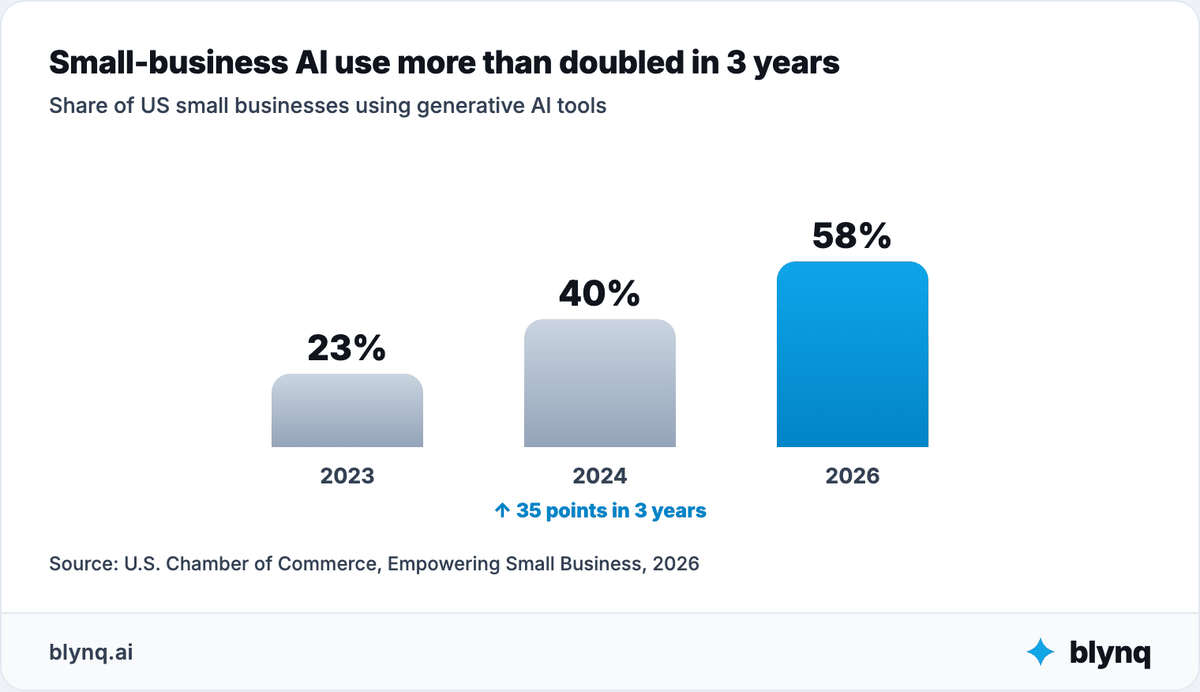
Adoption roughly doubled in two years, so a coach weighing this is late rather than early. U.S. Chamber of Commerce, Empowering Small Business
The business question is not only whether AI can write the follow-up.
The real questions are which enquiries matter, why calls stall, and what the relationship can carry.
How do you keep clients moving between sessions?
You keep clients moving by giving an Operations Agent the delivery process, then using specialized tools for transcription, recaps and intake.
Delivery work combines intake, session notes, commitments, prep, follow-up and several clients running on different cadences.
An Operations Agent can analyze that process, find where preparation slips and clarify what needs attention now.
Specialized tools can transcribe a session, draft the recap or chase the intake form.
This is also where the strongest efficacy evidence sits.
Research by Theeboom and colleagues at the University of Amsterdam found clients with AI support between live sessions showed 34% higher goal attainment.
The gain comes from continuity between sessions, not from AI replacing the session. Theeboom research, cited in Delenta's AI coaching guide
Client Experience uses the same context to prepare better recaps and surface the commitments a client keeps missing.
AI should help you remember and prepare. It should not simulate attention or make a client feel processed.
You still own the relationship, the questions you ask, and the judgment about what a client actually needs.
How do you protect your rate and your capacity?
You protect your rate by connecting package, hours delivered and revenue per client, which is Finance and Analytics work rather than delivery work.
More clients do not automatically mean a better practice. Unpaid prep, scope drift and 1:1 hour caps can hollow out a full calendar.
Some coaches are productizing instead of adding hours.
One coach on Reddit described peers selling a trained AI mentor as a standalone product for $1,000 to $2,000 a year.
That is a single practitioner's account of coaches they know, not a market benchmark.
Treat it as a direction being tested, not a proven price point. Reddit thread on selling an AI coach product
Finance and Analytics can connect package type, hours delivered, retention and revenue per client.
Strategy and Productivity then connect those findings with capacity, niche and a realistic week.
The goal is not more possible actions. It is a reasoned choice about which clients, offers and formats deserve limited attention.
What does one practice problem look like followed across the business?
Followed across the practice, one pipeline problem usually turns out to be an offer and capacity problem instead.
Consider a solo business coach whose enquiries are steady but signings have stalled. The instinct is to publish more content.
Sales analysis shows discovery calls happen but end without a clear decision. Marketing finds the offer is described in coaching language, not client outcomes.
Finance shows the 1:1 package is priced below the prep it actually needs.
Operations reveals the calendar has no room for more 1:1 hours anyway.
Strategy recommends naming the outcome and testing a group format before adding any content volume.
A proposal workflow still helps. But publishing harder first would have driven more enquiries into a call that was not converting.
The value comes from examining one problem through connected perspectives, before execution scales it.
Where do specialized coaching AI tools and agents fit?
Specialized coaching AI tools and agents fit where the bottleneck is narrow and execution-heavy.
That covers transcription, recap drafting, scheduling, intake, content repurposing and client portals.
Business agents and agents built for one job do different work.
| Business Agent layer | Specialized execution layer |
|---|---|
| Diagnoses, plans and ranks across a role | Performs or owns a defined workflow |
| Uses broad practice context | Uses workflow-specific or client-specific data |
| Connects questions across functions | Goes deeper inside one execution category |
| Example: determine why discovery calls stop converting | Example: transcribe a session and draft the recap |
The market holds several kinds of product. ChatGPT, Claude and Gemini support general research, drafting and analysis.
Fathom and Otter.ai transcribe sessions. NotebookLM turns those transcripts into per-client recall you can query later.
Paperbell and CoachAccountable handle scheduling, packages, contracts and client portals, though both assume you have already decided what you sell.
Coachvox builds an AI version of a coach trained on their own material, which is the product shape behind the standalone-subscription idea above.
These are not interchangeable. A transcription tool does not decide whether your package is priced correctly.
A scheduling platform does not decide which niche to pursue. A content tool drafts, but you decide what is worth saying.
Blynq sits on the practice-management side. Its business roles work from shared context across Sales, Marketing, Operations, Finance, Analytics and Strategy.
The right setup often combines both: coaching tools for execution, and a connected set of business agents for the thinking and the decisions.
Do you need one specialist or a connected AI back office?
You need one specialist when the problem stays inside one responsibility, and a connected AI back office when it crosses several.
Practice questions cross functions constantly:
Marketing to enquiries to discovery calls to signed clients to delivery hours to retention to revenue to the next offer decision.
A marketing recommendation may depend on which clients actually renew. An operations priority may depend on capacity.
A pricing decision may depend on the prep hours hiding behind a package.
Use this rule:
| Situation | Likely starting point |
|---|---|
| One isolated output | Chatbot or tool |
| One repeatable workflow | Automation or specialized agent |
| One ongoing business responsibility | Broad agent role |
| A question crossing several business functions | AI team with shared context |
Why does practice context change coaching AI recommendations?
Practice context can change coaching AI recommendations completely, because the same question has opposite correct answers for different practices.
Consider a common question: should I raise my rates?
No responsible answer exists without the current client mix, package structure, prep hours, retention and enquiry volume.
One coach needs more enquiries. Another needs a better offer. A third already has more commitments than the week can hold.
Prompt-based work restarts from the same briefing every time: niche, offer, client list, session cadence, capacity and recent results.
Context-aware AI starts from validated goals, constraints, decisions, actions, outcomes and lessons it already holds.
It should not remember everything indiscriminately. It should separate verified practice knowledge from assumptions and retrieve only what the current decision needs.
Why do AI agents need one shared view of the practice?
AI agents need one shared view because otherwise you are the integration point, manually carrying retention data into pricing and capacity into marketing.
Several agents do not become a team because they sit in one menu.
Operations may know delivery load, Finance may know revenue per client, and Sales may know which enquiries convert.
If you connect them by hand, nothing has changed.
Solo coaches feel this sooner than firms, because one person holds every role a larger practice would split across staff.
A useful shared view holds niche, offer structure, client segments, session cadence, capacity, pricing and past decisions.
Session content and client records need stricter handling than any of that.
Shared context does not replace role expertise. It makes Sales, Marketing, Operations and Finance relevant to the same practice.
An AI team becomes an AIOS when agents, skills, knowledge, memory, tasks and workflows grow around that shared understanding.
The goal is not more AI. It is a practice that is easier to understand, decide for and run.
What do clients still need from a coach when AI gets faster?
Clients still need presence, challenge and a relationship they trust, even when AI gets faster at the work around the session.
AI does not make coaches irrelevant. It changes which parts of the job clients value.
A coaching educator drew the line more precisely than most vendor material does.
"AI can be useful in the systems AROUND coaching, such as daily prompts to send, follow up emails, that kind of thing. However, AI will not replace a real life person sitting down to create a safe space and asking you powerful questions..."
Reddit user CoachTrainingEDU wrote that in r/Coaching. Reddit thread on AI coaching
That is the whole architecture in one sentence: automate the systems around coaching, not the coaching.
The efficacy research points the same way. The Amsterdam finding above measured AI support between sessions, layered onto live human coaching, not instead of it.
When transcription, recaps, scheduling and drafting get faster, clients still need someone who can:
- Notice what a client is avoiding and name it.
- Read tone, hesitation and body language in the moment.
- Ask the question the client did not want asked.
- Hold accountability that a person actually feels.
- Adapt the approach when the stated goal is not the real one.
- Carry responsibility for the relationship over months.
One path uses AI mainly to publish more and reach more people.
The other uses it to arrive better prepared and to protect the hours where the actual coaching happens.
The second path strengthens your role. The value moves from producing material toward the judgment inside the session.
Where does coaching work still need human judgment?
Coaching work still needs human judgment wherever client trust, confidential material or a decision about a person's life is involved.
No license governs coaching the way one governs a therapist or an accountant. The boundary is professional and contractual instead.
The ICF Code of Ethics sets confidentiality, transparency and client-agreement duties for members and credential-holders.
Those duties apply regardless of which tool drafted something. ICF ethical standards
| Area | AI can help with | Human owns |
|---|---|---|
| Enquiries | Basic questions, capture and routing | Fit judgment and whether to take the client |
| Discovery calls | Prep, background and question suggestions | The conversation and the read on the person |
| Intake | Chasing, reminders and completeness checks | What the answers actually mean |
| Session delivery | Nothing client-facing without consent | The entire session |
| Session notes | Transcription and recap drafts | Accuracy, interpretation and what gets recorded |
| Between-session support | Prompts, reminders and resource delivery | Whether a client needs a human right now |
| Progress review | Organizing commitments and patterns | The judgment about whether progress is real |
| Client material | Drafting and repurposing | Voice, accuracy and approval before it ships |
| Pricing | Organizing inputs and scenarios | The rate and the offer |
| Duty of care | Flagging what looks urgent | Recognizing risk and referring out |
Recording and transcription need explicit consent, framed as protecting the client rather than as a convenience for you.
Coaches who do this well disclose it upfront and minimize what the model ever sees.
"I'm upfront with clients whenever AI is involved and consent/privacy are hard requirements... On privacy, we pseudonymize identifying info at capture (including names), so model processing doesn't see personal identifiers."
Reddit user chroma900 wrote that in r/lifecoaching, a forum for independent coaches.
They are also building a product in this space.
Read it as an informed practitioner view rather than a neutral one. Reddit thread on using AI without replacing the human part
Pseudonymizing at capture is the practical version of confidentiality. Consent covers the recording; minimization covers everything after it.
The correct fallback is usually simple: keep it out of the tool and handle it in the session.
AI should have an escalation path, not an unlimited mandate.
How do you choose the right AI setup for a coaching practice?
You choose the right AI setup for a coaching practice by evaluating its operating model, not its label.
Ask 6 questions of anything you are considering:
- What responsibility or workflow does it help own?
- What can it analyze, recommend or execute?
- What practice or client data can it access, and under what terms?
- Does it rely on verified source data?
- What must you review before it reaches a client?
- Does it integrate with the systems that matter, and show what it did?
Consider 3 legitimate approaches:
| Approach | Strengths | Trade-offs | Best fit |
|---|---|---|---|
| Custom build | Maximum control and practice-specific rules | Technical ownership, maintenance and integration risk | Practices with technical support and distinctive methods |
| Self-directed Claude or ChatGPT | Flexibility, strong analysis and per-client instructions | You design the context, memory and orchestration | Advanced AI users who want control |
| Ready-made AI team or purpose-built SaaS | Faster setup, structured roles and continuity | More opinionated and limited to supported capabilities | Coaches who want structure without building it |
The gap is narrowing on the infrastructure side.
The SBA Office of Advocacy reports the large-versus-small AI adoption gap compressed from 1.8x to 1.2x between early 2024 and late 2025.
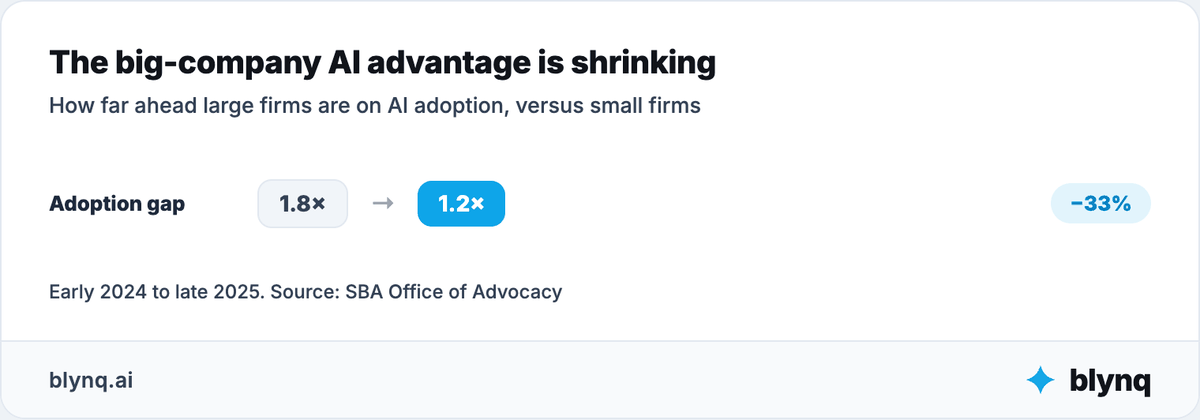
Cloud-hosted, no-code tools mean a solo practice can now run a stack that used to require a team.
Before committing, verify the system actually reads from and writes to what you need: calendar, scheduling platform, client records, email and payment.
Check permissions, approvals, activity logs and failure handling. Ask specifically whether session content trains the vendor's models, and get the answer in writing.
Do not assume "works with" means "integrates with." If you constantly re-brief the system and copy data between tools, the AI is adding admin.
How do you put AI to work in your coaching practice in 30 days?
Put AI to work in 30 days by picking 1 measurable goal and diagnosing the bottleneck behind it.
Run the agent alongside your current process, then expand only where it earned the expansion.
Start with the goal, not the tool.
Week 1: Diagnose
Choose a goal and a bottleneck. Do not start with a product.
Common candidates: discovery-call conversion, admin hours per client, or retention past the third session.
Define the 1 metric that would show improvement.
Exit criterion: a named metric and a current baseline number, written down.
Week 2: Build context
Give the system what judgment requires: niche, offer structure, client segments, session cadence, capacity, pricing and previous decisions.
Decide what stays private or needs controlled access. Session content and client records belong in that category by default.
Exit criterion: the agent answers a question about your practice you did not have to re-explain.
Week 3: Run alongside the current process
Use the agent for analysis, planning or structured work while the existing process stays visible.
Review errors, missing context and drafts that do not sound like how you actually speak to clients.
Exit criterion: a written list of what it got wrong and what context was missing.
Week 4: Evaluate and expand carefully
Measure the metric from Week 1. Record what the system learned and what still needs your review.
Add another skill or role only when it solves a real adjacent problem.
If the second role depends on knowledge from the first, prioritize shared context over another disconnected tool.
Exit criterion: a keep-or-drop decision supported by the baseline number.
Example setup for a solo business coach
Suppose the goal is better discovery-call conversion without adding enquiry volume.
| Setup layer | What to include |
|---|---|
| Business context | Niche, offer structure, client segments, session cadence, capacity and pricing definitions |
| Sales Agent | Review enquiries, identify where discovery calls stall and recommend follow-up priorities |
| Analytics Skill | Compare conversion by enquiry source, segment and offer |
| Specialized workflow | Prepare the discovery call from intake answers and draft the follow-up |
| Human boundary | You run the call, read the person, and decide whether the client is a fit |
| Success measure | Higher discovery-to-signed conversion after 30 days, without weaker client fit |
This is enough for a first setup. It needs no separate agents for enquiries, calls, proposals and follow-up.
Start with the responsibility, add the skills and workflow it needs, and expand only when a problem genuinely crosses into a new role.
What to do now
Pick 1 practice result that needs to change this quarter, and write down the number that measures it today.
Diagnose what is actually blocking it, using the 8-step sequence above. The bottleneck is rarely where the first instinct points.
Decide your consent and privacy line before any tool touches a session: what gets recorded, what gets pseudonymized, and what never leaves the room.
Then automate the systems around coaching, and leave the coaching itself alone.
AI agents help most when they own a real responsibility, use several skills and understand the practice behind the task.
The future is not a separate bot for every action. Expect fewer capable agents, specialized execution where it earns its place, and shared context underneath.
The point is not to add more AI. It is to make the practice easier to understand, decide for and run.