









What are AI agents for agencies?
AI agents for agencies are systems that take ongoing responsibility for part of the agency: Marketing, Sales, Operations or Finance.
Specialized agents own narrower work, like drafting a proposal. Some act alone. Others analyze and prepare work for review.
The useful question is not which tool to buy, but what an agent should own. Blynq sits on that business side.
Learn how to run your business with an AI teamWhich AI agents can help run a small agency?
The AI agents that help run a small agency are 8 business roles: Marketing, Sales, Operations, Client Experience, Finance, Analytics, Strategy and Productivity.
The useful starting point is not a separate agent per client, deliverable or channel.
A focused set of agents works better, each owning a meaningful part of the agency.
| AI Agent | What it can help a founder do | Most useful when |
|---|---|---|
| Marketing Agent | Clarify positioning, plan campaigns and turn the agency's own case studies into content | The agency markets clients well but neglects its own pipeline |
| Sales Agent | Qualify inbound requests, scope proposals and follow up on stalled pitches | Inquiries arrive but too few convert into signed retainers |
| Operations Agent | Review delivery workflows, deadlines, handoffs and capacity across clients | The same deliverable takes longer every time it repeats |
| Client Experience Agent | Improve client reporting and flag accounts at risk of churn | Clients ask what they are actually paying for |
| Finance Agent | Review retainer margin, scope creep and pricing scenarios | Billable hours look full but margin keeps shrinking |
| Analytics Agent | Connect leads, proposals, delivery time and profit per client | Client profitability is a guess, not a number |
| Strategy Agent | Compare niches, service lines and productization options | Clients start asking to buy the workflow instead of the retainer |
| Productivity Agent | Turn deadlines, pitches and internal tools into a realistic weekly focus | Everything feels urgent across every client at once |
These 8 support the business side. Agencies also use specialized agents and tools for narrow execution.
Common examples include proposal drafting, ad monitoring, client reporting and internal tool prototyping.
The distinction matters. A Strategy Agent can diagnose whether to productize a workflow. A reporting agent pulls 1 client's monthly numbers.
One supports the business decision. The other runs a defined workflow.
What counts as an AI agent in a small agency?
An AI agent in a small agency is software that holds an ongoing responsibility. A chatbot answers one question; a tool finishes one job.
The terms get confusing quickly. Here is the simplest way to tell the 4 shapes apart.
| Chatbot | AI Tool | AI Agent | AI Team | |
|---|---|---|---|---|
| What it does | Answers a question | Completes a specific job | Helps own an ongoing responsibility | Helps across several parts of the agency |
| What you do | Ask each question | Open or trigger it when needed | Give it a goal or responsibility | Give the team access to shared agency context |
| What it knows | Usually the conversation or limited product memory | Information needed for its job | Context relevant to its role | Context shared across different specialists |
| Founder example | "Draft a reply to this client's revision request" | Summarize this month's ad performance into a report | Own proposal drafting and follow-up across every pitch | Marketing, Sales and Finance work from the same agency picture |
So stop asking whether something is technically an agent. Ask 3 better questions instead.
What will it take responsibility for? What information will it use? What will the founder still have to do?
How can AI help you run a small agency?
AI helps run a small agency by removing repetitive proposal drafting, scattered reporting, disconnected client profitability and the guesswork about which service to productize.
Find your problem in the left column before shopping for anything.
| Recurring problem | What AI can help remove | Best-fit agent or AI setup | When to prioritize it |
|---|---|---|---|
| Proposals take too long | Drafting a custom scope from past proposals | Sales Agent + proposal tool | When every pitch starts from a blank page |
| Client reporting eats the week | Pulling numbers into 1 monthly view | Client Experience Agent + reporting tool | When several clients report on the same day |
| Ad monitoring is manual | Anomaly flags and daily checks | Operations Agent + monitoring tool | When a campaign drifts before anyone notices |
| Onboarding is inconsistent | Structured intake and kickoff briefs | Operations Agent + onboarding workflow | When every new client starts from scratch |
| Margin is unclear per client | Connecting scope, hours and retainer fee | Finance Agent + Analytics Agent | When billable hours are full but profit is not |
| Clients ask to buy the workflow | Deciding what to productize and at what price | Strategy Agent | When the same deliverable repeats across clients |
| Content production is slow | Turning 1 brief into several formats | Marketing Agent + content tool | When output volume is the bottleneck, not ideas |
| Internal tools never get built | Prototyping a small tool instead of a manual process | Operations Agent + a coding agent | When the same workaround gets repeated by hand |
| Capacity is unclear | Connecting deadlines, pitches and delivery load | Operations Agent + Productivity Agent | Before taking on another retainer |
| The agency's own marketing is neglected | Turning case studies and results into a pipeline | Marketing Agent + Sales Agent | When client work crowds out the agency's own leads |
| Priorities are unclear | Connecting goals, workload and constraints | Strategy Agent + Productivity Agent | When everything feels urgent |
This is a map, not a shopping list. Some problems need a tool. Others need a skill inside a business role.
Others still need a specialized agent that owns a workflow, or several agents working from shared context.
Diagnose the bottleneck before choosing the system.
How should a founder choose what to give an AI agent first?
A founder should choose the first AI agent from the bottleneck blocking a named result, not from the most interesting demo.
Most agencies start the same way. Reddit user whonix29, a creative director at a small studio, described the pattern others should copy.
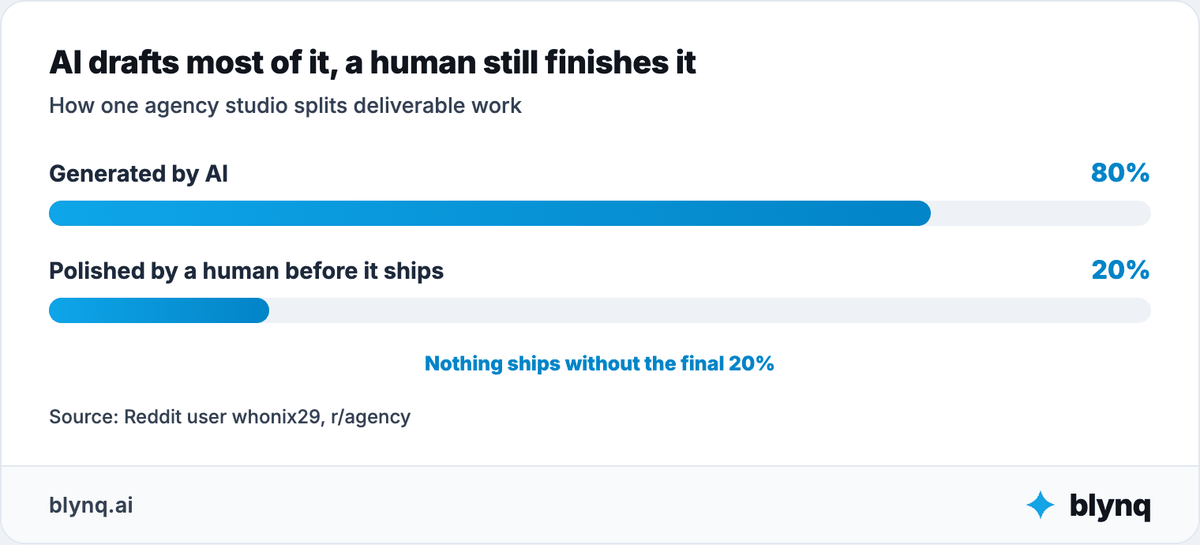
"AI generates 80%, humans polish 20%," she wrote. "Every workflow should work without you being involved. Otherwise AI is just a fancy to-do list."
Proposal work is where several founders start for a reason. Operations Director erickrealz put it directly on r/agency.
"Train it on your past successful proposals and it'll pump out custom scopes way faster than writing from scratch every time. Just review and tweak."
Suppose the goal is healthier margin without losing clients. "Add more AI tools" sounds like the obvious answer.
But thin margin has at least 6 possible causes:
- Proposals that undersell the real scope of work.
- Delivery that takes longer than the retainer was priced for.
- Reporting time that never gets billed.
- A workflow repeated for every client instead of packaged once.
- Client churn nobody saw coming.
- More clients than the team can serve well.
Adding tools without diagnosing the cause makes the wrong one of these worse.
Work this sequence before choosing an agent or tool:
| Step | Founder question |
|---|---|
| Goal | What result needs to change? |
| Bottleneck | What is preventing that result today? |
| Responsibility | Which area owns the problem? |
| Capability | What must AI analyze, recommend or execute? |
| Context | What must it know to give a useful answer? |
| Constraints | What limits budget, time, capacity or risk? |
| Human boundary | What decision stays with the founder? |
| Architecture | Is the right fit general AI, a broad agent, a specialized system or an AI team? |
Do not design the agency around what AI can do. Design the AI around what the agency needs to achieve.
How do roles, skills and tasks show up in a small agency?
Roles are the business area an agent owns, skills are what it can do inside that area, and tasks are the work happening right now.
These terms get used interchangeably. Keeping them apart stops a founder buying a separate system for every small job.
| Concept | Definition | Founder example |
|---|---|---|
| Agent | AI entity holding ongoing responsibility | Sales Agent |
| Role | Business domain the agent owns | Sales |
| Skill | Capability used inside the role | Proposal drafting from past scopes |
| Task | Specific work being done now | Draft this week's 3 pending proposals |
| AI Tool | Product for a particular job | Ad-performance reporting tool |
| Automation | Predefined workflow | Send a kickoff brief when a client signs |
| Specialized Agent | System owning a narrow ongoing workflow | Monthly client reporting across every account |
| AI Team | Several agents sharing business context | Marketing, Sales and Finance using the same agency knowledge |
| AIOS | Operating layer connecting agents, skills, memory, knowledge, tasks and workflows | Shared AI operating environment for the agency |
The core idea is simple. Agents are roles. Skills are capabilities. Tasks are the work being done.
Automation alone does not make something an agent. Neither does an "agent" label on a pricing page.
Does every small-agency task need its own AI agent?
No. Most small-agency tasks are skills inside a role the founder already needs, not grounds for buying another agent.
The taxonomy matters because it stops an AI stack becoming a new kind of software clutter.
Drafting 1 client's monthly report is not a Reporting Agent. It is a task using a summarizing skill inside Client Experience.
Comparing this month's ad spend across 2 clients is not a Spend-Comparison Agent. It is a task using Analytics skills.
A system that drafts every proposal, learns from past scopes and flags anything unusual for review is different.
That may qualify as a specialized agent, because it owns a narrow but ongoing workflow.
The difference is responsibility, not branding.
How can AI support the business behind the retainers?
AI supports the business behind the retainers in 3 connected places: deciding what to sell, delivering it without adding headcount, and protecting the margin underneath.
How do you decide what to sell when clients want the system, not the service?
You decide what to sell by noticing which deliverable repeats across clients, then treating that repetition as a product decision, not a delivery problem.
The pressure is already visible in how clients ask. One agency founder described the shift directly on r/agency.
"Clients are starting to ask if they can just buy access to our AI workflows instead of hiring us."
The exposure is structural, not just a client mood.
"The agency model survives on information asymmetry and manual labor," wrote Curtis, a solo founder, "both of which AI eliminates."
He was describing his own AI product, Shortlist, on Indie Hackers, so read it as a founder's pitch as well as an observation.
Some founders are answering that question by packaging the workflow itself. Agency principal Mike Ali described the logic on Indie Hackers.
"Clients don't always want the service. Sometimes they just want the system itself," he wrote.
"Once you've built the same workflow a few times, productizing it just makes sense."
A solo automation-agency founder made the same call after repeating one client build too many times.
Bec, founder of Hotham AI, described the same pattern.
"I kept rebuilding the same 'instant AI reply to new leads' flow for different clients," she wrote. "Finally packaged it as a standalone product."
Not every founder agrees productizing is the safer bet. A search-agency founder framed the counter-argument on r/agency.
"Can they buy a workflow? Sure," wrote JimMorrison71, in the same thread.
His comment, the highest-scored in the discussion, continued: "Can they buy my judgment and years of experience? Not really."
Both are real strategies, not a contradiction.
A Strategy Agent can help decide which repeated workflow is safe to package, and which relationship depends on judgment a product cannot replace.
How do you deliver client work without adding headcount?
You deliver more without hiring by giving an Operations Agent the delivery process itself, then using specialized tools for reporting, monitoring and drafting.
Growth without headcount is already documented, not theoretical. One founder described tripling client count while improving margin.
Reddit user Neither-Raspberry-60 described the result on r/agency.
"We're now on our 25th client after launching this agency 4 months ago," they wrote.
"We're able to improve our profit margin as well since we need less people."
A solo developer described a similar leverage effect on the delivery side itself.
Thibaut, a French web-agency founder, described a similar leverage effect on Indie Hackers.
"I work alone," he wrote. "Claude Code is basically my co-founder at this point... it genuinely cut my dev time in half."
An Operations Agent can analyze the delivery process, find where the same task repeats by hand and clarify what a specialized tool should own instead.
The human still owns client judgment, the account relationship and every promise made in a pitch.
How do you protect margin as pricing pressure grows?
You protect margin by connecting scope to hours to what the retainer actually charges, which is Finance work rather than a delivery feeling.
Billable-hour pricing is already under pressure. Clients increasingly expect AI-era efficiency to show up in what they pay, not just in what they receive.
Finance and Analytics can connect client scope, delivery hours and retainer fee into 1 view, so pricing decisions are not made on a hunch.
Strategy and Productivity then connect those findings with capacity and which clients are worth keeping at their current price.
The goal is not more automation. It is a reasoned choice about which service, client and price point actually pays for the team's time.
What does one agency problem look like followed across the business?
Followed across the business, a full pipeline with thin margin usually turns out to be a pricing problem.
It wears the costume of a capacity problem.
Consider a small agency delivering the same onboarding workflow, proposal structure and monthly report for every client, each rebuilt from scratch.
The first instinct is to hire, or to add another point tool for the loudest complaint.
But the founders who described real margin gains did neither.
They packaged the repeated workflow once, and used it to serve more clients with fewer people.
Not every repeated task is safe to package this way.
Client judgment, negotiation and the account relationship stayed human in every account above.
The value came from separating what repeats from what depends on judgment, not from adding capacity to a process nobody had examined yet.
Where do specialized agency AI tools fit?
Specialized agency AI tools fit where the bottleneck is narrow and execution-heavy.
That covers proposal drafting, ad monitoring, client reporting and internal tool prototyping.
Business agents and agents built for one job do different work.
| Business Agent layer | Specialized execution layer |
|---|---|
| Diagnoses, plans and ranks across a role | Performs or owns a defined workflow |
| Uses broad agency context | Uses workflow-specific or client-specific data |
| Connects questions across functions | Goes deeper inside one execution category |
| Example: decide whether to productize a repeated workflow | Example: draft this month's client report |
The market holds several kinds of product. ChatGPT, Claude and Gemini support general research, writing and analysis.
Zapier connects apps and runs a fixed sequence of steps.
Several founders use it for exactly that: drafting emails, summarizing reports and creating tasks automatically.
Claude Code builds and edits software directly, which is why solo technical founders describe it as replacing a developer hire rather than just drafting copy.
AgencyAnalytics tracks a client's visibility across search and AI answer engines, a category agency leaders increasingly ask for by name.
These are not interchangeable.
A reporting tool does not decide whether a workflow is safe to productize. A coding agent does not decide which relationship depends on judgment.
A workflow executes the steps it was given, but the founder still defines the trigger, the exceptions and what happens when something breaks.
Blynq sits on the business-management side. Its business roles work from shared context across Marketing, Sales, Operations, Finance, Analytics and Strategy.
The right setup often combines both: execution tools for the narrow jobs, and a connected set of business agents for the thinking and the decisions.
Do you need one specialist or a connected AI back office?
You need one specialist when the problem stays inside one responsibility, and a connected AI back office when it crosses several.
Small-agency questions cross functions constantly:
Marketing to leads to proposals to delivery to margin to the next positioning decision.
A marketing recommendation may depend on which clients are actually profitable. A staffing decision may depend on capacity.
A pricing decision may depend on which workflow just got productized and which one still needs a person.
Use this rule:
| Situation | Likely starting point |
|---|---|
| One isolated output | Chatbot or tool |
| One repeatable workflow | Automation or specialized agent |
| One ongoing business responsibility | Broad agent role |
| A question crossing several business functions | AI team with shared context |
Why does business context change agency AI recommendations?
Business context can change agency AI recommendations completely, because the same question has opposite correct answers for different agencies.
Consider a common question: should this workflow be productized, or kept as a service?
No responsible answer exists without current margin, how replaceable the workflow actually is, and which clients pay for judgment rather than output.
One founder needs to package a repeated build. Another founder's real value is the relationship a product cannot replicate.
This is usually where a founder is most alone. Nobody checks the read before the pricing model changes.
Prompt-based work restarts from the same briefing every time: the agency, the client roster, the numbers, what was already tried.
Context-aware AI starts from validated goals, constraints, decisions and outcomes it already holds.
The founder is not re-explaining the agency just to get a useful answer.
Why do AI agents need one shared view of the agency?
AI agents need one shared view because otherwise the founder is still doing the connecting.
Pipeline health, delivery capacity and what each client actually nets stay 3 separate pictures.
Several agents do not become a team because they sit in one menu.
A sales tool tracks the pipeline, a delivery tool tracks hours, a finance tool tracks margin.
If the founder still connects them by hand, nothing has changed.
Institutional knowledge is exactly what a shared view is meant to hold. One founder described the asset directly.
Search-agency founder T.J. Robertson named the asset directly on r/agency.
"Our people are still our number one asset," he wrote, "but honestly the number two asset at this point is our Claude skills."
He put thousands of hours into that library before it became worth anything.
That is the argument for treating shared context as a real asset, not a side project.
A useful shared view, sometimes called a Business Brain, holds positioning, client roster, pricing, capacity, current priorities and past decisions.
Client data needs stricter access, verified sources and clear retention rules.
Shared context does not replace the founder's judgment. It makes Marketing, Sales, Operations and Finance relevant to the same agency.
An AI team becomes an AIOS when agents, skills, knowledge, memory, tasks and workflows grow around that shared understanding.
The goal is not more AI.
The goal is an agency that is easier to understand, decide for and run, without the founder holding every connection alone.
What do clients still need from an agency when AI gets faster?
Clients still need an agency that knows what to do with an AI's output, not just an agency that can produce output faster.
AI does not make agencies irrelevant. It changes which parts of the work clients actually value.
The pressure is concentrated in execution roles, not judgment roles.
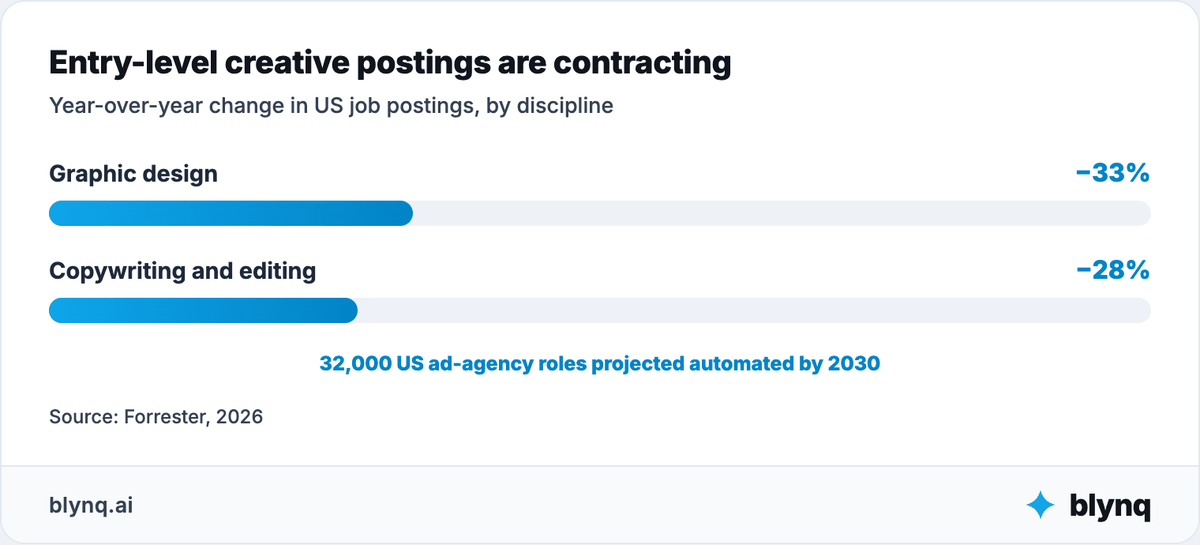
Forrester projects 32,000 US ad-agency positions automated by 2030. Copywriting postings are down 28% and graphic design postings down 33% year over year.
Judgment work is exactly what those postings never covered.
The strongest defense of this came from a search-agency founder.
He was answering a client who wanted to buy the workflow instead of the retainer.
"Can they buy a workflow? Sure," wrote JimMorrison71 on r/agency, in the highest-scored comment found for this guide.
"Can they buy my judgment and years of experience? Not really. That's what they're paying me for."
His analogy makes the point concrete.
"I could sell you an x-ray of your broken leg right now," he wrote.
"You'd have no idea how to read it or how to triage the situation."
The in-house alternative has a documented failure pattern, not just a defensive claim.
One 4-person agency owner described what happens when clients try to skip the agency entirely.
Reddit user madamTDG described the pattern on r/marketing.
"A lot of clients got offers for agentic AI marketing services... open rates on emails drop, socials take a nosedive, ads underperform," she wrote.
"We have a fair share of those clients coming back after 8-10 months of AI."
When drafts, reports and campaign variants get faster, clients still need someone who can:
- Recognize when a result does not fit the pattern the AI was trained on.
- Read the output and know whether it is actually good.
- Negotiate scope, budget and timeline with judgment a template cannot supply.
- Take responsibility when a campaign underperforms.
- Remember the account history a fresh AI session does not have.
- Say no to a request that would hurt the client long-term.
One founder's own workflow shows the honest shape of this trade.
Creative director whonix29 keeps a strict rule: "AI generates 80%, humans polish 20%... never final without human check."
The agencies coming through this transition are not the ones with the most AI.
They are the ones clearest about which 20% only a person can do.
Where does small-agency AI still need human control?
Small-agency AI still needs human control wherever a client relationship, a public claim or money is involved.
The closer AI gets to those, the stronger review should become.
| Area | AI can help with | Human owns |
|---|---|---|
| Client intake | Basic questions, capture and routing | Scoping conversations and any promise made |
| Proposals | Drafting from past scopes | The final price and terms |
| Onboarding | Structured intake and kickoff briefs | The relationship and expectations set |
| Content and campaigns | Drafting and variant generation | What actually ships under the client's name |
| Ad monitoring | Anomaly flags and daily checks | Strategic changes to spend or targeting |
| Reporting | Pulling and structuring numbers | Interpretation and the story told to the client |
| Pricing | Organizing scenarios and comparisons | The number the client actually sees |
| Productization decisions | Organizing which workflows repeat | What gets packaged and at what price |
| Client disputes | Summarizing the history | The resolution and the tone |
| Data handling | Organizing and retrieving | What leaves the agency, and to whom |
Disclosure deserves particular caution. Founders in this KB are split on whether clients need to know AI touched a deliverable.
One agency principal described the practice directly on r/marketing.
"AI is a sort of intern making my first draft that I thoroughly refine," he wrote, "so I don't need to disclose nothing."
That is a defensible position only if the human refinement is real and thorough, not a rubber stamp.
A brand's own audience is growing warier of visible AI, not more comfortable with it.
Client trust is the actual asset at risk here, more than any single deliverable.
Treat every AI-touched output as something a person reviewed before it left the agency, whether or not the client is told.
The correct fallback is usually simple: draft it with AI, then have the person who owns the account read it before it ships.
AI should have an escalation path, not an unlimited mandate.
How do you choose the right AI setup for a small agency?
You choose the right AI setup for a small agency by evaluating its operating model, not its label.
Ask 6 questions of anything you are considering:
- What responsibility or workflow does it help own?
- What can it analyze, recommend or execute?
- What agency or client data can it access, and under what terms?
- Does it rely on verified source data?
- What must the founder review and approve?
- Does it integrate with the tools that matter, and show what it did?
Consider 3 legitimate approaches:
| Approach | Strengths | Trade-offs | Best fit |
|---|---|---|---|
| Custom build | Maximum control and agency-specific rules | Technical ownership, maintenance and integration risk | Founders with technical skill and a distinctive process |
| Self-directed Claude or ChatGPT | Flexibility, strong analysis and custom projects | The founder designs the context, memory and workflow | Founders who want to design their own setup |
| Ready-made AI team or purpose-built SaaS | Faster setup, structured roles and continuity | More opinionated and limited to supported capabilities | Founders who want structure without building it |
The last row has several named options, and they are not identical.
Sintra AI offers 12 named specialist assistants covering marketing, sales, SEO and support in 1 chat platform.
Marblism offers 6 named AI employees sharing 1 memory it calls "the Brain," at a lower price point than most alternatives in this category.
Lindy AI is narrower by design.
Lindy is 1 always-on assistant handling email, scheduling and calls, built for someone who wants a single assistant rather than a named team.
Blynq is a fourth option here, an AI team of 11 named agents built around a persistent Business DNA.
Judge all 4 on the same 6 questions above rather than on which one is named first.
Most agencies are still early in this, whichever option they pick.
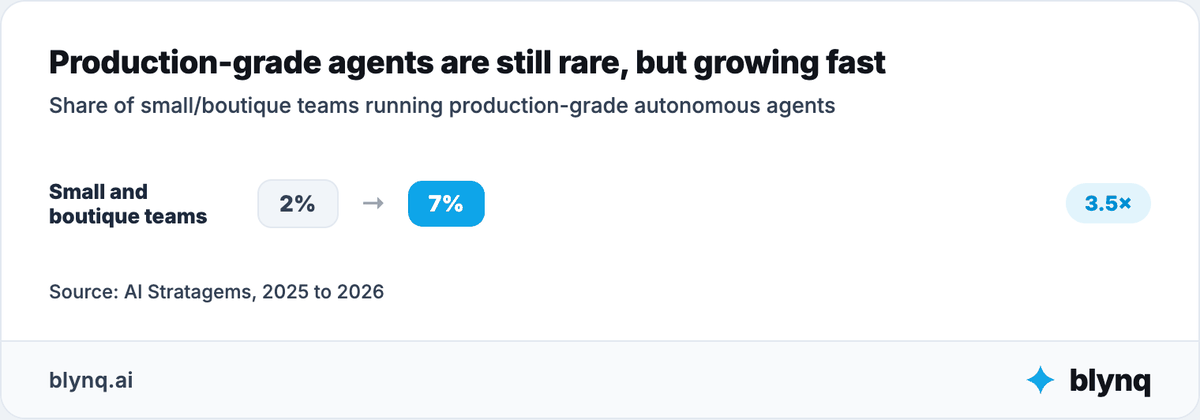
AI Stratagems puts small teams running production-grade autonomous agents at 7%, up from 2% a year earlier.
Before committing, verify the system actually reads from and writes to what matters: the CRM, the ad platforms, the reporting tools, the invoicing software.
Check permissions, activity logs and failure handling. Ask what happens when a sync fails silently, because that costs more than it saves.
Do not assume "works with" means "integrates with."
If you constantly re-brief the system and copy data between tools, the AI is adding management work.
How do you put AI to work in your small agency in 30 days?
Put AI to work in 30 days by picking 1 measurable goal and diagnosing the bottleneck behind it.
Run the agent alongside your current process, then expand only where it earned the expansion.
Start with the goal, not the tool.
Week 1: Diagnose
Choose a goal and a bottleneck. Do not start with a product.
Common candidates: proposals that take too long, margin that keeps shrinking, or a workflow repeated for every client.
Define the 1 metric that would show improvement.
Exit criterion: a named metric and a current baseline number, written down.
Week 2: Build context
Give the system what judgment requires: the agency's positioning, client roster, pricing, capacity and recent decisions.
Decide what stays private or needs controlled access. Client data belongs in that category by default.
Exit criterion: the agent answers a question about the agency without needing to be re-briefed.
Week 3: Run alongside the current process
Use the agent for analysis, planning or structured work while the existing process stays visible.
Review errors, missing context and recommendations that do not fit how the agency actually operates.
Exit criterion: a written list of what it got wrong and what context was missing.
Week 4: Evaluate and expand carefully
Measure the metric from Week 1. Record what the system learned and what still needs the founder's judgment.
Add another skill or role only when it solves a real adjacent problem.
If the second role depends on knowledge from the first, prioritize shared context over another disconnected tool.
Exit criterion: a keep-or-drop decision supported by the baseline number.
Example setup for a solo agency founder
Suppose the goal is deciding whether a repeated workflow is safe to productize.
| Setup layer | What to include |
|---|---|
| Business context | Positioning, service lines, client roster, pricing and recent proposals |
| Strategy Agent | Compare which workflows repeat across clients and which depend on judgment |
| Analytics Skill | Compare margin and delivery hours by client and service line |
| Specialized workflow | Draft proposals from past scopes and flag anything unusual for review |
| Human boundary | The founder handles client judgment, pricing and every promise made in a pitch |
| Success measure | A clear decision on 1 workflow, productize or keep as a service, after 30 days |
This is enough for a first setup. It needs no separate agents for proposals, reporting, monitoring and pricing.
Start with the responsibility, add the skills and workflow it needs, and expand only when a problem genuinely crosses into a new role.
What to do now
Pick 1 result that needs to change this quarter, and write down the number that measures it today.
Diagnose what is actually blocking it, using the 8-step sequence above. The bottleneck is rarely where the first instinct points.
Decide what stays with the founder: client judgment, pricing, disclosure and every promise made in a pitch. Then choose the setup that fits what remains.
The read does not have to happen alone. Check it against real numbers before repricing a retainer or productizing a workflow.
AI agents help most when they own a real responsibility, use several skills and understand the agency behind the task.
The future is not a separate bot for every client. Expect fewer capable agents, specialized execution where it earns its place, and shared context underneath.
The point is not to add more AI. It is to make the agency easier to understand, decide for and run.