









What are AI agents for accountants?
An AI agent for accountants is software that owns an area of the practice, not a single task.
Document tools like Dext own capture and categorization. Business platforms like Blynq help interpret the business context behind them.
Both keep that area's context between uses, unlike a chat window. Neither signs your return, so that stays yours.
Learn how to run your business with an AI teamWhich AI agents can help run an accounting practice?
The AI agents that help run an accounting practice are 8 business roles: Operations, Sales, Marketing, Client Experience, Finance, Analytics, Strategy and Productivity.
The useful starting point is not a separate agent per client, return or ledger.
A small set of agents works better, each owning a meaningful part of the practice.
| AI Agent | What it can help an accountant do | Most useful when |
|---|---|---|
| Operations Agent | Review close processes, recurring work, document chasing, deadlines and capacity | Cleanup work eats the margin and busy season overruns |
| Sales Agent | Qualify inquiries, scope engagements, price proposals and follow up on advisory conversions | Prospects arrive but convert into low-value compliance work |
| Marketing Agent | Clarify who the practice serves, plan referral work and explain advisory services | The practice takes whoever calls and the niche is unclear |
| Client Experience Agent | Improve client updates, organize recurring questions and flag accounts needing attention | Clients only hear from you at filing deadlines |
| Finance Agent | Review realization, fixed-fee erosion, write-offs and pricing scenarios | Revenue holds but the effective hourly rate is falling |
| Analytics Agent | Connect client types, engagement hours, write-offs and profit per client | Practice management data does not explain profitability |
| Strategy Agent | Compare niches, service lines, client segments and pricing models | Compliance work is growing faster than advisory |
| Productivity Agent | Turn deadlines, extensions, cleanups and advisory work into a realistic weekly focus | Everything is urgent from January to April |
These 8 support the practice side. Accountants also use specialized agents and tools for narrow execution.
Common examples include document capture, transaction categorization, reconciliation, AR collections, tax research and close management.
The distinction matters. An Operations Agent can diagnose why three clients closed late.
A document-chasing agent gets the missing bank statement. One supports the decision; the other runs a defined workflow.
What counts as an AI agent in accounting?
An AI agent in accounting is software that holds an ongoing responsibility. A chatbot answers one question; a tool finishes one job.
The terms get confusing quickly. Here is the simplest way to tell the 4 shapes apart.
| Chatbot | AI Tool | AI Agent | AI Team | |
|---|---|---|---|---|
| What it does | Answers a question | Completes a specific job | Helps own an ongoing responsibility | Helps across several parts of the practice |
| What you do | Ask each question | Open or trigger it when needed | Give it a goal or responsibility | Give the team access to shared practice context |
| What it knows | Usually the conversation or limited product memory | Information needed for its job | Context relevant to its role | Context shared across different specialists |
| Accountant example | "Draft an email explaining a K-1 to a client" | Extract line items from a stack of receipts | Own the month-end close across every client | Operations, Finance and Sales work from the same practice understanding |
So stop asking whether something is technically an agent. Ask 3 better questions instead.
What will it take responsibility for? What information will it use? What will you still have to review?
How can AI help you run an accounting practice?
AI helps run an accounting practice by removing document chasing, repetitive categorization, close-status guesswork and the manual work of connecting scope to realization.
Find your problem in the left column before shopping for anything.
| Recurring problem | What AI can help remove | Best-fit agent or AI setup | When to prioritize it |
|---|---|---|---|
| Clients send documents late | Chasing, reminders and intake tracking | Operations Agent + document-chasing workflow | When missing records delay every close |
| Reconciliation eats the week | Matching, categorization and exception surfacing | Operations Agent + bookkeeping tool | When bank feeds create more review than relief |
| Month-end close slips | Checklists, status visibility and blocker tracking | Operations Agent + close workflow | When several clients close in the same week |
| Tax research takes too long | First-pass research and drafting you then verify | Specialized tax research tool | When a novel client position needs authority |
| Client questions pile up | Drafting answers and organizing recurring themes | Client Experience Agent | When clients only hear from you at deadlines |
| Advisory never gets sold | Spotting which clients need advisory and preparing the conversation | Sales Agent + Analytics Skill | When capacity exists but conversions do not |
| Fixed fees erode | Connecting scope, hours and realization by client | Finance Agent + Analytics Agent | When revenue holds but the effective rate falls |
| Scope creep goes unbilled | Tracking out-of-scope requests against the engagement letter | Operations Agent | When extra work surfaces at year end |
| Capacity is unclear | Connecting deadlines, extensions, cleanups and available hours | Operations Agent + Productivity Agent | Before accepting more clients |
| Marketing spend is disconnected from profit | Connecting sources, engagement type, realization and cost | Marketing, Sales, Finance and Analytics | When referrals and ads produce different client quality |
| Priorities are unclear | Connecting goals, deadlines, commitments and constraints | Strategy Agent + Productivity Agent | When everything is urgent from January to April |
Document chasing sits at the top of that list for a reason.
Research firm GetUku found autonomous document chasing is the most requested agent job, named by roughly 70% of firms.
That demand says something useful: the bottleneck most practices feel first is not analysis, it is waiting on other people.
This is a map, not a shopping list. Some problems need a tool. Others need a skill inside a business role.
Others still need a specialized agent that owns a workflow, or several agents working from shared context.
Diagnose the bottleneck before choosing the system.
How should an accountant choose what to give an AI agent first?
An accountant should choose the first AI agent from the bottleneck blocking a named result, not from the most impressive demo.
Suppose you want busy season to stop overrunning. "Automate the bookkeeping" sounds like the obvious answer.
But an overrunning busy season has at least 7 possible causes:
- Clients deliver records late.
- Books arrive already behind and need cleanup.
- Scope creep goes untracked and unbilled.
- Review takes longer than preparation.
- Too many clients priced below cost.
- No documented process for the work to follow.
- More clients than the practice can serve well.
Automating the ledger would make several of these worse, not better.
This failure has a documented shape. A CPA at a firm that does cleanup work described what arrives after clients try AI-only bookkeeping.
"AI usually makes things worse if you're behind on books or have unlinked accounts, personal expenses mixed in, or inconsistent categorization."
Reddit user BrainyTrishCPA wrote that in r/Accounting, a forum where accountants discuss practice management. Reddit thread on AI bookkeeping platforms
Automation applied to a broken process accelerates the breakage. Fix the intake before you automate the ledger.
Work this sequence before choosing an agent or tool:
| Step | Accountant question |
|---|---|
| Goal | What practice result needs to change? |
| Bottleneck | What is preventing that result today? |
| Responsibility | Which area owns the problem? |
| Capability | What must AI analyze, recommend or execute? |
| Context | What must it know to give a useful answer? |
| Constraints | What limits budget, time, capacity or risk? |
| Human boundary | What judgment or sign-off stays human? |
| Architecture | Is the right fit general AI, a broad agent, a specialized system or an AI team? |
Do not design the practice around what AI can do. Design the AI around what the practice needs to achieve.
Most firms are earlier in this than the marketing suggests. Forbes and SMB Group put advanced AI-integration maturity at just 8% of firms.
Being at the beginning is the normal position, not a late one.
How do roles, skills and tasks show up in accounting?
Roles are the practice area an agent owns, skills are what it can do inside that area, and tasks are the work happening right now.
These terms get used interchangeably. Keeping them apart stops you buying a separate system for every small job.
| Concept | Definition | Accountant example |
|---|---|---|
| Agent | AI entity holding ongoing responsibility | Operations Agent |
| Role | Business domain the agent owns | Operations |
| Skill | Capability used inside the role | Close process review |
| Task | Specific work being done now | Find why 3 clients closed late |
| AI Tool | Product for a particular job | Receipt extraction tool |
| Automation | Predefined workflow | Send a reminder when a client document is missing |
| Specialized Agent | System owning a narrow ongoing workflow | Document chasing across every client |
| AI Team | Several agents sharing practice context | Operations, Finance and Sales using the same practice knowledge |
| AIOS | Operating layer connecting agents, skills, memory, knowledge, tasks and workflows | Shared AI operating environment for the practice |
The core idea is simple. Agents are roles. Skills are capabilities. Tasks are the work being done.
Automation alone does not make something an agent. Neither does an "agent" label on a product page.
Does every accounting task need its own AI agent?
No. Most accounting tasks are skills inside a role you already have, not grounds for buying another agent.
The taxonomy matters because it stops an AI stack becoming a new kind of software clutter.
Drafting one client email is not a Communications Agent. It is a task using a writing skill inside client experience.
Comparing write-offs across clients this quarter is not a Realization Agent. It is a task using Finance and Analytics skills.
A system that chases every missing document, tracks what arrived, and escalates the accounts still outstanding is different.
That may qualify as a specialized agent, because it owns a narrow but ongoing workflow.
One automation builder who works with accounting firms named the real predictor of whether that automation succeeds.
"If you have a concrete, solid SOP that staff follow, then that is a perfect candidate for automation."
Reddit user Rumble1205 wrote that in r/Accounting. Reddit thread on AI and bookkeeping
Undocumented work is the constraint, not model capability. If the SOP does not exist, writing it is the first project.
The difference is responsibility, not branding.
How can AI support the practice behind the returns?
AI supports the practice behind the returns in 3 connected places: winning the right work, delivering it through the calendar, and protecting the economics underneath.
How do you turn capacity into advisory work?
You turn capacity into advisory work by identifying which clients need it and preparing the conversation.
That is Sales and Analytics work, not compliance work.
A Marketing Agent can clarify who the practice serves, plan referral work and explain advisory services in language a small-business client understands.
The hard question is not how much content AI can produce. It is which clients would pay for advice and are not being asked.
A Sales Agent works deeper than a proposal template. It reviews the client list, compares engagement types and finds accounts stuck on compliance-only work.
It can diagnose where advisory conversations stall. A specialized workflow then prepares the scoping questions and the follow-up.
The payoff shows up in independent benchmarking.
The Rosenberg Survey, a long-running independent benchmark of CPA firms, reports revenue-per-partner gains of 15% to 20% at advisory-focused practices.
That figure is not vendor-published, which makes it the sturdiest number in the advisory-pivot argument. Accounting AI statistics roundup
The business question is not only whether AI can draft a proposal.
The real questions are which clients matter, why advisory stalls, and what the relationship can carry.
How do you keep clients, closes and filings moving?
You keep the calendar moving by giving an Operations Agent the process itself, then using specialized systems for documents, categorization and close status.
Delivery work combines client records, bank feeds, categorization rules, close checklists, deadlines, extensions and several outside parties.
An Operations Agent can analyze that process, find where work stalls and clarify what needs attention now.
Specialized systems can extract receipts, chase missing statements, surface reconciliation exceptions or track close status across clients.
Task-level compression is real and measurable. CPA.com reports up to 80% automated preparation on individual returns and a 50% cut in document analysis time.
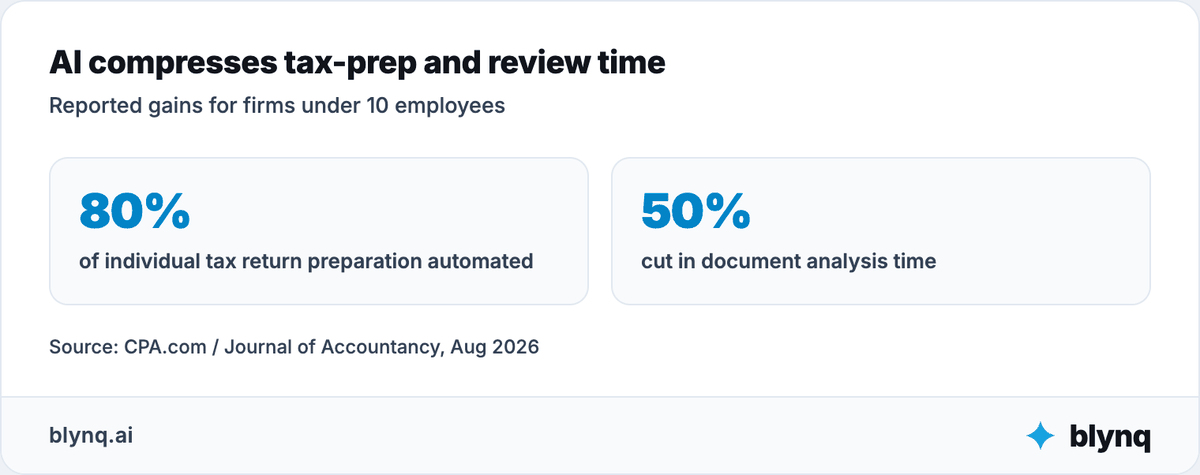
The Journal of Accountancy, the AICPA's own publication, independently confirms both figures in firms with fewer than 10 employees. Real-life ways small firms use AI
Two citation paths landing on the same numbers is rare in this category, which is why these are the figures worth planning against.
Client experience uses the same context to prepare clearer updates and surface the questions clients keep asking.
AI should help you remember and prepare. It should not impersonate attention or make the relationship feel automated.
The human still owns judgment calls, positions taken on a return, sign-off and every promise made to a client.
How do you protect realization, capacity and pricing?
You protect realization by connecting scope to hours to write-offs to profit per client, which is Finance and Analytics work rather than bookkeeping work.
More clients do not automatically mean a better practice. Cleanup hours, scope creep, software costs and unbilled review can hollow out a full client list.
Time savings alone do not fix this, because saved hours refill with the same low-value work unless something changes what you sell.
One small-firm owner described exactly that trap after adding 11 bookkeeping clients in half a year.
"reconciliations that used to take 3 hours now take 45 minutes with bank feeds and AI categorization. but that just means clients expect more, not less."
Reddit user SlightMetal51 wrote that in r/Accounting.
They added that the firms struggling are those still charging for data entry with no advisory work. Reddit thread on bookkeeping demand
Efficiency raises client expectations rather than lowering client demands. That reprices the work, and repricing is a Finance decision.
Finance and Analytics can connect client type, engagement hours, write-offs, realization and cost.
Strategy and Productivity then connect those findings with capacity, niche and a realistic weekly focus.
The goal is not more possible actions. It is a reasoned choice about which clients, service lines and pricing models deserve limited attention.
What happens when you trace one problem across the whole practice?
Tracing one busy-season problem across the whole practice usually finds an intake, pricing and capacity problem instead.
Consider a sole-practitioner CPA whose busy season overran by 6 weeks. The instinct is to buy bookkeeping automation before January.
Operations analysis shows the delay starts at intake, not at the ledger.
Records arrive late, and a third of files need cleanup before work can begin.
Analytics finds the cleanup concentrates in clients acquired through one referral source. Finance shows those same clients sit below cost at the current fixed fee.
Strategy recommends changing the intake requirements and repricing that cohort before adding any tool.
A document-chasing workflow still helps, and it addresses the real bottleneck. But automating categorization first would have accelerated the wrong step.
The value comes from examining one problem through connected perspectives, before execution scales it.
Where do specialized accounting AI tools and agents fit?
Specialized accounting AI tools and agents fit where the bottleneck is narrow and execution-heavy.
That covers document capture, categorization, reconciliation, AR collections, tax research, close management and reporting.
Business agents and agents built for one job do different work.
| Business Agent layer | Specialized execution layer |
|---|---|
| Diagnoses, plans and ranks across a role | Performs or owns a defined workflow |
| Uses broad practice context | Uses workflow-specific or client-specific data |
| Connects questions across functions | Goes deeper inside one execution category |
| Example: determine why realization is falling | Example: chase a missing bank statement |
The market holds several kinds of product. ChatGPT, Claude and Gemini support general research, drafting and analysis.
Fazeshift automates accounts receivable and collections. Dext handles document capture and extraction.
Blue J focuses on tax research with sourced authority, which matters more than speed when a position has to hold.
LiveFlow and Puzzle work on reporting and ledger automation, though both assume your underlying books are already clean.
General chatbots and domain-tuned tools are not the same thing on ledger work.
One comparison found a domain-tuned bookkeeping agent hit 83% accuracy against 33% for generic ChatGPT.
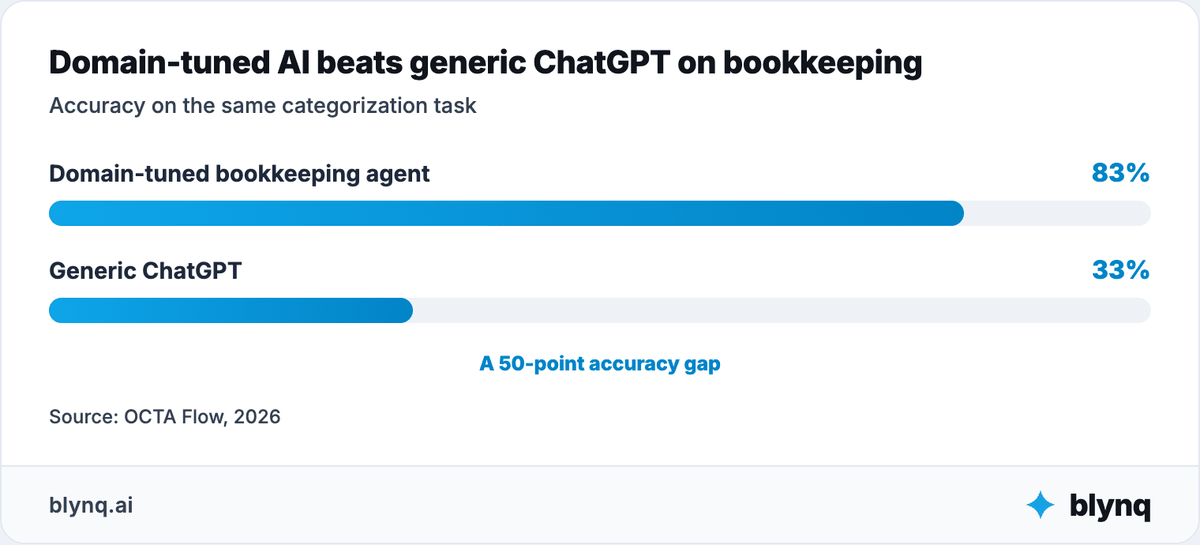
That gap is the practical answer to "why not just use free ChatGPT" for rule-bound categorization. Comparison of AI tools for bookkeepers
These products are not interchangeable. A collections tool does not decide whether your fixed-fee pricing works.
A research assistant does not decide which clients to pursue.
A categorization engine executes rules, but you define the chart of accounts, the treatment and the exceptions.
Blynq sits on the practice-management side. Its business roles work from shared context across Operations, Sales, Marketing, Finance, Analytics and Strategy.
The right setup often combines both: accounting tools for execution, and a connected set of business agents for the thinking and the decisions.
Do you need one specialist or a connected AI back office?
You need one specialist when the problem stays inside one responsibility, and a connected AI back office when it crosses several.
Practice questions cross functions constantly:
Marketing to inquiries to engagements to delivery hours to write-offs to realization to profit to the next pricing decision.
A marketing recommendation may depend on which clients are profitable. An operations priority may depend on capacity.
A pricing decision may depend on cleanup hours and the client mix behind them.
Use this rule:
| Situation | Likely starting point |
|---|---|
| One isolated output | Chatbot or tool |
| One repeatable workflow | Automation or specialized agent |
| One ongoing business responsibility | Broad agent role |
| A question crossing several business functions | AI team with shared context |
Why does practice context change accounting AI recommendations?
Practice context can change accounting AI recommendations completely, because the same question has opposite correct answers for different firms.
Consider a common question: should I take on more bookkeeping clients?
No responsible answer exists without the current client mix, cleanup hours, realization by client and close cycle time.
Capacity, pricing model and the referral sources behind each cohort matter just as much.
One accountant needs more volume. Another needs better pricing. A third already has more clients than the practice can serve well.
Prompt-based work restarts from the same briefing every time: client list, service mix, software stack, deadlines, capacity and recent results.
Context-aware AI starts from validated goals, constraints, decisions, actions, outcomes and lessons it already holds.
Configuration effort is what stops most practices here. GetUku found more than 80% of firms want plain-language setup rather than technical configuration.
The bottleneck is rarely capability. It is how much work the accountant must do before the system knows anything useful.
It should not remember everything indiscriminately. It should separate verified practice knowledge from assumptions and retrieve only what the current decision needs.
Why do AI agents need one shared view of the practice?
AI agents need one shared view because otherwise you are the integration point, manually carrying client profitability into pricing and capacity into intake.
Several agents do not become a team because they sit in one menu.
If Operations knows cycle time, Finance knows write-offs and Sales knows which engagements were scoped loosely, but you connect them by hand, nothing has changed.
Small firms feel this sooner than large ones, because a sole practitioner personally holds every role a larger firm splits across staff.
A useful shared view holds service mix, client segments, engagement scope, close calendar, capacity, pricing model, current priorities and past decisions.
Client financial data needs stricter access, verified sources and clear retention rules than any of that.
Shared context does not replace role expertise. It makes Operations, Sales, Finance and Analytics relevant to the same practice.
Blynq is built around exactly that pattern. Its Operations, Sales, Finance and Analytics agents read from one shared practice profile, not four separate ones.
An AI team becomes an AIOS when agents, skills, knowledge, memory, tasks and workflows grow around that shared understanding.
The goal is not more AI. It is a practice that is easier to understand, decide for and run.
What do clients still need from an accountant when AI gets faster?
Clients still need an accountant for judgment, defensible positions, interpretation and accountability, even when AI gets faster.
AI does not make accountants irrelevant. It changes which parts of the job clients value.
The structural pressure is a labor shortage, not a software threat.
The AICPA projects 340,000 unfilled US CPA positions by 2030, alongside a 17% fall in accounting graduates since 2020.
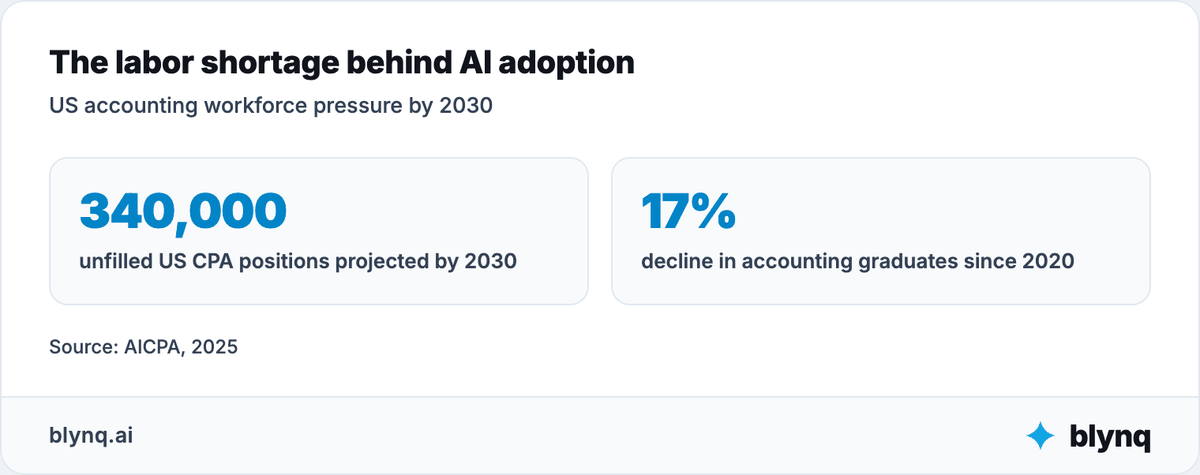
Demand for qualified judgment is rising while the supply of people who can give it shrinks. Accounting AI and workforce statistics
Accountants are not deferring to the output either. CPA Practice Advisor reports 97% of workers prioritize human judgment over automated output.
That is trade press rather than a vendor survey, which makes it a credible read on how the profession actually treats these tools.
When categorization, drafting, extraction and first-pass research get faster, clients still need someone who can:
- Interpret what the numbers mean for a specific decision.
- Recognize when a transaction or client situation does not fit the template.
- Take a defensible position and explain the risk attached to it.
- Advise on structure, timing and trade-offs.
- Coordinate with attorneys, lenders, auditors and the IRS.
- Sign, and carry the responsibility that signature creates.
One path uses AI mainly to process more volume at the same price.
The other uses it to arrive better prepared and to sell the judgment that was always the scarce part.
The second path strengthens your role. The value moves from producing the numbers toward interpreting them and standing behind the position.
Where does accounting AI still need human control?
Accounting AI still needs human control wherever a filing, a position, client money or professional liability is involved.
The closer AI gets to those, the stronger review should become.
| Area | AI can help with | Human owns |
|---|---|---|
| Client intake | Basic questions, capture and routing | Engagement scope, independence and conflict checks |
| Document collection | Chasing, reminders and completeness checks | What counts as sufficient documentation |
| Bookkeeping | Categorization, matching and exception flagging | Judgment calls, unusual transactions and the final ledger |
| Month-end close | Checklists, status and blocker visibility | Accruals, estimates and sign-off |
| Tax research | First-pass research and summaries | Verifying authority and taking the position |
| Tax returns | Drafting, extraction and cross-checking | Filing sign-off and representation before the IRS |
| Client communication | Drafting and organizing recurring questions | Advice and the relationship |
| Advisory | Structuring inputs and building scenarios | The recommendation and its consequences |
| Financial statements | Assembling and explaining verified inputs | Source accuracy, presentation and any assurance work |
| Client data | Organizing and retrieving | What leaves the practice, and under what consent |
Tax research deserves particular caution. A practicing tax attorney put the reliability of AI-generated authority bluntly.
"My experience with ChapGPT is that its citations to authority are usually not even close. I'd guess about 10% are correct."
That comment came from gatortaxguy on TaxProTalk, a discussion forum for tax professionals. TaxProTalk thread on AI tax research
Every citation gets verified at the source before it supports a position.
A plausible-looking authority that does not exist is worse than no research at all.
Practice before the IRS carries its own standard of care. Circular 230 governs due diligence, competence and the positions an accountant may take.
Nothing about using AI changes what you attest to when you sign. IRS Circular 230 for tax professionals
Client data carries a sharper risk than most accountants expect.
Internal Revenue Code section 7216 makes unauthorized disclosure of tax return information a criminal offense.
Pasting client return data into a consumer AI tool can be a disclosure.
Confirm consent, terms and data handling before any client information leaves the practice. 26 U.S. Code section 7216
The AICPA Code of Professional Conduct sets the confidentiality and competence duties underneath all of it. AICPA Code of Professional Conduct
The profession has been consistent about the ceiling. GetUku found no firms willing to grant fully unsupervised AI autonomy.
Zero is a striking number, and it reflects where liability actually sits.
The correct fallback is usually simple: route it to the accountant for review.
AI should have an escalation path, not an unlimited mandate.
How do you choose the right AI setup for an accounting practice?
You choose the right AI setup for an accounting practice by evaluating its operating model, not its label.
Ask 6 questions of anything you are considering:
- What responsibility or workflow does it help own?
- What can it analyze, recommend or execute?
- What practice or client data can it access, and under what terms?
- Does it rely on verified source data?
- What must you review and sign?
- Does it integrate with the systems that matter, and show what it did?
Consider 3 legitimate approaches:
| Approach | Strengths | Trade-offs | Best fit |
|---|---|---|---|
| Custom build | Maximum control and firm-specific rules | Technical ownership, maintenance and integration risk | Practices with technical support and distinctive processes |
| Self-directed Claude or ChatGPT | Flexibility, strong analysis and per-client instructions | You design the context, memory and orchestration | Accountants who want to design their own setup |
| Ready-made AI team or purpose-built SaaS | Faster setup, structured roles and continuity | More opinionated and limited to supported capabilities | Accountants who want structure without building it |
The gap that decides which approach works is training, not budget. Karbon data reported via Forbes shows 85% enthusiasm against 37% receiving formal AI training.
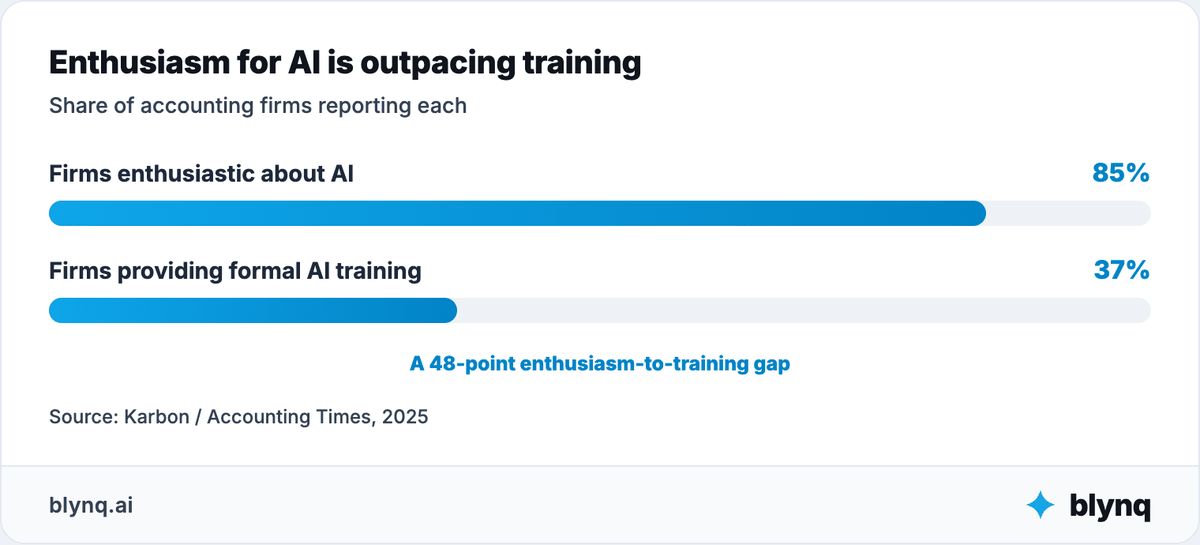
A 48-point gap explains most stalled deployments better than any product comparison does. AI usage in accounting survey
Before committing, verify the system actually reads from and writes to what you need.
That means QuickBooks Online or Xero, practice management, document management, tax software, payroll and e-signature.
Check permissions, approvals, activity logs and failure handling. Ask specifically whether client data trains the vendor's models, and get the answer in writing.
Do not assume "works with" means "integrates with." If you constantly re-brief the system and copy data between tools, the AI is adding administrative work.
How do you put AI to work in your accounting practice in 30 days?
Put AI to work in 30 days by picking 1 measurable goal and diagnosing the bottleneck behind it.
Run the agent alongside your current process, then expand only where it earned the expansion.
Start with the goal, not the tool.
Week 1: Diagnose
Choose a goal and a bottleneck. Do not start with a product.
Common candidates: close cycle time, cleanup hours per client, document turnaround, or advisory conversion.
Define the 1 metric that would show improvement.
Exit criterion: a named metric and a current baseline number, written down.
Week 2: Build context
Give the system what judgment requires: service mix, client segments, engagement scope, close calendar, capacity, pricing and previous decisions.
Decide what stays private or needs controlled access. Client return data and PII belong in that category by default.
Exit criterion: the agent answers a question about your practice you did not have to re-explain.
Week 3: Run alongside the current process
Use the agent for analysis, planning or structured work while the existing process stays visible.
Review errors, missing context and recommendations that ignore how your clients actually operate.
Exit criterion: a written list of what it got wrong and what context was missing.
Week 4: Evaluate and expand carefully
Measure the metric from Week 1. Record what the system learned and what still needs your sign-off.
Add another skill or role only when it solves a real adjacent problem.
If the second role depends on knowledge from the first, prioritize shared context over another disconnected tool.
Exit criterion: a keep-or-drop decision supported by the baseline number.
Example setup for a sole-practitioner CPA
Suppose the goal is a shorter close cycle without adding review hours.
| Setup layer | What to include |
|---|---|
| Business context | Client list, service mix, engagement scope, close calendar, capacity and realization definitions |
| Operations Agent | Review the close process, identify where work stalls and recommend the fix |
| Analytics Skill | Compare cycle time, cleanup hours and write-offs by client |
| Specialized workflow | Chase missing client documents, track what arrived and prepare the next action |
| Human boundary | You handle judgment calls, positions taken on a return, sign-off and representation |
| Success measure | Shorter close cycle and fewer cleanup hours after 30 days, without added review time |
This is enough for a first setup. It needs no separate agents for intake, chasing, categorization and close.
Start with the responsibility, add the skills and workflow it needs, and expand only when a problem genuinely crosses into a new role.
What to do now
Pick 1 practice result that needs to change this quarter, and write down the number that measures it today.
Diagnose what is actually blocking it, using the 8-step sequence above. The bottleneck is rarely where the first instinct points.
Write the SOP for the work you intend to automate. Undocumented process is the constraint that stops most deployments, not model capability.
Decide what stays human: judgment calls, positions on a return, sign-off and representation. Then choose the setup that fits what remains.
AI agents help most when they own a real responsibility, use several skills and understand the practice behind the task.
The future is not a separate bot for every action. Expect fewer capable agents, specialized execution where it earns its place, and shared context underneath.
The point is not to add more AI. It is to make the practice easier to understand, decide for and run.